|
Originally Posted by jim_0068
|
After watching Yoda's finish swivel video, i can say that the only difference between's "ben swivel" and "yoda's swivel" is that yoda is simply swiveling it back to the plane and STOPPING and letting the left wrist re-cock to the finish. Where as "ben's swivel" is swiveling it as much as the face will allow which would be looking at the ground.
|
I feel very strongly about this issue of the
Finish Swivel -- both the fact that it is
absolutely essential and also that it
absolutely can be overdone. I should know: I was taught Swivel Action at age 16 and didn't differentiate it from Hinge Action for the next twenty years. To bad for me, but it doesn't have to be that way for you. Not if I can help it.
It is exceedingly important to have the correct concept in order to Translate the Mechanic into its describable Feel. And that is the main reason I produced the differentiating Hinge and Swivel Action videos put up this morning.
Jim is right that I teach the Finish Swivel as advocated by
Homer Kelley:
1. "After the selected Hinge Action has been executed, the Swivel is again useful for Snap Rolling the Hands into their
On Plane Condition for the Finish." (2-G)
2. "But all players must Swivel -- actually rotate their Wrists -- into the
"parallel to the Plane" position for the Finish after the Followthrough." (4-D-0)
But he also warns:
3. "Some players even intentionally execute
Impact as exclusively a Swivel, making Clubface alignments extremely fleeting and erratic." (2-G)
[Bold in the above quotes by Yoda.]
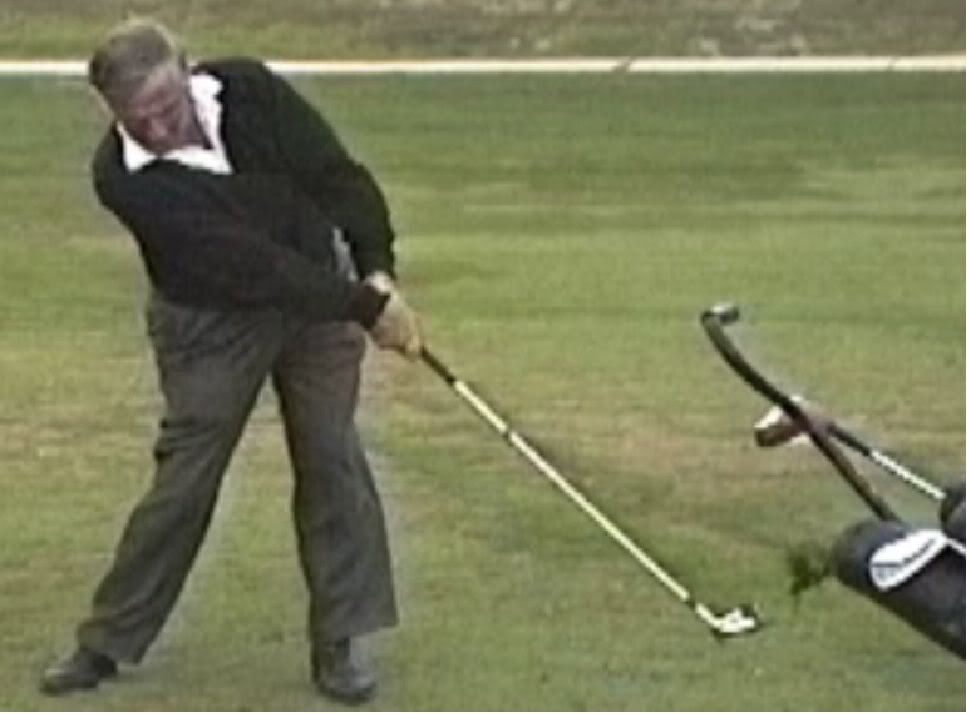
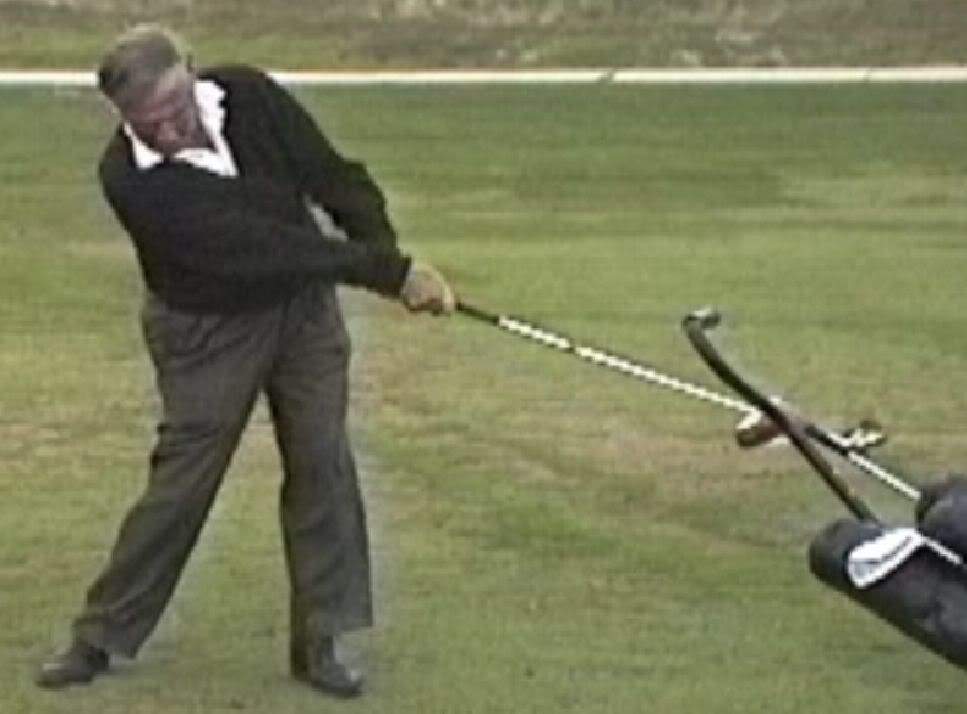
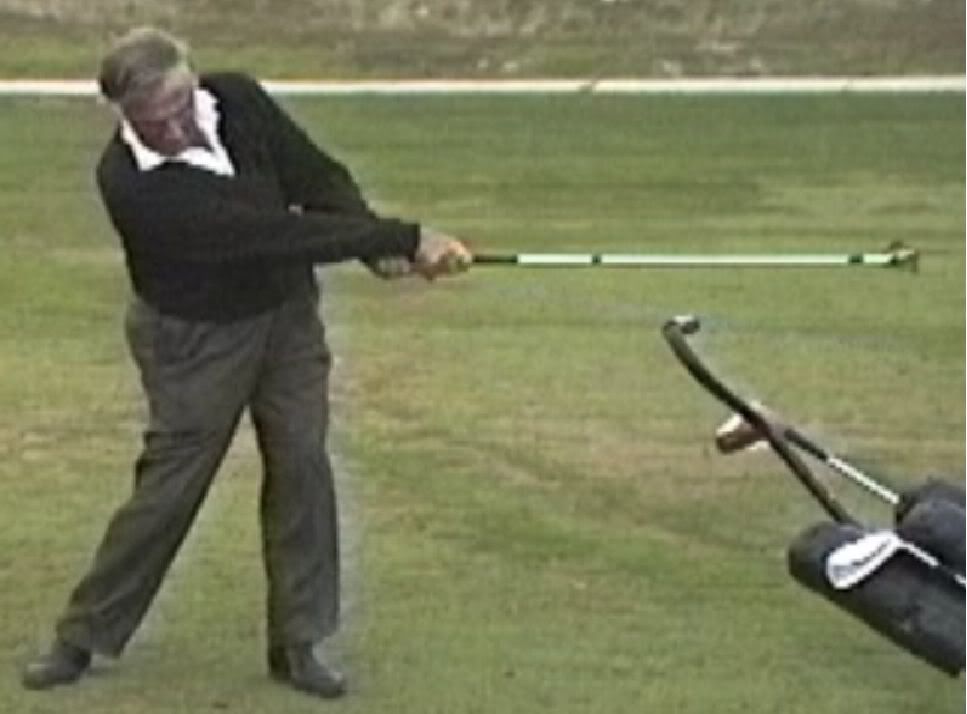
The first three photographs below (originally posted above by
Tongzilla) illustrate an
Over Swivel. Now, this particular Action may have been for a purpose or simply an error of Execution. Regardless, it is certainly something more than a Horizontal Hinge Action followed by an On Plane Swivel.
In the first photo -- the end of the Follow-Through (Both Arms Straight position with the Club approximately 45 degrees to the ground) -- the toe of the Club should be pointing 'along the Line'. Instead, it is well-Closed to that alignment, far beyond the "Vertical to the ground" alignment of Horizontal Hinge Action. In the second photo, the exaggerated Closing continues. Finally, in the third photo, with the Clubshaft parallel to the ground -- and On Plane (assuming it is also parallel to the Plane Line) -- the Clubface is facing directly toward the ground (and
not towards the Plane). The same is true of the Flat Left Wrist. The back of the Hand points directly to the ground (rotated Under Plane).
Contrast these photos with those below extracted from my
Finish Swivel video. At waist high (Photo 1) -- with Shaft On Plane parallel to the ground and Line -- the back of my Flat Left Wrist is parallel to the Plane, as is the Clubface. This is the correct On Plane Swivel Action.
In Photos 2 and 3, I deliberately chose a stop-action showing the back of my Flat Left Wrist similarly approaching -- but not reaching -- the Horizontal. The difference from the first sequence above is that this Action did not occur until much later in the Stroke (with the Hands chest-high and the Clubshaft Position well above the Hands). Even then, much (if not all) of this 'beyond the Plane' action occurred because my Right Shoulder comes Off Plane into the Finish. This 'high' Right Shoulder causes the On Plane Swivel to appear more exaggerated than it really is.


 The Golfing Machine
 is all about
Alignment Golf. This term appears twice in the
first paragraph of the
Preface and is virtually interchangeable with the term
Geometric Golf that appears on the front cover. Likewise,
LynnBlakeGolf.com is all about Alignment Golf. Know that this post is not about differentiating Instructors. Instead, it is about differentiating
alignments.
Make sure you know
exactly the required alignments. Then, do your best to execute them correctly.
That is all you can do.
And that is what you
must do if you are to play your best Golf.