
|
Losing the forward bend, allows the shaft to "ride down" the upper arm and let it go to right field, likewise stay in the forward bend and the clubs delivery line shifts out to in...
|
Quote:
When I look at a swing- I look for the area that is most out of line. What "I" see is that from halfway down to impact and beyond- you are coming over the top of the swing - hugely. As a result - what you see at times is both feet flat on the ground at impact- since you don't need much if any hip slide for clearing. With that- the right foot doesn't roll in- but you get up on the toe and it lifts up- kind of like an after thought. By looking at the two swings 8:16 and 8:33 where you are aware of "uncocking" versus the two swing 9:07 and 0:25 where you focus on the hands forward etc. - it seems to me that by having that thought in 9:07 and 9:33 that it changes your entire swing including your backswing. To me the backswing is shorter on those two swings as opposed to the earlier ones. That changes the total dynamics of the motion and you pull the ball more. Personally, I don't think that the uncocking is something that you should be concentrated on for a change and certainly not something you should be aware of when you are swinging a golf club without working on any particular thing in your swing- normal procedure. If you were to decide to change the halfway down over the top move- with the right shoulder way out - as opposed to more back and down- it won't be easy uncovering the other changes that you'll need to incorporate to make the "new" move work efficiently. Issues like trying to keep you head still and the orientation of your eyes on the ball - could be a few of many reasons why you swing the way you do. Just realize that it is just not one change but finding what other changes you'll need to make in order to coordinate the better downswing won't be so easy. Here is one way that I would think of this- if you are coming way over the top of the ball halfway down AND still hitting a lot of straight shots and some slight pulls- then you have additional items in your swing that are "push" factors that are offsetting the "pull"move. So when you don't make the pull move coming down and make no additional changes in your swing- the ball should go way right i.e. block or push. From there you need to applaud yourself and then figure what other items are in your swing that have subconsciously or consciously been overcoming the pull swing fault. One such area you might look to is when you pass impact and move towards the finish- from down the target line now - you will sometimes see the arms move quite vertical- that's one push move to over come the pull downswing. Not sure you are laid off at the top - but I'm guessing you are slightly- might take a look at that- some additional head or shoulder rotation should allow that or just a more inside takeaway with the hands- will create it. Food for thought. |
When I look at your swing, I think that you swing is so good (and of such a high caliber) that I wonder whether your propensity to pull some shots to a small degree may relate to a few minor points.
Here is a simple diagram.  The green curved line represents the path of the clubhead. The orange dotted line represents the ball-target line, and intended direction of a straight ball flight. Red dot is the ball. Blue lines represent the hook-face arrangement of the clubface (exaggerated in this diagram). To hit the ball straight, one has to take into account the fact that a golf club has an inbuilt hook face arrangement. That means that one has to place the ball behind the low point of the clubhead swingarc, and ensure that the clubhead is slightly open at the exact moment of first ball contact to ensure that the clubface is square at the exact moment of ball-clubface separation - if one wants the ball to go straight. Could it be i) that your clubface approaches the ball minimally less open when you hit pulled shots, or ii) that you are hitting the centre of the back of the ball rather than the inner quadrant when you hit pulled shots, or iii) that your clubhead swingarc is not perfectly symmetrical to the ball-target line but fractionally open to the ball-target line when you hit pulled shots? Jeff. |
Quote:
Nice post Jeff. And a nice golf swing. |
Slowed Down Swings
I slowed down the film, if it will help anyone pick up on something.
http://www.youtube.com/watch?v=R8izd_Lu8YM Thanks, For looking at it. Nathan |
I decided to download your latest video to my computer, and I used my swing analyser program to study your swing in depth.
I found one flaw in your last swing that could predispose to pulling. 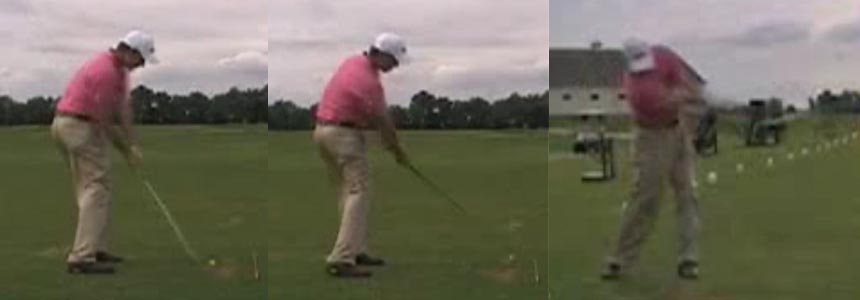 In your first two DTL swings, you have an excellent downswing pivot action (hips first, shoulders second) and you have a good posture at impact. Images 1/2 shows that your pelvis is open and your shoulders less open. However, in your last swing (see image 3) you can see that your pelvis stalled in the downswing, and it failed to complete its rotation even though your arms are now fully extended towards the target in the finish phase of the swing. That failure to rotate your lower body well started in the early downswing and it seemed that your upper torso was rotating much faster than your lower torso, which means that your kinetic sequencing was out-of-synch in that particular swing. That type of error would cause the equivalent of an "upper body dive" swing, which causes an out-to-in swingpath through the impact zone and a pull if the clubface is square to the clubhead swingpath. It is difficult to tell if your clubhead swingpath was out-to-in in that particular swing because it was not DTL. Here is a photo showing the results of an "upper body dive" movement where the upper body turns much faster than the static lower body. 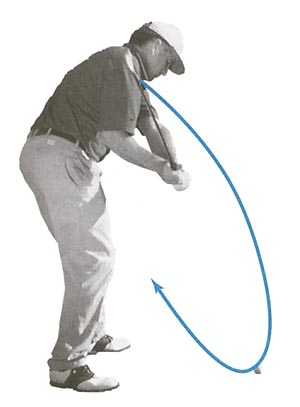 Jeff. |
2 Attachment(s)
You guys sure Mike O isn't on to something here? No more right arm at impact...not enough under...post impact still on inside of flat back foot...like the hips rotated in place and upper body coming up and over and prematurely ahead of lower.
|
Quote:
|
Quote:
|
Quote:
|
| All times are GMT -4. The time now is 04:17 PM. |