LynnBlakeGolf Forums

LynnBlakeGolf Forums (http://www.lynnblakegolf.com/forum/index.php)
-   The Golfing Machine - Basic (http://www.lynnblakegolf.com/forum/forumdisplay.php?f=16)
-   -   Turned Shoulder Plane (again) (http://www.lynnblakegolf.com/forum/showthread.php?t=2289)

nevermind 02-13-2006 08:31 AM

Turned Shoulder Plane (again)
 
When using the TSP, assuming you want some elbow bend at impact, seems like you have a choice of having either the trail shoulder or forearm on the same plane as the shaft at impact. Which one is it? Why?


:confused:

nevermind 02-13-2006 07:32 PM

Quote:

Originally Posted by rwh
Look at yourself in down the line view in a mirror at Impact Fix. Put tape on the mirror to represent the plane. You will see that your right shoulder can be set on the same plane as the clubshaft and the right forearm.

Not without a straight arm I cant. What does it take for the shoulder to be considered on the plane? If it requires the shoulder to be bisected by the plane, I don't see how you can have both the trail shoulder and forearm on the same plane angle without a straight arm. If it only requires the shoulder to rest on top of the plane then I can see how you could have the trail shoulder and forearm on the same plane angle with a very, very slight bend at the elbow.

Can you draw me a picture rwh? Or better yet post a pic of someone [-o<

nevermind 02-13-2006 09:39 PM

Unfortunately I don't have my copy anymore, and without some other visual depicting what your saying is possible, a fourth stickmen for example, I just can't swallow it rwh, sorry :( However, I have found an answer that Mike O gave when I asked a similar question early last year :oops:

Quote:

Originally Posted by Mike O
I think it's obvious that the right shoulder is ideally just on-plane during the start-down. If it's thrusting - then ideally during that thrust period it would be on plane- but not necessary as you could have an offsetting thrust to balance it out if it was thrusting offplane- see 2-N-1 for that discussion. Of course, there are certain limited conditions/strokes where the right shoulder could be on-plane throughout the downstroke - but we're talking about the norm i.e. you'll have a tough time finding a professional who has their right shoulder on plane at impact- if not impossible. For those that think the right shoulder should/could be on plane throughout the downstroke then you'll need to clearly prove your point.

So in his opinion the stickman in the middle is closest to the real world reality.(hope that's right) I've seen photo's showing golfers using the TSP and looking like each of the stickmen, and I'm just curious which variant TGM would advocate. So far the middle guy is 1up. If you can draw a fourth alternative or post a pic of someone doing differently, please do. How bout the TSP's number one fan. Yoda?

nevermind 02-18-2006 11:42 PM

Anyone else, or is it case closed?

tongzilla 02-19-2006 05:30 AM

Right Shoulder On Plane or not.
 
Quote:

Originally Posted by nevermind
When using the TSP, assuming you want some elbow bend at impact, seems like you have a choice of having either the trail shoulder or forearm on the same plane as the shaft at impact. Which one is it? Why?


:confused:

The second and third picture (from the left) are both correct. Just different body types and/or different amount of Axis Tilt.

You always want the entire Right Forearm (which includes the Right Elbow) to be On Plane at Impact giving you maximum support and minimizing Impact deceleration during this violent collision. This will almost certainly mean having the Right Shoulder slightly above Plane. There is absolutely no problem with that (10-13-D).
The more Right Elbow bend you have during Impact, the more likely you are using a shallower Plane Angle (e.g. Elbow Plane or Hands Only Plane), and the more above Plane your Right Shoulder becomes. When using the Turned Shoulder Plane, your Right Elbow should only have a slight bend at Impact, therefore your Right Shoulder will only be slightly above Plane.
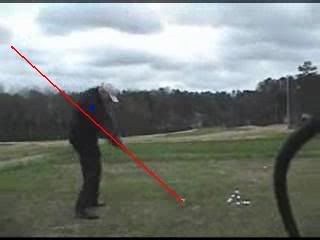


The red line represents the Turned Shoulder Plane, which was drawn through the Right Shoulder joint when Lynn was at the Top. The tiny blue dot represents his Right Shoulder, which is clearly above Plane.

annikan skywalker 02-19-2006 04:04 PM

[quote=tongzilla]

Quote:

The more Right Elbow bend you have during Impact, the more likely you are using a shallower Plane Angle (e.g. Elbow Plane or Hands Only Plane), and the more above Plane your Right Shoulder becomes. When using the Turned Shoulder Plane, your Right Elbow should only have a slight bend at Impact, therefore your Right Shoulder will only be slightly above Plane.
Are you absolutely sure that this is a statement of fact or it is an opinion???....


Tom Watson had a lot of elbow bend and his plane angle wasn't shaloow...He shalllowed it out by a full sweep release and an increasing the amount of Axis Tilt...

As a matter of fact if you maintain too much right elbow bend it is difficult to get the right forearm pointing at the plane line during release and impact....


tongzilla 02-19-2006 04:12 PM

[quote=annikan skywalker]
Quote:

Originally Posted by tongzilla


Are you absolutely sure that this is a statement of fact or it is an opinion???....


Tom Watson had a lot of elbow bend and his plane angle wasn't shaloow...He shalllowed it out by a full sweep release and an increasing the amount of Axis Tilt...

As a matter of fact if you maintain too much right elbow bend it is difficult to get the right forearm pointing at the plane line during release and impact....

It's opinion not fact, I'm just generalising. But remember I'm assuming that the Right Forearm is On Plane (as it should be), not above or below Plane, as a few of your photos show.

annikan skywalker 02-19-2006 04:28 PM

Would you agree or disagree? That in order to have the right forearm pointing on-plane as your assumption states...that the amount of right elbow bend depends on whether or not the right wrist is Uncocked(Tom Watson), Level(Mac O'Grady) or Cocked (Donna Andrews)....Also the degree of Waist Bend, Axit Tilt and Knee Bend along with numerous other factors greatly influence this alignment.....

checkout the pics...they are not an opinion and they are not in a random order at all.....As a matter of fact each picture was carefully selected and placed to reveal certain relatioship variations to the others....


Another interesting note...Plane Angle through Impact...

Watson - Squared Shoulder?
Couples - Turned Shoulder?
O'Grady - Elbow Plane?
Andrews - Hands Only?

tongzilla 02-19-2006 04:38 PM

Quote:

Originally Posted by annikan skywalker
Would you agree or disagree? That inorder to have the right foream pointing on-plane as your assumption states...that the amount of right elbow bend depends on whether or not the right wrist is Uncocked(Tom Watson), Level(Mac O'Grady) or Cocked (Donna Andrews)....Also the degree of Waist Bend, Axit Tilt and Knee Bend along with numerous other factors greatly influence this alignment.....

Are you suggesting it's possible to get your Right Forearm On Plane without a Level Right Wrist? I don't see how that's possible.

annikan skywalker 02-19-2006 04:47 PM

I'm not suggesting anything...just trying to make you think before you make such bold statements such as "always"...

The degree of right elbow bend is greatly affected not only by plane angle such as the turned shoulder plane...but ball location. right forearm angle of approach. amount of wrist bend, Right Shoulder Location, Amount of Downstroke Hip Slide..etc......etc...etc..


So lets assume the right forearm is on-plane.. the right wrist is level and bent....
Squared Shoulder Plane would have less amount of elbow bend less Waist Bend and Knee Bend than Turned Shoulder Plane..thus one would assume the Elbow Plane would have more elbow bend ,Waist Bend and Knee Bend....


Is the above "always" true?

tongzilla 02-19-2006 05:32 PM

Quote:

Originally Posted by annikan skywalker
I'm not suggesting anything...just trying to make you think before you make such bold statements such as "always"...

The degree of right elbow bend is greatly affected not only by plane angle such as the turned shoulder plane...but ball location. right forearm angle of approach. amount of wrist bend, Right Shoulder Location, Amount of Downstroke Hip Slide..etc......etc...etc..


So lets assume the right forearm is on-plane.. the right wrist is level and bent....
Squared Shoulder Plane would have less amount of elbow bend less Waist Bend and Knee Bend than Turned Shoulder Plane..thus one would assume the Elbow Plane would have more elbow bend ,Waist Bend and Knee Bend....


Is the above "always" true?

I don't think my statement was actually that 'bold' since I used phrases such as "more likely", etc., which implies there are other things involved here. So don't take it as gospel!

Things tend to get exponentially complicated when we start looking at so many different factors. In such situations, I find it helpful to make the ceteris parabis (everything else equal) assumption. With that in mind, I would say my comments in post #8 is true. Of course, by merely increasing the bend in your right elbow, you would inevitably change a host of other things, but they changed to accomodate the right elbow bend, not the other way round. Also keep in mind the original purpose of my post is to shed some light on nevermind's question.

By the way, I really appreciate your insights and contributions David :) .

nevermind 02-24-2006 10:34 PM

Quote:

Originally Posted by tongzilla
The second and third picture (from the left) are both correct. Just different body types and/or different amount of Axis Tilt.

So it's OK to have a straight trail arm at Impact? Assuming an almost straight arm, what, if any, is the impact of having the Follow Through at such a short distance from impact?

Quote:

You always want the entire Right Forearm (which includes the Right Elbow) to be On Plane at Impact giving you maximum support and minimizing Impact deceleration during this violent collision. This will almost certainly mean having the Right Shoulder slightly above Plane. There is absolutely no problem with that (10-13-D).
This is what I've been after, thankyou. I'll take the always for whats it's worth ;) I've read that one of the reasons that the TSP is so good is because the trail shoulder can provide support to the clubshaft. At what point does that occur, for how long and what is the benefit in terms of actual performance? My guess is it begins supporting at Start Down, continues to do so for as long as the shoudler remains on plane (usually as far as Release?) and I've no idea to what extent it improves consistancy, compression etc etc. Maybe it just helps a little in keeping the club on plane at Start Down :confused:

Quote:


The red line represents the Turned Shoulder Plane, which was drawn through the Right Shoulder joint when Lynn was at the Top. The tiny blue dot represents his Right Shoulder, which is clearly above Plane.
Interested in the location of your blue dot Tong. Is it always the bottom edge of the shoulder that TGM marks as the shoulder? Can you tell I'm no anatomy expert? :rolleyes: Did you take into account the camera angle when you drew that TSP? I've got that clip and if I draw the line where you have it it is WELL below the shoulder at the Top. What am I missing?

nevermind 02-27-2006 08:13 AM

Tong? Anyone?

Without giving up on having the above questions answered, I've got some more.:rolleyes:

Questions so far have been in relation to a golfer with a zero shift downstroke on the TSP, now for one where the golfer shifts the clubshaft down to a flatter plane during the Downstroke. In that case, how long should you aim to keep the trail shoulder moving down plane(TSP)? Without a clue on the "how long", my guess is that golfers shifting down to a flatter clubshaft plane are likely to keep the trail shoulder going downplane(TSP) further into the Downstroke than those with the club on the TSP. Is that way off?

This is my understanding as it stands, still some work to be done. Ready to admit I'm prolly a long way from having a firm grasp on this. :(
When using the TSP on the Downstroke, you will almost certainly have the trail shoulder moving above plane before impact. That allows (or is it just coincidence?) the trail forearm to be on plane at impact without having a straight trail arm.
When using a flatter clubshaft plane, you can have the shoulder move down plane(TSP) all the way to impact and beyond and still have the trail forearm on plane with the shaft at impact with some elbow bend.
[-o<

tongzilla 02-27-2006 04:03 PM

Right Arm at Impact and the Right Shoulder
 
Quote:

Originally Posted by nevermind
So it's OK to have a straight trail arm at Impact? Assuming an almost straight arm, what, if any, is the impact of having the Follow Through at such a short distance from impact?

No, you don't want to have a straight right arm before or during Impact unless you're striving for a "soft" Impact. Aim to have your Right Arm slightly bent (use some common sense here!). If it's bent too much, then maximum Clubhead Speed for that Stroke will not have been reached. If it's almost straight, you risk going into Angular Deceleration. So you want a bit of leeway.
Also, none of this matters if you don’t have your Right Forearm return to its Right Forearm Angle of Approach. That’s the by far the important thing. And it should determine the amount of bend you need. If in doubt, you want to build your pattern such that you can return to your Right Forearm Angle of Approach in the most consistent and powerful way as possible.

Quote:

Originally Posted by nevermind
Interested in the location of your blue dot Tong. Is it always the bottom edge of the shoulder that TGM marks as the shoulder? Can you tell I'm no anatomy expert? :rolleyes: Did you take into account the camera angle when you drew that TSP? I've got that clip and if I draw the line where you have it it is WELL below the shoulder at the Top. What am I missing?

I used the right shoulder joint to draw my dot. I didn't take into account the camera angle. I don't know how to do this, but if you can overlap the frame where Yoda is at the Top with the frame at Impact, it would be helpful.

I know I have left some questions unanswered because I just ain't got the time! I'm sure there are others out there who can help -- show yourselves!

tongzilla 02-27-2006 04:05 PM

Right Shoulder in relation to Plane Angle
 
Quote:

Originally Posted by nevermind
Tong? Anyone?

Without giving up on having the above questions answered, I've got some more.:rolleyes:

Questions so far have been in relation to a golfer with a zero shift downstroke on the TSP, now for one where the golfer shifts the clubshaft down to a flatter plane during the Downstroke. In that case, how long should you aim to keep the trail shoulder moving down plane(TSP)? Without a clue on the "how long", my guess is that golfers shifting down to a flatter clubshaft plane are likely to keep the trail shoulder going downplane(TSP) further into the Downstroke than those with the club on the TSP. Is that way off?

This is my understanding as it stands, still some work to be done. Ready to admit I'm prolly a long way from having a firm grasp on this. :(
When using the TSP on the Downstroke, you will almost certainly have the trail shoulder moving above plane before impact. That allows (or is it just coincidence?) the trail forearm to be on plane at impact without having a straight trail arm.
When using a flatter clubshaft plane, you can have the shoulder move down plane(TSP) all the way to impact and beyond and still have the trail forearm on plane with the shaft at impact with some elbow bend.
[-o<

When using a flatter Plane Angle, it's alright to have your Right Shoulder above Plane. Just make sure it's moving roughly parallel to your selected Clubshaft Plane. Your Right Shoulder should never be below Plane.

nevermind 02-28-2006 12:06 AM

new stickman added


I've added stickman No.4 because when I look at swings people have labelled as using the TSP that's what I sometimes see.

Quote:

Originally Posted by tongzilla
No, you don't want to have a straight right arm before or during Impact unless you're striving for a "soft" Impact. Aim to have your Right Arm slightly bent (use some common sense here!). If it's bent too much, then maximum Clubhead Speed for that Stroke will not have been reached. If it's almost straight, you risk going into Angular Deceleration. So you want a bit of leeway.

Oh, when you said the second and third stickman were correct I figured you realised I drew stickman no.3 with a straight trail arm ;) Anyway, cool info there Tong. I kept seeing the tiny amount of elbow bend people on the TSP often had and thought to myself surely more would be better. But if I've understood, now I know that so long as you avoid a straight arm, any elbow bend is sufficient.

Quote:

Also, none of this matters if you don’t have your Right Forearm return to its Right Forearm Angle of Approach. That’s the by far the important thing. And it should determine the amount of bend you need. If in doubt, you want to build your pattern such that you can return to your Right Forearm Angle of Approach in the most consistent and powerful way as possible.
Thanks :) I'll stew on that for a little while.

Quote:

I used the right shoulder joint to draw my dot. I didn't take into account the camera angle. I don't know how to do this, but if you can overlap the frame where Yoda is at the Top with the frame at Impact, it would be helpful.
It's just that to a layman (well me) the shoulder joint looks like one big circle, and it's hard to fathom why you guys choose one point though that circle over another. Doesn't matter I guess, usually the line people draw for the TSP goes throught the same spot in my imagined circle (lower portion)... it's just that you missed my circle entirely in that photo.

I don't know how to overlap frames either, but are you telling me that you can draw the line where you have it and when you move the clip frame by frame just before the end of the backstroke and just into the downstroke it looks like the shoulder is on that line? When I look at that clip and draw the TSP where I see it, I see alignments much more like stickman No.4 than No.2 :confused:

Quote:

When using a flatter Plane Angle, it's alright to have your Right Shoulder above Plane. Just make sure it's moving roughly parallel to your selected Clubshaft Plane.
Hmmm, OK. So the same as when using the TSP, it's Ok for the shoulder to move above plane, so long as there is still some down to go with the out and forward. Would you want to turn parallel right from the get go or would you have a plane shift(of the shoulders) from the TSP to this parallel plane at some point after the Start Down?

What about this quote, "The Right Shoulder should move toward Impact on the preselected Downstroke Clubshaft Plane. If it can't quite reach that Plane, then it's better to use a steeper Plane." I've had trouble with this quote for a long time and never get far, like when do you have a preselected clubshaft plane and when don't you? Is it only relevant to the very beginning of the downstroke? I now know that "toward impact" does not neccessarily mean all the way to impact and beyond, and in the case of the TSP is will not be all the way. But your also saying that when using a flatter clubshaft plane, instead of using a steeper shoulder turn(TSP), you can use a plane of the same anlge as the clubshafts but with a different baseline?

Sorry for harping on you Tong, I struggle with only a couple of variables, so I can't converse with Annikan[wink], Yoda is too busy answering other posts[mad/sad] and proly nobody else can make sense of my dribble, looks like your my man [mix b/w green smilie, purple embarassed and the sun glasses dude]

Admin: Four images per post, come on! [praying]

tongzilla 02-28-2006 04:01 AM

Right Shoulder and Plane Angle...again
 
Quote:

Originally Posted by nevermind

Hmmm, OK. So the same as when using the TSP, it's Ok for the shoulder to move above plane, so long as there is still some down to go with the out and forward. Would you want to turn parallel right from the get go or would you have a plane shift(of the shoulders) from the TSP to this parallel plane at some point after the Start Down?

The Right Shoulder should move directly towards the Ball during Start Down. Keep your Head still, and your Axis will Tilt as a result. As the Downstroke proceeds, it may not be possible to keep your Right Shoulder on the Clubshaft Plane, so it can use a steeper plane.

Quote:

Originally Posted by nevermind
What about this quote, "The Right Shoulder should move toward Impact on the preselected Downstroke Clubshaft Plane. If it can't quite reach that Plane, then it's better to use a steeper Plane." I've had trouble with this quote for a long time and never get far, like when do you have a preselected clubshaft plane and when don't you?

The preselected Downstroke Clubshaft Plane is the Clubshaft Plane at Startdown. So if your Clubhshaft shifts to a less steep Plane during Downstroke, your Right Shoulder would be above Plane by Impact.


Quote:

Originally Posted by nevermind
Is it only relevant to the very beginning of the downstroke? I now know that "toward impact" does not neccessarily mean all the way to impact and beyond, and in the case of the TSP is will not be all the way. But your also saying that when using a flatter clubshaft plane, instead of using a steeper shoulder turn(TSP), you can use a plane of the same anlge as the clubshafts but with a different baseline?

The Clubshaft always Trace the Striaght Plane Line, in other words it should be On Plane regardless of Plane Angle. This is not true with the Right Shoulder, especially after Startdown.

Bottom line: at Startdown, the Clubshaft should be pointing at the Plane Line, and consequently, the Hands should be On Plane, and the Right Shoulder should also be aligned with the Inclined Plane (On Plane). You check this by seeing if the Clubshaft 'intersects' the Right Shoulder joint at Startdown, rather than going above or below it. Camera angle is paramount.

nevermind 02-28-2006 06:57 AM

nice post Tong, that was very clear even for me. :) One question :rolleyes:, you mentioned that moving the right shoulder down a plane roughly parallel to the clubshaft plane is an option when that plane is flatter than the TSP, does that mean that after startdown, the shoulder will actually shift from the TSP to this parallel plane, then work down that plane? Is that something you can conciously control? Would you teach that to someone if they weren't already doing it? Or is it really common and basically everyone who's shoulder turn becomes flatter after start down is moving down a plane roughly parallel to their shaft plane?

nevermind 02-28-2006 06:59 AM


Can't help but feel that the blue line is a more accurate depiction of the TSP. When the clip is forwarded to impact the alignments look very much like stickman No.4. What do you think?

Forgot to add, I love this footage of Lynn and watch it maybe more than anything else. Thanks LBG :)

tongzilla 02-28-2006 01:27 PM

Come out!
 
Come out, Yoda! It's your turn!

:D


All times are GMT -4. The time now is 07:47 AM.