
|
Fulcrum at Left Wrist
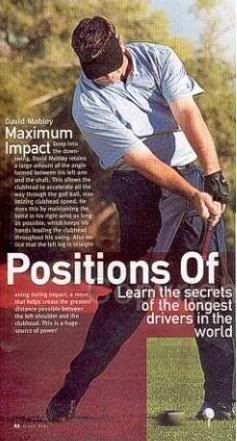 This obviously shortens the Swing Radius considerably because it now only extends from the Clubhead to the Left Wrist rather than to the Left Shoulder. It moves Low Point forward -- rather than being opposite the Left Shoulder, it is now opposite the Left Wrist. But surely a Long Drive Champion such as David Molbey wouldn't be using an inferior procedure like this. He has one of the slowest clubhead speeds in the business, yet he is one of the best. Could this be the reason why? How can TGM explain this? Lets say he does this because he wants to hit down on the ball. But what's the advantage of this procedure compared with the standard one where you just place the ball behind the Left Shoulder without changing Low Point location? I have more comments later. I'd like to hear what you guys have to say. |
Quote:
Per 7-17, halting the backstroke with the feet and letting the same tension pull the Downstroke through Impact is "swinging from the feet" and gives the Stroke maximum Swing Radius. The difference between this look that Mobley exhibits and a bent left wrist at impact is that the former does not result in disruption of clubhead orbit and throwaway, while the latter does. That Mobley is Long Drive Champion despite a "shortened swing radius" proves that there is more to long drives than just pure clubhead speed. Per 2-M-1, power is mathematically expressed as 1/2 Mass x Velocity Squared. Per 2-M-2, Mass is varied by Acceleration Rate and Swing Radius. Clubhead speed is varied by Acceleration Time and Release Interval. Other factors that need to be considered is centeredness of impact, wind, equipment etc... |
1. 2-K Compare the Primary Lever Assembly (6-A-2) with the common flail. While the “swingle” is seeking its “in-line” (full extension ) relation with the “handle” (catching up) there is “Centrifugal Acceleration.” When it becomes “in-line” (caught up) this settles into “Centrifugal (Angular) Momentum” (Full Extension). If it passes its “in-line” relation, it again seeks its “in-line” relation (backs up) and “Centrifugal Deceleration” sets in with a huge power loss. These three phases demonstrate what is termed herein “The Law of the Flail” – the Swingers primary concern.
2. 2-P . So as the Clubhead moves from minimum to maximum radius, its Surface Speed (6-N-0) in miles per hour (MPH) increases geometrically. However, the RATE at which the Clubhead radius increases is an additional velocity factor – that is, its “Overtaking Rate” (6-F). Which is dictated by Hand Speed, Trigger Delay (7-20, 7-23) and Travel and which continues until the In-Line (6-B-0) FULL EXTENSION of the Lever Assembly (6-A) is achieved. So for maximum Power at any Clubhead Speed, the Ball must be struck before Full Extension per 2-N-1. Full Extension (Angular Momentum 2-K) can occur at any time or exist all the time during a Stroke per Pattern, regardless of Impact Point or Low Point (2-N). Impact during Full Extension produces a “soft” Impact and is a very useful simplification. See 2-K and 2-L#2. |
Quote:
|
No Arch.
Quote:
What could be happening is this. David has his Aiming Point very far forward. This naturally delays the Release to the extent that the Clubhshaft cannot reach its in-line condition with the Left Arm before the Left Arm is vertical to the ground. This explains how he can have the ball after the Left Shoulder and at the same time not have the Clubhead ascending during Impact. All without an Arched Left Wrist. So here's something to think about for those who say that Low Point is always opposite the Left Shoulder when you have a Flat Left Wrist. It may look unorthodox, but I think placing the ball well forward is a great way to learn how to hit down. Also teaches you to how to control the direction of your Thrust from the Top. Do this for a while, then place the ball back to a more 'normal' location, you will suddenly find it very easy to hit down. |
Nice Post Tong...How would move this Fulcrum back to the Shoulder?
|
Quote:
    |
Quote:
As such, I have altered my original reply to your post accordingly. |
More . . .
    How about the Wedges on Duval. How could he miss it even with the Turned Left Hand. I would like to see his move now. With all the press he's gettin' on his improved play looks like we could find a recent sequence. He's back to being fat now. Which you gotta like. Winner!!! Winnner!!! Chicken Dinner!!!!! |
Lee
What a great picture of Trevino- I got to buy that one.
|
TGM- Explained
Quote:
This is certainly one place where TGM is the only place to be, to have this explained! Slower clubhead speed? KE=1/2M x V squared Especially with a guy the size and strength of this guy, and the athletic motion (lag) that he makes. Lowpoint? His clubhead is at lowpoint, opposite the left shoulder- and now he's going to be hitting slightly upward on the ball. If the clubhead goes lower- looks like he'll pop it up to me. Angular Acceleration? Until he get's to both arms straight- he's going to have Angular Acceleration. Most the time someone's hitting up on the ball- they have allowed the left wrist to bend- but not in this situation. |
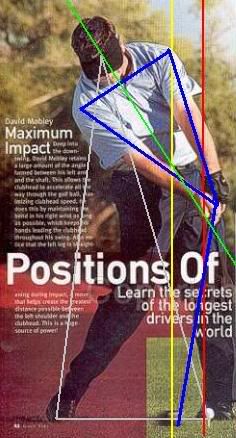 Yellow Line: where Low Point would be if it was opposite Left Shoulder. Red Line: Impact Line Blue Lines: Power Package and Primary Lever Assembly (Left Arm and Club) Grey Triangle: Base of neck in relation to feet. Green Line: Axis Tilt The only way that Clubhead will be going up from there is if the Clubshaft doesn't get any more in line with the Left Arm. Which is extremely unlikely. |
Mikey's Avatar
Quote:
Or am I missing something? Ok don't answer that . . .  |
Hi tongzilla,
My eyes are very uneducated but aren't we assuming here that his head remains in the same place. It looks to me like his head is slightly behind centre, might his head be moving up and backwards to allow him room to hit the ball? |
Quote:
|
Quote:
|
Company's Coming!!!!! Better tidy up!!!!
Quote:
We submit the following for your review. Please restate your case so that we may formulate our response. Sincerely, The Office of Kelley, Buck, Hogan, Player & Nelson    |
More Company
Two more for review . . . These are from the Gallery of this here Website.
  |
Pics aren't too clear, but to me, all of them except Mr Trevino, have the ball behind the Left Shoulder at Impact.
And all of them have the Clubhead descending during Impact (no exceptions). |
Quote:
What were we fightin' about again? This is like me and what's her name at home. I get blistered and I can't remember what I done. Tell me what your problem is sweetie . . . sorry I mean Tongzilla. |
Quote:
Basically, the main points I'm trying to make are: David Molbey's Left Wrist isn't Arched even though the Ball is in front of his Left Shoulder and the Clubshaft is leaning forwards at Impact and the Clubhead is still not ascending at Impact. This can happen if your Aiming Point is very far forward, which means the in-line condition isn't reached until much later. What makes this photo so unusual is that the Ball is way ahead of the Left Shoulder at Impact, and yet the Clubshaft and the Left Arm is still considerably out of line. Also notice how if I were to swivel that blue line representing the Clubshaft, so that it just touches the ball (Impact), the Clubshaft would still be leaning forwards. |
Mobley's grip is prolly very strong too.....(Bent looking at the top (I've seen a vid)....appears like it will be Turned at Impact...)...
... What I see: -hands moving up, w/ Flat Left Wrist...cause they're beyond the centre of the Fulcrum that is the left arm....i.e. if the arm was straight the entire swing and anchored at the shoulder (as most arms are....**hey-ooooooo!**) the left hand will have traced a circle around the left shoulder.....maybe a slightly flatish circle if that centre moves forward during the swing.....but regardless, it is centred at the shoulder -clubhead moving at least level due to forward Aiming Point (and or unltra-dely or lack of Release....see below for more...) ... So.... Does a lack fo Release or super late (ultra-Snap? lol) Release have anything to do with it? What would it be? No Release? Snap Relese? How would you define a Release? Don't have my book with me. |
Quote:
Good point Tong.....thanks for the lines dood. ... Here's another pic for yall: http://www.golfonline.com/golfonline...0781-7,00.html |
Quote:
BTW: (it's always the Low Point of the hands tho, isn't it?) Cause if you grip it Turned.......the face is square to a Turned left wrist (even if that wrist is Flat)....and a Turned grip would tend to add forward lean I'd think. |
Love those lines!
Quote:
Great work with the lines! Really helps isolate some of the conversation or at least take a little of the "seems as if" out of the equation. (I need to get up to speed on some of those computer programs!) In fact, I think "your" cover with the lines, looks better than the original magazine cover! With everything- there is always room for interpretation, understanding, etc. So I'm not pushing all in on this one, but I'm still sticking with my original analysis. Specifically in regards to the upswing comment A) looks to me like if that clubhead goes down much more he is not going to hit it on the face properly and B) From where he is - I don't see why he couldn't retain whatever angles he has remaining (#1,#2, #3, #4 accumulators)until impact- afterall, at that speed and time between where the clubhead is now and impact - not much is going to happen- whatever down or up the clubhead makes is going to be small. I just think that due to everything else that I'm seeing and specifically if the clubhead could move up or down from that pre-impact location- that it would or would need to move up. It would be great to get a photo at impact of this guy and then draw your lines showing any movement change between this frame and the impact frame. Even with lines it might be so small that you couldn't isolate the change visually. Interesting topic though- and to isolate what I thought was at least one of the original questions- A) What's happening here? I guess we're still figuring that out. B) Can TGM explain it. This is where I think you and I had/have a different impression regarding what was happening. But regardless, in this context whatever is happening - I feel that TGM could definitely still explain it- after all you've put the question right in the TGM arena - regarding low point, angular motion, etc. I'm one who has never said that TGM had ALL the answers- but on this one whatever the answer is- I think TGM would have it. With all of that said, I know that I'm just making an educated or maybe an uneducated guess- I'm not sure we'll really be able to answer the clubhead up or down issue, in regards to his swing and where it's moving from here to impact- let's see what floats to the top - as the posting continues. |
At the risk of sounding obnoxiously repetitive, I will try to clarify a few points. If you tried to swivel my blue line representing the Clubshaft so that it now touches the Ball (Impact), the Clubshaft will still clearly be leaning forwards. Lets call this scenario #1.
Now, one may argue that the Clubshaft will not move like that because the Hands are moving forwards. So lets take this perspective to the extreme -- the Hands from this position shown in the photo move forwards, but all the relevant angles remain constant. Lets call this scenario #2. Is the Clubhead going up or down? The answer now depends on whether the Hands are going up or down. We can't say for definite, but I'm pretty sure than Hands won't be going down any further from that point. Hence the Clubhead will be ascending during Impact. Assuming the Left Wrist is Level in the picture (a very plausible assumption), it will be Uncocking from this frame to Follow Through (2-P). That certainly makes scenario #2 a less likely candidate, i.e. unlikely the Clubhead will be ascending during Impact. Some more information on scenario #1. I said that the blue line (Clubshaft) swivels to Impact. But how? So far, I have only mentioned the Left Wrist Unocking more thereby lengthening the Primary Lever Assembly (a perpendicular motion, but since the Hands are Turned slightly, it will cause the Clubhead to move forward as well as downward). However, there is also the effect of the Left Wrist Rolling, which will cause the Clubshaft to appear more in-line with the Left Arm from the front view without any Unocking of the Left Wrist. Since Molbey is a Swinger who needs to strike the ball with maximum compression, it is very likely that Horizontal Hinging is being used. And this will clearly accentuate the Rolling effect described. Like Homer said, there must be a definite Hinge Action for every shot, and anyone who wants to argue that there will not be any additional Roll between this frame shown and Separation will need to give a very strong and well thought out reason (e.g. everything is moving so quickly and there is very little time in between, is not a good enough reason). |
Quote:
|
Deceptively Strong Grip
Quote:
However, a little more detective work needs to be done. Note how the Mobley's Clubface is also Turned (facing more towards the camera), since we can see a large portion of the Clubface. This closely matches the condition of his Left Hand, so the grip is actually more neutral than it seems. |
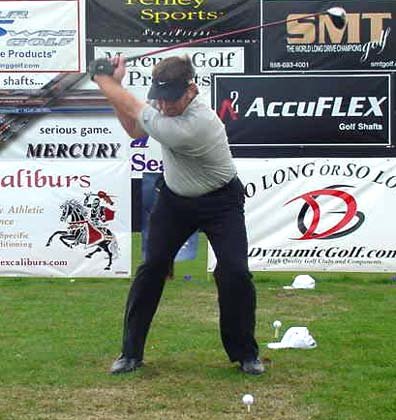
Mobley . . . Pivot Lag DAMN!!!!
Check this out. FANTASTIC!!!!
 |
tongzilla,
If David Mobley is hitting the ball with his hands infront (i.e the clubshaft had not yet reached it's inline conditon with the left arm) and he is not arching his wrist, then surely he must have a strong grip to square the clubface? |
Quote:
Here's a good one:  |
 It's pretty clear the Clubhead is going up through Impact in this particular pic. Notice the open stance, or more likely, this was shot at an angle. His Left Wrist is Arched here. Notice how the Ball is even more forward of the Left Shoulder than the previous photo. |
Quote:
Is this something that needs "fixing?" Or do you leave it be? Thanks! B |
I had once posted here or somewhere else regarding my take on hitting down or up. Everyone references the ground and clubhead path.
I contend that you can be hitting down with regrard to your power applied and yet in reference to the ground it would appear because of the clubhead path's that you are hitting up. My focus was on the Right Shoulder path, still moving down and foward assuming you have your wedges in tact. IMO drawing lines and applying definitions with out the understanding of the reference used in the definitions can lead to suspect conclusions. Take the standard definition of Low Point, left shoulder, arm vertical line down to define it on or below the ground. Now does this require the shoulders to be square to the clubhead plane line? If the shoulders were open does this change it anyway, the definition and location? Does Axis Tilt impact it, assuming no sway? And there are more questions. Is it convenient to define low point to the ground, even if you have an uphill or downhill lie? If low point is truly the full extension of the swing radius, then I would think position of the shoulders, rotation and tilt, will change this point. Though it may be projected to the ground, isn't the real purpose in defining low point is for location of the ball such that it is at or behind low point so the applied force will be down and through vs having an upward motion characteristic where applied power will no longer be accelerating? If we had an overhead view of the golfer in question, and applied traditional definitions as seen in the lines, what would we see in regards to the Impact Line and Low Point Line? What would be the clubhead orbit? As it is being defined it would appear that the clubhead orbit would be from out to in since we would have to pass over the low point to reach the impact point. (The Impact Plane Line is always parallel to the Low Point Plane Line on the Sweet Spot Plane. They can be one of the same lines when the ball is located at low point, else the Impact Plane Line is aways between the golfer and the Low Point Plane Line.) I think that he is driving down and out or has the ball at the true Low Point Location. I shall hang on to this picture, makes for good notes in my study of the lines, angles and analysis of video and pictures. I think your second picture is at an angle the right side closer to the camera than left. Again, the more I see these lines applied for analysis the more I begin to believe that they are mis-applied. |
Quote:
|
Quote:
That's great -- I'd love to learn more about drawing lines. So may you please demonstrate how you would do it on the same pictures? Of course, a complementary analysis and explanation would also be helpful. |
Consistency
Quote:
Interesting thread and pics. Are these guys REALLY going for consistency or are they looking for that 1 "bomb"? I recall watching a former LD champ launch some while standing a few feet away. The speed, sound, and power doesn't come across on TV. Of course neither does the wildness of some of the misses. :) CG |
Great Point CG...Most ( Not All) guys that have the Left Wrist as the Fulcrum and that far forward are very inconsistent as far as drving accuracy...But what the hell....if you can hit it that far...just finding it between the trees is accurate enough...
Par 4 450 yards PlayerA - Tee shot 350 yards Approach 100 yards from the rough PlayerB - Tee shot 250 yards straight down the middle of the fairway with a 200 yard approach.... I think everyone here would tend to go with A...it's all...probability..... Once I convinced an Anonymous Tour Player of this "tremendous asset" he started to dominate the Hooters Tour and has since moved up to the Nationwide Tour as a result of this change in perspective.... |
Quote:
If somebody came to you looking like that at Impact, and they were trying to SCORE better vs. punish it, would you fix it or leave it be? Thanks! B |
They (thems guys on tour) need to play courses where there's more bush (thick bush) or water lining the holes.
|
| All times are GMT -4. The time now is 11:02 AM. |