
|
Why You've Struggled
From the Final Missing Piece
In Five Lesson, Hogan stressed the importance of starting the downswing with the truning of the hips. In fact, he mentions it OVER 40 TIMES, so it was obviously important to him. However, most amatures cannot master this critical move, and it's one of the main reasons they struggle with Hogan's teaching. Most amatures cannot get their weight over to their left side soon enough in the downswing. If the average golfer starts to turn his hips with his weight centered, he completely opens up the left side of the golf course because his center of gravity is behind the ball and his left shoulder may or many not get ahead of the ball. The tendency for the average player is to come over the top and pull the ball left: a better player will likely hit a hook. To counter this tendency and to get the weight over the left foot earlier in the swing, better players will slide the hips forward at the beginning of the downswing before rotating them. However, it is difficult to slide and trun the hips repeatedly and accurately at the beninning of your downswing unless you have the cooridination of a tourning pro, and even then this will occasionally fail. It requires tremendous coordination in order to consistently move the center of mass forward when the hips are turning, so players stop turning their hips, and they tend to hold the clubface open to prevent the pull-hook. They begin to lay the face back and play a pull-slice. By incorporating the missing piece into his swing, Hogan got his hips forward during his backswing. One there, Hogan could start by the downswing by turning his hips and move his body in perfect sequence for maximum power. With his hip action, Hogan figured out a way for his body to produce repeatable alignments, a flat or slightly bowed left wrist and a straight left arm at impact, every time. This body motion allowed his hands to play a much lesser role. His body put him in a perfect position to hit the ball with power and precision. In the thred prior to his one, showing Yodas swing, note that Yoda appeared to keep a lot of weight on the left side in the backswing. The pictures appear to show that Yoda was on his left side prior to starting the downswing. From this position Yoda could set the accumulator with a slight hip turn to start the downsing. Hey V.J., Hope that I did not infringe on your book. It is such a masterpiece. |
I realise that VJ believes that Hogan got most of his body weight onto his left foot at the end-backswing and that he therefore didn't have to shift-rotate his pelvis left-laterally during the downswing. I, however, am not convinced by the evidence provided in his book.
Here is a photo sequence of Hogan's downswing. 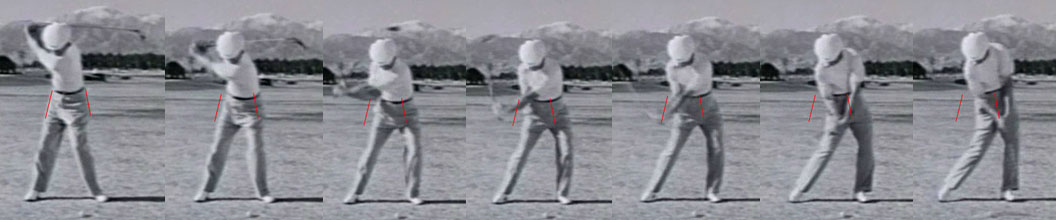 I placed red lines on the outer border of Hogan's pelvis at the end-backswing (after he shifted his pelvis to the left during the late backswing). The series of images demonstrates that Hogan still had a large left-lateral shift of his pelvis during the downswing. Jeff. |
Shift
Jeff, the digrams that you drew were very good. Thank you for
the pictures of Hogan. I think that the shift, that V.J. presents, is for the center of mass/center of gravity of the body rather than the pelvis. The center of mass is right between the feet at address but moves to just inside the left foot with the shift before the downswing. V.J. mentions that the center of mass is through the body in line with the seams of the pants and aprox at the forward inter heals. I think that the appearance of a big shift, after the downswing is due to the pivot way to the left where the center of mass has moved. For the pelvis. I think that the Hula Hula accounts for the appearance of the hip slide. V.J. is the expert and could clear up missconceptions that I may have made. What I have said is my impression, not necessarly his. |
Quote:
The point of all this . . . Hogan did whatever he needed to do to create the desired ball flight . . . but one thing you can see pretty consistently in Hogan is lots of #3 angle and a club that swings IN and ON PLANE quickly after low point . . . I think that is a BIG piece of the "Secret." |
Quote:
|
12 piece bucket
I agree with your perspective that one can interpret Hogan's swing in different ways depending on "how" one views his swing. I simply try and reconcile the different expressed viewpoints as best I can - within the limits of my personal set of biases. I also think that we cannot definitely answer the question as to whose personal perspective is most accurate, because Hogan is not available for formal testing in a research laboaratory. I wish he was - I would love to acquire a better understanding of his swing, that would be more readily measurable with today's golf laboratory research equipment. Jeff. |
dkerby
I cannot quite understand your viewpoint - particularly the following statement. "I think that the appearance of a big shift, after the downswing is due to the pivot way to the left where the center of mass has moved." If the center of mass is already located well left of center at the end-backswing, then I cannot understand how one can still pivot far over to the left during the downswing. What part of Hogan's body is located well to the left of center at the end-backswing position, and how can one determine its mass relative to the total body mass? Jeff. |
Jeff,
How come the sequence you made approaching the top of backswing and the transition for the down swing got only one picture to show your point of view? In my try with the capture, there are 188 frames of the same clip you did. From a few I made, I can see, before the club approaching the very top of the swing, the lower body already moved forward…or as VJ’s comment: “get the weight over to their left side soon enough in the downswing” http://us.f6.yahoofs.com/hkblog/Ps8k..._____D0mkCIVqi In the second row, the club was going even back and down while the lateral hip motion was already there. The lateral move not only _________ but also ___________. |
Quote:
|
KOC
Your question is why do I represent the end-backswing position with a single photographic image, and you seem to imply that it might not demonstrate the "true" amount of left-lateral pelvic/weight shift seen in the final moments of the backswing. First of all, I produce only a single end-backswing image for simplicity sake. Secondly, let me define what represents my definition of the end-backswing - it is the time-point when the clubshaft starts to move in the opposite direction. So, using a swing analyser program, I advance the video frame-by-frame until the clubhead starts to change direction. I then back off one-frame, and that represents the end-backswing position - and it incorporates Hogan's final left-lateral pelvic shift in the final moments of the backswing. As your series of images demonstrates, if I was off by a single frame, it would have very little effect one one's overall impression. I did the same process with another swing video of Hogan. I waited until the clubshaft changed directions to determine the end-backswing position. 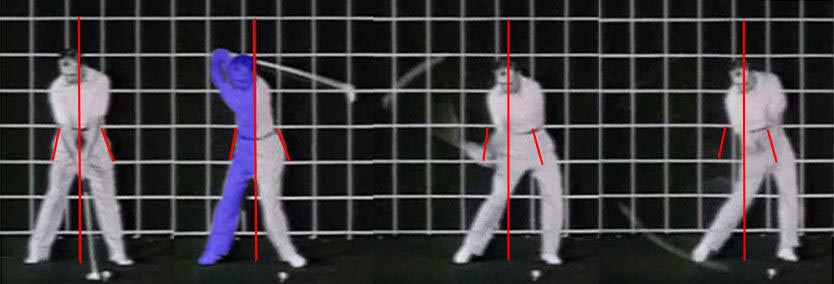 The blue-colored area represents that part of Hogan's body that 'appears" to be right of the center of his stance at the end-backswing position. Anticipating that you may claim that my single-frame representation of the end-backswing doesn't accurately represent the end-backswing position, I have produced the following series of images. 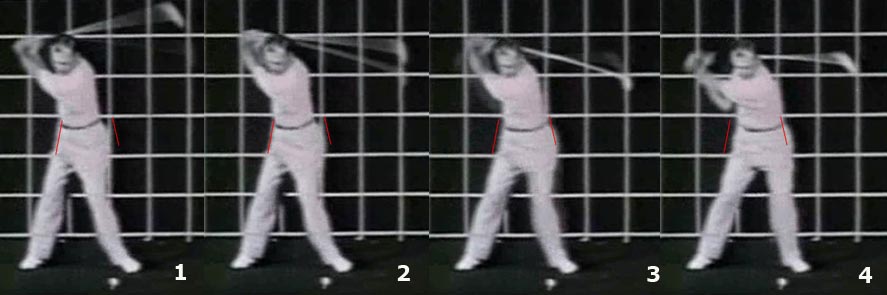 I advanced the video one frame at a time. Image 4 shows the clubhead changing direction. Therefore. image 3 accurately represents the end-backswing position (and includes the left-lateral pelvic slide that occurs in the final moments of his backswing). Look at his clubhead position in image 3, and note that it is in the same position as my single-image representation of the end-backswing in the previous series of images. I do not believe that there is any foundation for any "belief" that I am deliberately misrepresenting reality. Jeff. |
Jeff,
Is it possible that you should define the "end-backswing" as when his hands change direction, and not the club? Because his hands have started moving back down in frame 3. |
Quote:
Thanks for the work, that is really nice and i am reading 8-6 now...might be we have different idea of the term "end of the backswing":eyes: |
Quote:
P.S. Congratulations on breaking the 3000 post mark! I'll be sending a nice letter to your wife- making sure she knows about your accomplishment!:eyes: |
Holeout
I think that the clubhead should start to change directions almost at the same time as the hands change directions. However, I could easily concede that in Hogan's situation, there may be slight delay between Hogan's hand movement and clubhead movement, because Hogan had ultra-flexible wrists and there may be a momentary delay before the clubhead changes directions. KOC There is no "gold standard" definition of the end-backswing, and I prefer to use the golf research laboratory definition. Even Phil Cheetham at the TPI now uses this same definition - when the clubhead changes direction. He previously defined the end-backswing position when the lower body changed directions and started to move forwards. Jeff. |
Five Lessons
Pg 93, Hogan said Initiating the downswing with the hips is of
such critical importance that many top-run golfers, sensing that their timing will be better accomodated, start to turn their hips to the left a fraction of a second before the club reaches the top of the backswing. There's nothing wrong with this. Pg 74, When the hips are turned back to the left, this tightens the muscles between the hips and the shoulders just a notch more-something like the way a fellow gives each lug that little extra tightening twist when he's changing a tire. Maximum tension in the muscles betwee the hips and the shoulders produces maximum speed. Jeff, I love your pictures. Thanks for putting them up. If you get a chance, look a frame No. 3 on page 41 of the Final Missing Piece. It shows that Hogan had moved the center of Mass to the left leg before starting down. |
Appearance
Jeff, I think that Leadbetter said it best. "I believe that Hogan's
lateral hip slide is a major cause of his high finish. Let me explain why. The slide toward the target position his hips well foward. As his hips began to rotate open from this forward position, Hogan raised his body and stood up on the shot after impact." I think that the key here is that Hogan was able to pivot with the Center of Mass way to the left near or over his left leg. Another point, V.J. noted that the head drops almost two inches at the top of the swing. This is caused by the shift left before the downswing. V.J. presents via of an engineering study what and where the Center of Mass/Center of Gravity is. Keep up the great work/postings/pictures. I sure enjoy them. |
Jeff,
Regardless any definition you want, the most important move i learnt from VJ work...it is a gif file, refresh the page to see the "MOVE".  |
dkerby
You seem to define the center of mass as the area around the navel. In that sense, Hogan did move his center of mass slightly leftwards in the final stage of the backswing (as seen in image 3 on page 41). However, that doesn't mean that 70% of Hogan's total body mass was on the left foot at the end-backswing position. The center of mass can be slightly leftwards of the stance center, but the proportion of total body mass favoring the right side versus left side has to also factor in the weight of the upper torso, two arms and head. You also wrote-: "When the hips are turned back to the left, this tightens the muscles between the hips and the shoulders just a notch more-something like the way a fellow gives each lug that little extra tightening twist when he's changing a tire. Maximum tension in the muscles betwee the hips and the shoulders produces maximum speed." I personally believe that your theory that increasing the stretch of the torso muscles - by moving the pelvis before the upper body (what Jim McLean calls the dynamic X-factor) - produces maximimum swing power is a theory without adequate scientific evidentiary support. I wrote a review paper on Jim McLean's X-factor, and I used this photo to make a point. 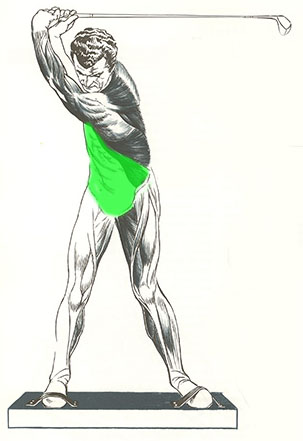 The torso muscles stretched when the pelvis moves before the upper torso is shown in green. Those muscles are essentially the abdominal oblique muscles on the right-lateral side of the mid-torso. I personally don't believe that stretching those few (limited) muscles plays a large role in generating pivot power in the downswing. However, I do think that kinetic sequencing is important and I do that think that one should start the downswing with a hip shift-rotation movement before rotating the shoulders - but I think that the primary reason relates to the concept of i) taking up spinal slack, and ii) getting a balanced sequential torso rotation (like a figure skater spinning on the ice - the spin has to start from the bottom-up). I personally think that the stretch factor concept (stretching eccentrically loaded torso muscles muscles by a small amount) plays a minor role in maximising swing power. Jeff. |
dkerby
You wrote-: "Jeff, I think that Leadbetter said it best. "I believe that Hogan's lateral hip slide is a major cause of his high finish. Let me explain why. The slide toward the target position his hips well foward. As his hips began to rotate open from this forward position, Hogan raised his body and stood up on the shot after impact." I disagree with Leadbetter's assertion that it was solely the lateral pelvic slide that is responsible for Hogan's excellent high finish. I think that Hogan's excellent high finish was simply due to the i) overalll efficiency of his downswing pivot action + ii) his superbly executed continued-torso rotation post-impact. His downswing pivot action was so efficient that he fully released his power accumulators to a straight right/left arm post-impact situation. However, he not only released his power accumulators perfectly, he also continued to turn his torso superbly during the followthrough and finish phases of the swing, and that directed his straight arms in an upwards and leftwards direction to a high finish. You also wrote-: "I think that the key here is that Hogan was able to pivot with the Center of Mass way to the left near or over his left leg." I personally don't think that having the center of mass (body mass near the center of the torso) slightly leftwards increases the efficacy of the downswing pivot action. The human body is not like a spinning cylinder, which spins faster when the center of mass is near the central axis of rotation. Hogan had a superb downswing pivot action for many reasons, and one of the main reasons relates to his body alignment at the start of the downswing. 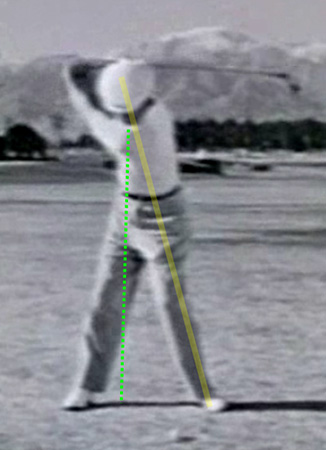 Hogan had a typical reverse K look at the at the start of the downswing. I personally believe that when the upper torso is angled to the right (causing the head to be slightly right-of-center) while the lower torso is angled to the left (thereby creating the reverse-K appearance) that the human body is optimally positioned to perform an efficient downswing pivot action. The yellow line represents the skeletal structural alignment between the head and left foot (spine, pelvis, left thigh, left tibia) that can be braced when the downswing is initiated by a pelvic shift-rotational movement. I personally believe that Hogan's super-efficient lower body movement during the early/mid downswing required this skeletal structural alignment (spine and upper torso angled slightly to the right) to allow it to occur with maximum efficiency. In other words, I place major emphasis on body alignments (especially supporting skeletal structural alignments) that allow for optimum biomechanical movements and I place minor emphasis on central body weight distribution (especially passive weight [organ weight and mesenteric fatty tissue weight] distributed in the mid-body). Jeff. |
KOC
I agree with you that Hogan's transition pelvic move is important, but I think that the value of the "transition move" relates to the creation of the optimal skeletal structural alignments necessary for an optimum downswing pivot action (see post reply to dkerby above) and that it has has nothing to do with moving passive central body mass closer to the left leg. When Hogan shifted his pelvis left-laterally in the late backswing, he optimised his reverse-K alignment before starting his downswing pivot action in earnest. To reinforce my argument that body alignment places a major role in swing power, look at this swing video of Shawn Clement swinging off one-leg. http://www.youtube.com/watch?v=T2FnfZlRwak He can hit the ball as far, if not slightly further, off one-leg than two legs. Why? Note that he has no body coiling in his one leg swing, and therefore zero X-factor, and the absence of any coiling of his upper body against the resistance of his lower body doesn't affect his swing power. I think that a key element in his one-leg swing's swing power is the method that he adopts to position his spine with rightwards spinal tilt at address. That maneuver creates the braced reverse-K structural alignment necessary for his "efficient" downswing pivot action over one-leg. Jeff. |
Quote:
|
KOC
I am not sure what question you are asking. Anyway, consider Shawn Clement's one leg swing. 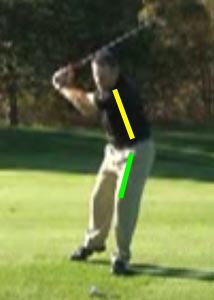 This is his alignment when he starts the downswing. His spine and upper torso are angled to the right (yellow line) while his thighs (green line) are angled to the left. That is the critical body alignment that allows for an effective downswing pivot action. How does he start the downswing? Not by a lower body movement (shift-rotation of the hips). He states that he simply lets the momentum of the club produce the downswing. Now whether he pulls the club down with his hands, or whether he starts the downswing with a right shoulder throw action, the end-result on his lower body can be clearly seen in the video. His left knee moves left-laterally and the left thigh rotates counterclockwise (while he puts increasing weight on the left foot) => that causes the pelvis to rotate to the left/backwards. That lower body move is exactly what Hogan does in his downswing (except that Hogan initiates the downswing with a lower body movement). How does Shawn Clement get into the proper alignment position to start his downswing. A key element is that he starts at address with rightwards spinal tilt. Then he pulls the right hip back during the backswing and that causes the pelvis to shift left-laterally while the head (and therefore upper spine) is kept stationary. In particular, as a result of the pelvic shift movement left-laterally, the lumbar spine moves left-laterally while he keeps his head and upper spine stationary. That produces the rightwards-tilted spine, rightwards tilted torso and stable head position (yellow line). I think that this skeletal alignment is the critical part of the equation. The fact that his central mass around his navel moves leftwards in the backswing (as a result of the left-lateral pelvic movement) is incidental. In other words, I agree with VJ's belief that the key element in Hogan's backswing is the angling of the right thigh to the left, which pushes the pelvis left-laterally during the backswing, so that Hogan has the reverse-K look exemplified by Shawn Clement in that photographic image. However, any weight shift is incidental - as Shawn Clement stated in his one-leg swing video. He makes no attempt to shift weight. He merely adopts the "correct" body alignments necessary to execute a fluid downswing over a braced lead leg. Jeff. |
|
Quote:
He has a weight shift (within the contact surface (heel and sole) area of the left foot and probably onto the right toe...despite what he says) He , very importantly, has a pre-turned right hip... he would not hit a good shot if that right toe were touching the ground parallel to target line. He avoids round-housing by placing the right foot behind him. Hogan achieved the same by moving his hips towards target before he pulled the right elbow down...avoiding collision. Easier to collide right elbow and right hip if you try and slide and pull down at the same time...maybe... I agree with his point about centred radius. Back to my day job! |
Quote:
Jeff . . . you make some good points man. In addition to your pelvis spine deal . . . the geometry makes sense. Pivot lag built in . . . axis tilt and left shoulder and low point location work. This dude has a nice video about his interpretation of Hogan's transition as well. Worth taking a look at. |
Golfbulldog
That's a terrific demonstration of Hogan's late backswing left-lateral hip shift movement. It gives one the impression that the greatest advantage of the "move" is that it starts to replant weight onto the left foot and thereby brace the left leg, so that it can support the downswing pivot thrust action that is going to happen a fraction-of-a-second later when the downswing starts in earnest. I think that Hogans' "timing" and fluidity of movement is his greatest swing characteristic. Regarding Shawn Clement. He must transfer weight to the right foot at the start of the backswing if he is moving his arms across his body to the right. However, any weight shift is incidental and not a deliberate action. His general intention is to have a centralised swing that is rotary in nature. That's how I think of Hogan's swing - it's a right-centralised rotary swing with no deliberate intent to shift weight in a lateral direction. A key element in a rightwards-centralised swing is that there is rightwards spinal/torso tilt during the downswing, and one couldn't swing effectively with leftwards spinal tilt or with a head/spine axis that shifts left-laterally during the downswing. I like Shawn Clement's concept about bracing the left side with a rightwards spinal tilt. Here is link to another Shawn Clement video lesson that emphasises this point of bracing the left side via the biomechanical technique of rightwards spinal tilt. http://www.youtube.com/watch?v=nI3i936JRd0 Note that when he "braces his tilt" he juts his left pelvis in a left-lateral direction. Hogan did that same maneuver, but he did it in the his late downswing when he shifts his pelvis left-laterally. In his one-leg swing video, Shawn Clement stresses the importance of having the right toe flared outwards so that the right hip can turn easily backwards during the backstroke. That allows the arms to move inside along an inside track, and get "deep" without any need for any deliberate independent arm-movements (independent of the overall directional movement of the shoulder sockets). I personally think that, as a side-issue, that his lack of coiling (due to a free right hip clearing action in the backswing) demonstrates that coiling the upper body against the resistance of a limited lower body turn is not a necessary/obligatory requirement for very effective swing power. Jeff. |
Great Material
This has developed into an excellent thread...thanks Jeff, KOC & Bulldog for the great material you have created and presented in this thread. The work is first class.:)
|
Quote:
That being said . . . I think he NAILED the Hogan move. Very nice. And anybody that talks about staying tilted with a centered head can be on the A-Team . . . period. He also has some nice videos on his site relating golf to other dynamic motions . . . at times I feel like he may try to sell me some weight loss products or some home cleaning supplies . . .but his information is well thought out. |
12 piece bucket
Although I like Shawn Clement's video lessons, he speaks in simplistic terms and uses vague terminology (eg. gravity, momentum) to describe forces powering the golf swing. He would be able to offer much better advice if he studied and understood TGM. Jeff. |
Shawn Clements videos
Jeff, it is not my theory that when the hips are turned back to
the left, that this tightens the muscles of the hips and the shoulders. This was Hogan's theory. I posted what he said. I do agree with his findings. I watched the video from Shawn Clements. I certainly agree with his braced tilt. His one leg drill was very good. Note that his center of mass was over the pivot axis before starting down. I do not agree with his video on the free fall of the arms. It appears that he is using a shift with turn as he dropps the arms. He says that he "pushes" through the ball. I think as a swinger that he should be pulling the arms through the ball. Hogan states, on pg 93, of the five lessons, that the arms are carried down by the movement of the hips. V.J. pieced together a particular swing in which Hogan rotated his hips 100 degrees in 0.18/Sec. V.J. went on to say that, "It is evident that this type of speed is correlated to having the the center of mass over an axis of rotation. Sure I believe in axis tilt. Note from Shawn's picture that his left shoulder appears to be even with the ball even with the axis tilt. This is a conerstone of V.J.s findings. If you try to use a shift with turn, as in the arms drop video, I do not think that you can make the moves that V.J. describes. I also agree with Yodas premis that you set the accumulators with the hip movement and whirl the gyroscope. Your work on the subject is very good. I certainly appreciate your time and effort. After watching the video, I can see where you are coming from. Donn |
Donn
You state that you don't agree with Shawn Clement's description of his "falling arms". I can understand why you may not understand his personal descriptions/perspective, because I have never really understood how Shawn Clement powers his swing, even though I have viewed all his 107 video lessons. He often uses terms like "falling arms", "club falling due to gravity", "using momentum to throw the club up to the end-backswing position" in the backstroke movement, "catapulting the arms through the impact zone". I think that I would better understand his swing if he used TGM terminology. However, I love watching him swing. He makes golf seem effortless and natural. He has an amazing capacity to swing consistently and always scuff the ground at the same point swing-after-swing. His timing is impeccable. I agree with you that Hogan had an amazingly fast and amazingly fluid pelvis rotation speed in his early/mid downswing. However, i don't think that it has anything to do with the fact that his center of mass is near his axis of rotation at the start of the downswing. I think that the answer lies in Hogan's amazing ability to get the relevant musculoskeletal structures to perform flawlessly (He could whirl the gyroscope like a superb ballet dancer eg. Michail Barysknikov). Jeff. |
Thanks Jeff. Somewhere I think that Homer Kelley said that
you can do anything you want as long as you know what you are doing. One of my favorite quotes from Homer: "Demanding that golf instruction be kept simple does not make it simple -- only incomplete and ineffective". Your topic for discussion is one of the best posted. I certainly hope that you bring up other topics for discussion. Your Drawings, pictures, references to videos and viewpoints are a real asset to the forum. Donn |
Quote:
OK, in the first shot he is REALLY going for it...one of the few pieces of Hogan footage where he nearly loses balance at the finish...so maybe discount this one... But the last footage is 1956 in Mexico...small time home movie....nothing to fear...nothing to prove....natural full swing.... The left heel only raises when he moves forward with his body maintaining the axis tilt established in the backswing. He does this without too much sag... He actually moves forward, increases hip rotation and lifts the left heel all at the same time...and it seems so natural...in VJ's book he describes a targetwards motion of the pivot much earlier in the backswing...this has to learnt...looks less natural than Hogan. OK, so i have not hit a ball in anger in 8 months...not even a range rock in 3 months... but in the mirror in my apartment I can achieve the same Hogan move by trying to do what Hogan tells us to do...it is TRYING to keep the club against the right hip (page 75 in my old Modern Fundamentals)... I do not achieve what he wants but I find that in trying to do so and also get a good right hip turn...the weight WANTS to move forwards...it is inevitable and feels natural...not a move that has to learnt. So what does it feel like...it feels like I am keeping my shin bone fixed, weight on inner right foot (Venturi had right golf shoe made to enhance this)...letting the knee rotate a little and permitting the right hip to move towards target...any comments...I was trying not to post due to work commitments but I re-read VJ's book and Modern Fundamentals...just can't keep away! Compare with Tiger's move in this video where he actually achieves what Hogan requested...right hip does not move at all in backswing... http://www.youtube.com/watch?v=cHcP6X7dEUo We know who has the most majors but then we also know Tiger would love to swing like Ben!! |
Golfbulldog
Phew! That's a confusing post. I have no idea what you are talking about. I cannot even work out if you are trying to describe the backswing or downswing, or whether the shin bone is the left or right shin bone. If I cannot understand your viewpoint, I cannot learn something new. Sigh! Jeff. |
Quote:
Your clip led me to make another one... http://www.youtube.com/watch?v=Tf12pH7sUkA Back to this topic, many members have disclosed the missing piece move from VJ’s book, here and somewhere else, we knew that VJ figured it out that Hogan’s weight was…. I think that is the “weight shift” issue and therefore hip motion, hip turn and knee action in the yellow book. I also related to what Mr. Hogan talked about in his 5-lessons book regarding Ed Stewart's left knee. I also noticed that Moe Norman said “:..I play into my leg, not on top of it.” I also noticed Jody Vasquez talked about the correct functioning of the right leg and my own take on that as the right feet and leg feel the ground and put against it for the change of direction at the “top”.…IMHO, the combination of the above is the essence of the rotary and lateral move. Sorry if you guys don't know what i am talking about...hehe….sometime it is difficult for a Chinese to say in other language precisely. |
KOC if we could even attempt to speak in Cantonese I am sure you would have a giggle at it! You do velly well (and for those who think this unPC, KOC knows I grew up speaking Chinglish:laughing9 ).
|
The important elements of Hogan's Missing Piece are:
The displacement of the pelvis in sequence: Meaning, when the the hip slide/axis tilt actually takes place. The Tri-pod Center: No stack n tilt with Mr. Hogan. The Hula-Hula of the hips moves the center of mass to the left leg axis. Low Point: The movement of the center of mass (hip slide/axis tilt/hula-hula)has an effect on low point. Which has an effect on the ball's relationship to the plane. Which has an effect on the bullet hole that goes through the baseball. Ball Positioning: Its relationship to low point and the arc/angle of approach Did Mr. Hogan move laterally before the completion of the backswing? Yes he did. Did Mr. Hogan's pivot sequence change after the wreck? Just a little video research can show you significant changes in his pivot sequence. Did the impact Mr. Hogan's game? Just look at the record with the above in mind. |
vj
I have a few questions regarding your concept of planar shifts in Hogan's swing. This is the photo from your book. 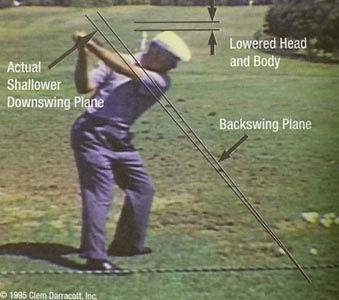 You have drawn two planes - a backswing and downswing plane - and implied that Hogan swung on the lowered downswing plane because of the movement of his center of mass leftwards in the late backswing, so that it is closer to the pivot axis. I cannot understand your point of view from two angles. First of all, why have you drawn the plane lines in those positions? My TGM-based understanding of a plane is that it has relevance to the movement of the clubshaft. Hogan never swung his clubshaft along those planes. The backswing plane you have drawn is Hogan's glass pane representation - where the glass pane rests on his shoulders. However, Hogan never swung his clubshaft on that plane. Hogan only stated that his left arm brushed against that plane in the late backswing, and that his hands never went above that plane. Surely, one needs to represent the shift in clubshaft planes in the TGM-manner. Here is a photo showing Hogan's clubshaft/hand planar shifts. 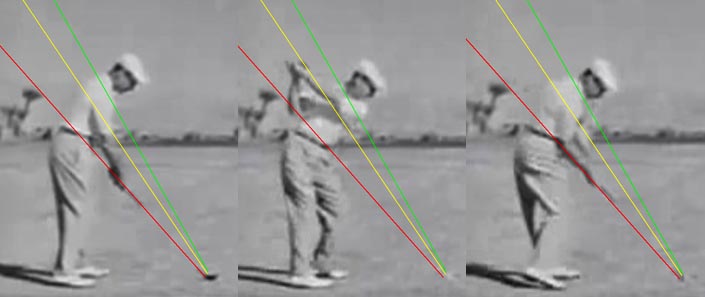 The green line represents your definition of the backswing plane (pane of glass resting on his shoulders). The yellow line is the turned shoulder plane, and the red line is the clubshaft-at-address plane, which is also the hand plane (butt end of the club points at the belt-buckle). During the backswing, the hands/clubshaft move from the hand plane to just below the turned shoulder plane, and during the downswing the hands/clubshaft move down to a point at impact where they are back on the hand plane. So, in what sense does Hogan swing on a shallower plane during the downswing compared to the backswing? I think that Hogan shallowed the clubshaft during the downswing as a result of his downswing (not backswing) hip shift-rotation movement. One can see that happening in this posed photo of Hogan. 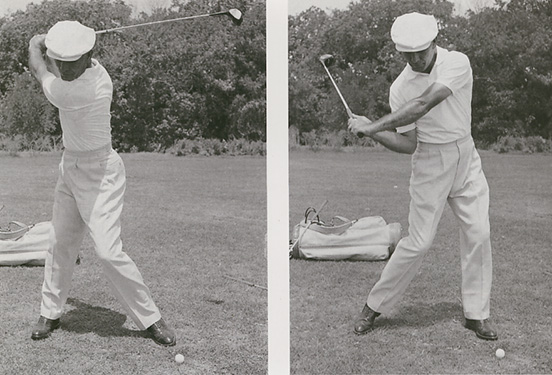 Hogan stated that the clubshaft would flatten as a result of the hip shift-rotation movement that starts the downswing. It is my belief that this clubshaft-flattening phenomenon will happen even if the pelvis doesn't shift left-laterally in the late backswing, so that the center of mass is closer to the pivot axis. In this posed photo, Hogan has not shifted his pelvis left-laterally (like you describe) and he can still flatten his clubshaft plane in the early downswing. I believe that it can occur due to the shift of the pelvis left-laterally in the downswing - because the movement of the pelvis left-laterally causes the lumbar spine to move left-laterally thereby creating a greater amount of secondary axis tilt, which then causes the right shoulder to move more downplane (more groundwards) when the shoulders rotate perpendicularly around the spine in the downswing. In other words, I think that all golfers will exhibit this clubshaft shallowing phenomenon if they move the pelvis left-laterally during the downswing (not backswing), and that any clubshaft-flattening phenomenon has nothing to do with a backswing phenomenon whereby the center of mass moves closer to the pivot axis. Jeff. |
Quote:
Backswing-transition into downswing...clue is in the video ...;) Look at Yoda's transition in KOC's video....looks very nice...got your reverse K and everything! :salut: :golf: |
Jeff,
The reference is to the plane Mr. Hogan spoke of in 5 Lessons. This point you are arguing about the movement of Hogan's pelvis always revolves around the same images. There are many, many that are not staged performances of Mr. Hogan's swing after 1950. I have a question for you now. Are you or is your company hiring? If so, I would like for you to hire me so that I can provide for my family, research golf, improve my own game and SPEND AS MUCH TIME ARGUING IN CYBERSPACE as you do. I say this without being argumenative. I just don't understand why you don't take a closer look into Hogan's pivot sequence. |
| All times are GMT -4. The time now is 06:57 AM. |