|
Tracing the plane line
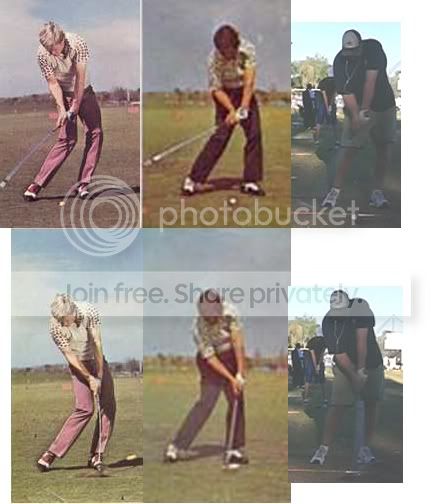
So obviously this is a key concept in the golf machine, you trace the plane line, if I understand it correctly, with the right forearm and #3 pressure point. I finally saw a picture of a few pro's, and compared it to myself. Here is Tiger, on plane:
 Here is myself, well above the plane, like in the next county.  I really would like to understand how to get it on plane like Tiger, or Els.........I assume this would be a critical step in my learning process? :golf: |
I feel like such an idiot, so like I bet I am supposed to trace that plane line on the back swing as well? The magic of the right forearm deal thing that has been talked about endlessly here?
Time to head back to the idiot box............ |
Quote:
Look at the Blur of your Clubhead in the Above Picture. You may be on the TSP? If so, though your #3 PP may be tracing the Plane Line, your Elbow and Forearm may not be On the Swing Plane until Impact. What's important is that your Right Forearm Flying Wedge is at Right Angles to the Left Arm Flying Wedge. It's important for the Right Forearm Flying Wedge to be at 90 degrees to the Plane of the Left Arm Flying Wedge. Quote:
|
oh boy.... very confused ):
you may be right, my hand is under the turned shoulder plane.  |
It's very difficult to grasp.
THE ICEMON ........Compare Pic 1 below, with your Pic 2 above.  |
1 Attachment(s)
Quote:
Kevin |
Bad angle
Quote:
Next time you take a video try and get the camera to point at the hands, elbow, or turned shoulder then you will be able to properly determine this. If you have a couple of fiberglass rods set them in the ground at the same angle, shaft angle is easiest, then set your camera so you only see 1 dowel. If you see 2 dowels your camera is off plane. A neat trick is to stand upright and move until you only see 1 rod. You will be amazed how far "behind" a player you need to stand in order to see the plane. |
Quote:
1. Booty 2. Shoulder Tilt 3. Left arm You can try to trace all you want but the bottom line is your pivot can jack up your plane . . . shoulders basically control the plane of the arms swing . . . spine/hips control the tilt of the shoulders . . . knees control tilt/turn of hips. Your shoulders are too tilty at this point so your left arm gets "out and away from you" as a result. Note how Tiger's left arm is essentially vertical to the ground at this point. Hogan may have thought he did this . . . but he didn't . . .   So . . . keep your head centered . . . keep your left shoulder from coming up and swing your arms down faster. Your right shoulder is too low at this point so your hands are getting shifted out over the plane. 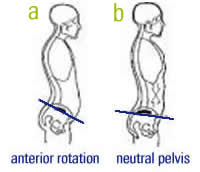 Feel like your your butt stays up against the wall and keep that booty UP longer as you slide your hips forward . . . hula hula. Booty Back Golf as O.B. Left says . . . feel like your hips are going back behind you as you go forward . . .  |
Thanks Bucket.....do you think part of the problem could be in the initial setup standing to far away from the ball?
|
Quote:
|
I will....I signed up for this deal at PGA Tour Super store that gives me unlimited access to their launch monitor and camera system for practice, you see I am an addict, its like free crack.
It has a really cool feature where you can draw a line, on say the turned shoulder plane, then go address the ball and see the real time image from a face on and DTL view, it has a 1 second or so delay. So it allowed me to play around with a little cause and effect. I moved closer to the ball and played around with taking the club back and all off sudden club was only the slightest bit outside and then just a shade off plane, by far the closest I had come. What followed was the best hitting session ever. I will get some pics this weekend. I will study the whole shoulder thing as well....oh and with the deal I got a free lesson, that should be entertaining on Wed..I am not mentioning TGM but I wonder how much of the advice will come close to the quality of information at this site! |
what do you think Bucket....
Swinger...Hitter...me-------hall of famer...hall of famer...errrrrrrrrr me 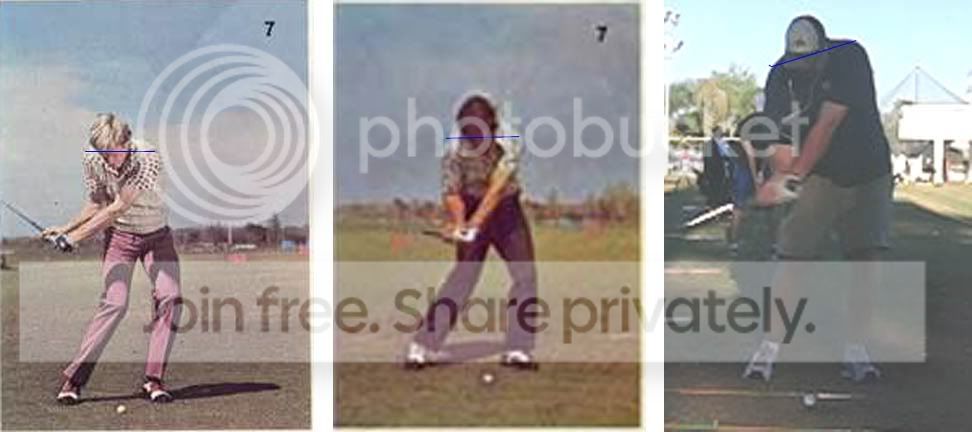 |
Quote:
Nice pic comparison . .. Lots to learn here. Good job. Can you compare the next two frames with the same three cats? |
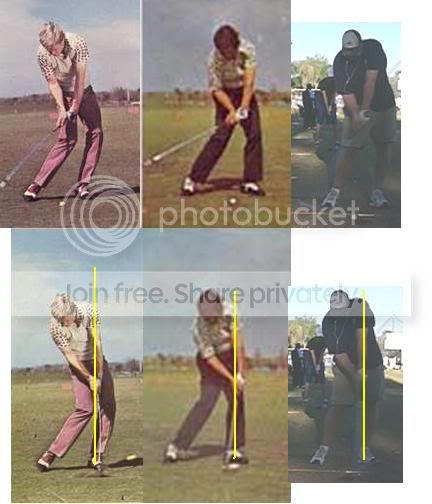
I tried to make myself the same size for context...you can see I am starting to dump it earlier but I still get to impact in a pretty good position. I love Lee's position, is there any better?
 |
Turn In the Barrel
Quote:
Your problems in Zones 2 and 3 (Arms and Hands) are largely the result of problems in Zone 1 (Body/Pivot). Simply stated, you're sliding (with no turn) through impact, big time. Draw a vertical line from Miller's left heel through his left shoulder. Do the same on the photos of Trevino and yourself. Notice how far your left hip is in front of that line. Notice also how both Miller and Trevino are rotating their left hips behind that line. I've PMed Bambam and asked him to draw the line for us. If anyone on line can get there first, have it! |
Trevino's impact positon looks greate face on.
Yoda, Any idea why the dancing feet / reverse C was so popular in the 70's? It looks kind of flimsy to me compared with modern footwork. But I guess they have to do it because of.... well, that's the part I am wondering about. Everytime I see this it seems to go hand in hand with longish hair and 70's dress code :laughing9 |
Quote:
Maybe on a dare or something. A fund raiser? I see some nice footjoys on Miller, are those Etonics on Lee? Remember those beauties? They weighed about twenty pounds each. I never had Etonics but my dad sure did. The Squire was wearing a nice pair when I met him at Marco Island. |
I updated the original photo with the lines.
|
1 Attachment(s)
|
Hip TURN
Quote:
No doubt you see what I'm talking about. There has been little lower body rotation, i.e., your hips have simply slid left with no turn. Do you know why it's a problem? :golfing_banana: |
The MAN At Fix
Quote:
Thanks, O.B.! |
Quote:
|
swing sequence with some reference lines showing some major pivot issues to my novice eyes....that being said this is actually improvement form when I started here.
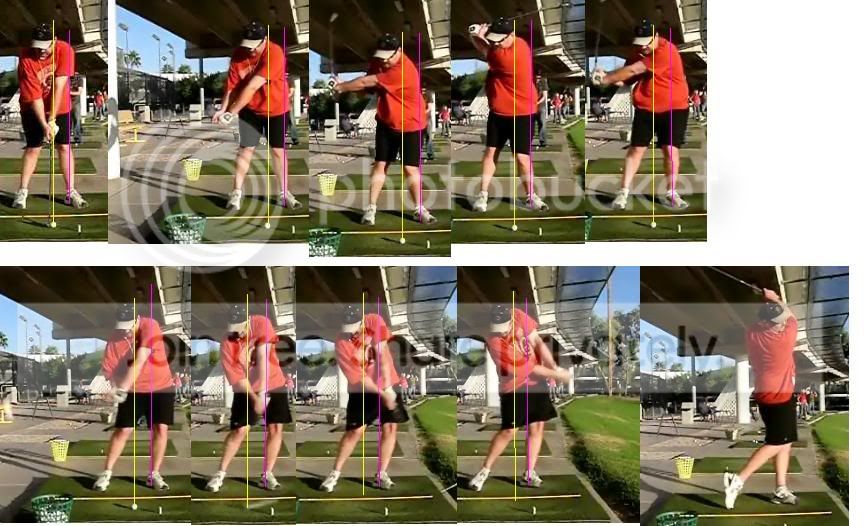 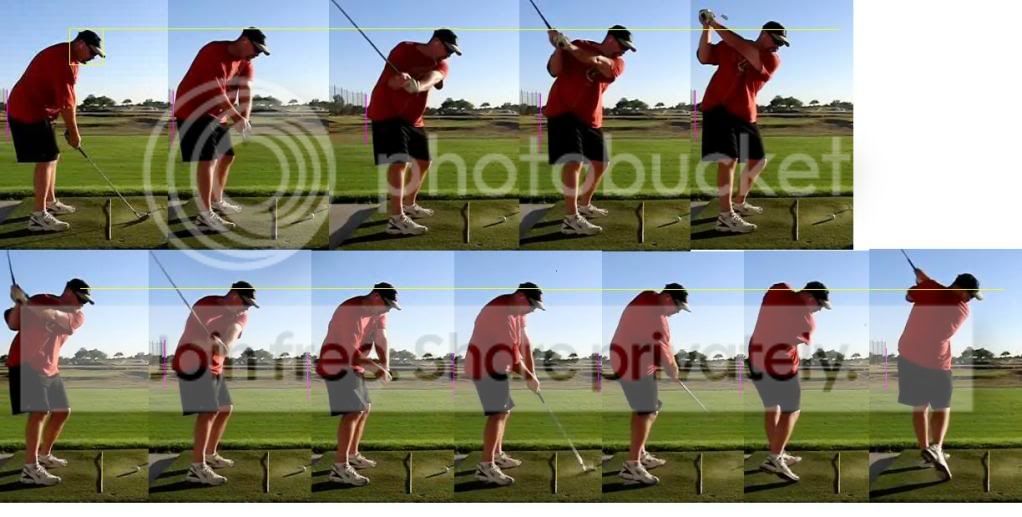 |
Slip Slidin' Away
Quote:
Where do you live? I will be in many parts of the country next year during PGA TOUR events. Maybe we can connect. I'll put up a schedule soon. At least a quasi-schedule! |
Tempe AZ...lots of good golf spots in my neck of the woods.
I got this book today....maybe some stuff that will help me? back to back is the FBR..err make that Waste Management Open and the WGC match play  |
Pivot Problem
Quote:
Do you agree that your Downstroke sliding -- with no turn until post-Impact -- could be a problem? |
Quote:
I found this in 7-16 that may be useful for the issue Quote:
|
gmbtempe,
If you accept advice from a 6 hcp, here's my 5 cents: Maybe you need to practice your footwork. It is your feet that drive the hips. Right hip forward and out - left hip forward and away from the target line. My guess is that you don't use your left thigh to push the left hip away from the target line. This move is very golf-specific. It is a bit like pushing your left foot forward. But since the foot is grounded your hip will move backwards instad. This is an important part of getting the hip to where you want it to be through impact. Back and up to support a good turn through the ball and save your back as well. You can practice it with a club across your neck, holding on each side. Try to get a big and stable shoulder turn. Rotate your upper body with the feet. The hip move is a combination of forward move and rotation, and to a certain extent the left and right hip joints move independant. As soon as you've incubated the left hip back move you should be able to drive and turn your hip to where you want it throught impact - at least without a ball. |
Clearing the Hip Turn Fog
Quote:
Then, some 25 years later, we get the post-humously published 7th edition. Not only did it fail to correct these oversights, it also listed the Slide Hip Turn as the selected Variation of Component #14 in both Basic Stroke Patterns (12-1-0 and 12-2-0). So now, we have a new generation of TGMers who must come to grips with the radical 'Slide' photos being 'what the TGM stroke looks like'. Not to mention that the Slide Hip Turn (or even the Standard and Delayed Hip Turns) is incompatible with the also new Rotated Shoulder Turn Variation as Component #13. Which, itself, is incompatible with both the Standard Pivot (listed Component #12) and the Line Delivery Path (listed Component #23). :crybaby: So, where were we now? Ah, yes: Given the current state of published affairs, what is the correct interpretation of the Downstroke Slide Hip Turn? Leaving your Right Hip in its Backstroke Turn, just get your weight back to your left side, then . . . Turn! :golfcart2: |
Quote:
I'd like to nominate for inclusion in the LBG Hall of Fame in the " Yoda's all time best posts" category of which there are many. I have filed it to my personal LBG file with exclamation marks. Regards Ob PS Yoda , what notations would you recommend we make to our 6th or 7th editions in this regard? |
Quote:
Here is a nice Yoda post from the LBG archives in which is he discusses the Rotated Shoulder Turn. Why would it be listed in the 7th editions Basic Strokes 12-1 and 12-2 I wonder? More importantly I hope Yoda comes back and recommends some notations for our 6th and 7th editions in regard to the Slide Hip turn. http://www.lynnblakegolf.com/forum/s...6209#post26209 Maybe this should be its own thread sorry for the digression. |
Chip Shots
Quote:
1. Standard Hip Turn (10-14-A); not Slide (10-14-B). 2. On Plane Shoulder Turn (10-13-D); not Rotated (10-13-C). 3. Hinge Action (7-10 / Ball Behavior) in Zone Three (9-3 / Ball Control); not in Zone Two (9-2 / Power). More for the posthumous editors: 4. Slide Hip Turn (6th, 7th editions) demands a Delayed (not Zero) Up and Down Turn constraint in 11-14-B. Further, photos 10-14-B #1 and #2 require an explanatory reference to the nonexistent Delayed Turn. Better, a reference to photos 10-14-A #1 and #2 (Standard) with an explanatory note differentiating the employed Sequencing. :smile: |
Quote:
Thats great Lynn When I went to make the notations in my 6th, there were a few already there and in what appear to be your hand! As if you knew my journey would bring me this way at some point. Those photos that accompany the Slide Hip Turn are indeed troubling! Its far easier on the eye and brain to make the necessary notations you recommend to the Standard Hip Turn photos 10-14-A #1 and #2. I have actually crossed out photos 10-14-B, #1 and #2! Thanks for getting back to us on this one, Lynn. |
What an experience, rotating through the shot rather than sliding, so much more power and control of the shot. I never crack 110 on the driver MPH but did several times and averaged 107. I hit 7 straight 5 irons 205 yards onto the range green.
It was like the harder and faster, under control, turn left from the top of my backswing the straighter it went. Great day, thanks all! |
gmbtempe,
Congrats with the progress. The paradox of golf is that it only gets easier the better you get. Quote:
Bring it on! PLEAZZZZZZE! |
Diggin' In the Right Place
Quote:
In lieu of that thinking and writing, most people just 'hit balls'. It takes someone special to make 'hitting balls' meaningful. :salut: |
Quote:
@gmbtempe Regarding the feel for a correct hip action, the easiest image I've found is is setting up with your back just in front of a wall/mirror. When you pivot back, you'll feel your right back pocket at some point touching/swiping the wall (at a point left of it's original position). From the top, keep this point of contact as you turn the left hip towards the wall. This will move your weight onto the left leg and the left hip to a position more forward than at address, but still within the left-foot line. No more danger of sliding. PS, did you ever talk to Greg Smith (GSEM) in Mesa? I'm sure he could help you along the TGM path. |
I had a couple lessons from Greg Smith last summer.
I have had some great success with getting the hips to rotate more and less slide the past couple weeks. I was able to do this with more of a hula hip move, I was able to improve my pivot rotation with a little more weight off my left foot at the top. Its worked well for contact and club speed (I dare say I am almost getting long with the driver). Directional issues persist with the shorter irons (driver and long irons are ok). |
Quote:
Kevin |
Hi Gmb. I have had a great experience with # 3pp.
:idea1: :)
I want to see if I understand your post. Tonight, I simply pretended I was Yoda and Kevin which was interesting. :laughing9 I leaned on my left side, stretched my left arm backwards until parallel to the ground and threw my #3 pp at the back quad of the ball. Earlier in the night I had been simply dropping my right elbow from the top and hitting the ball pretty long and straight :sleepy: :laughing9 . You know how we 21 hcp'ers roll! LMAO Anyway, I suddenly realized that the 20 something kid next to me was not hitting his driver further than me as was the case earlier in the evening. Despite his mightiest torque which made me wince as I watched, our shots were both disappearing at the top of the arc somewhere near the 250 marker in the dusk!:) :king: I tried my 3 and 5 wood, my 7 and 5 iron, all of which seemed to wobble as the shot through the air picking up an extra gear. Way cool. My chips went right where I aimed them and they seemed to pop! But, if I understand your post correctly, by turning my hips and throwing my #3 at the ball, I will have more zip?????:read: Could there really be such a simple way to describe and build a very good golf swing? I am now worried about putting. My pp # 3 will be knocking the ball back to the 100 yard marker! I'm sure the book will have the solution! Patrick pEducated Hands are those that can feel the resistance of motion -- CLUBHEAD lag. If the #3 pressure point is lost then "LAG" cannot be sustained. The hands must control the pivot! Have the #3 pressure point completely replace the CLUBHEAD, take #3 to the ball. The heart and soul of G.O.L.F. Is developing a swing based on the hands. Teach Hinge Action without Body Motion. Quote:
|
| All times are GMT -4. The time now is 11:03 AM. |