You've peaked my curiosity. Please explain how you would use this.
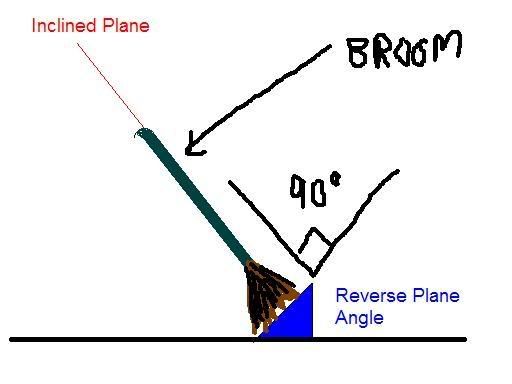
You would sweep the broom along the 'reverse plane board'.
Heres two things for starters...
Throwaway - If you sweep the board, you won't be throwing away the clubhead. It would come into impact like striking a match. Great for teaching people how to not have throwaway.
Plane - If you were to effectively sweep along the board you would have the flat part of bristles of the brush touching the board. You also learn to make this motion along a straight plane line. You wouldn't sweep the imaginary dust from the board with part of the bristles would you? This teaches that you have to be on 'a' plane angle as designated by the lie angle this is what Moe Norman describes as - 'being on the same height'.
You would sweep the broom along the 'reverse plane board'.
Heres two things for starters...
Throwaway - If you sweep the board, you won't be throwing away the clubhead. It would come into impact like striking a match. Great for teaching people how to not have throwaway.
Plane - If you were to effectively sweep along the board you would have the flat part of bristles of the brush touching the board. You also learn to make this motion along a straight plane line. You wouldn't sweep the imaginary dust from the board with part of the bristles would you? This teaches that you have to be on 'a' plane angle as designated by the lie angle this is what Moe Norman describes as - 'being on the same height'.
Wouldn't that encourage "covering" the plane line and not tracing it?
Wouldn't that encourage "covering" the plane line and not tracing it?
Respectfully and with great admiration for the both of you, would the reverse plane angle not encourage a reverse arc? Worse than covering? As ye go back so do ye go up and OUT . As in further OUT than the straight back of a vertical plane which we know as "covering".
Respectfully and with great admiration for the both of you, would the reverse plane angle not encourage a reverse arc? Worse than covering? As ye go back so do ye go up and OUT . As in further OUT than the straight back of a vertical plane which we know as "covering".
Explain 'cover' the plane line as I can think of more than one way you can mean it?
However sweeping along that board is going to produce a straight plane line.
I understand what you are getting at . . . it keeps the club on the plane ANGLE . . . . BUT . . . . the club moves in an Arc right? So why would you want it to stay on the board that long? The club POINTS at the line. It doesn't (or shouldn't) stay on the line.
It would be a good device to keep the person from raising the handle up and shutting the face fast.
I understand what you are getting at . . . it keeps the club on the plane ANGLE . . . . BUT . . . . the club moves in an Arc right? So why would you want it to stay on the board that long? The club POINTS at the line. It doesn't (or shouldn't) stay on the line.
It would be a good device to keep the person from raising the handle up and shutting the face fast.
This doesn't make any sence.
I can only assume by your post that you somehow think I am saying you are sweeping along the board for infinity .
Like the clubhead, the head of that brush travels in an arc. The idea is you just take your normal golf stroke and brush a portion of that board as it travels in this arc.... Not drag it along the entire board !
A straight line is a straight line - the fact it is on a board 90 degrees to the plane angle intended for release doesn't alter the fact. You are still maintaining a straight line relationship to a straight line. All that the board does is make the plane angle and plane line visually easier to see.




 .
. 

 Linear Mode


