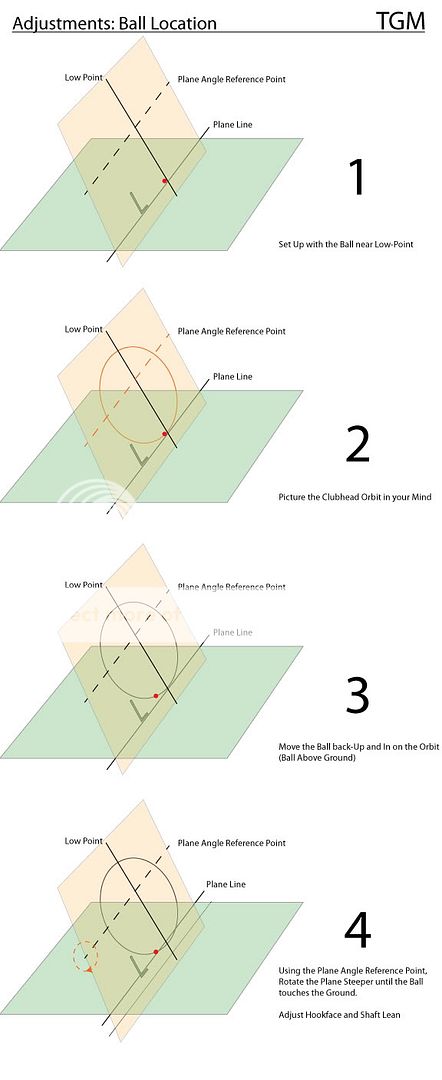
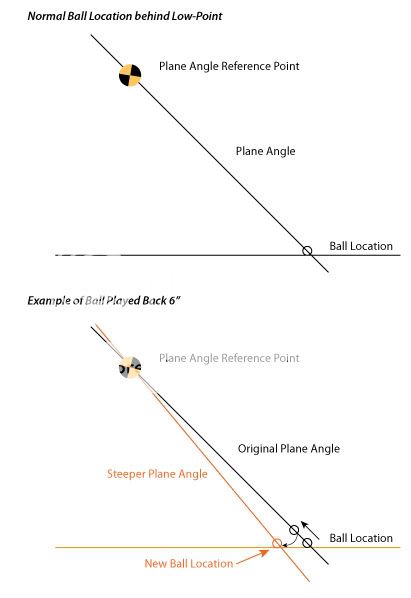
Following is a diagram to help explain Ball Location and it's affect on Plane Angle. Basically, the farther back from Low-Point the Ball is Located, then the Steeper the Plane Angle.
Homer Kelley's method is geometrically correct and allows Low-Point to remain at the Left Shoulder. In addition, it automatically adjusts the Angle of Approach.
Notice that the original Plane Line, inscribed on the surface of the Inclined Plane is still present. Step 4. It's below ground.
---------------------------------------------------------------------------------------------------------------------------------------------------------------------------------------------- Geometry of the Circle:
The implications of these "Alignments" are significant. As the Plane Angle Steepens for any given Club Length, the Club length decreases, which requires increased Hookface (Adjustment), which increases the Clubface Closing Ratio, which corresponds to the wider Angle of Approach of the aft Ball Location.
This means that for any ONE Plane Angle for any given Club, there is only ONE Ball Location that Hinge Action can produce Straight-away Flight without disturbing Low-Point Location.
Plane Angle, Ball Location, Hookface (closing Ratio) are inextricably related. Change one and you must change the other two to produce Straight-Away Ball Flight.
Woh, I have always assumed that when the ball is played further back (up plane) that made the low point further down in the ground but that the plan angle would not change.
Woh, I have always assumed that when the ball is played further back (up plane) that made the low point further down in the ground but that the plan angle would not change.
What if after 3 you lowered your center , left shoulder or whatever to the get the club on the ground? Thereby maintaining the shaft angle, lie angle, plane angle and moving the base line plane line under ground.....which would via address alignment only create a divot?
Place the bottom edge flat on the ground, heel-toe, as possible and square the leading edge to the target while the shaft and face are aligned vertically. Easy, right?
Lean the shaft forward without disturbing the Leading Edge Alignment of square to the Target and level to the ground.
Note that the Shaft Plane has Flattened by a large number of degrees.
If you raise the Shaft to the original plane, then the face will open substantially.
Close the face by rotating the shaft counterclockwise until the leading edge is again, square to the target and level to the ground.
You have learned to change the Hook-face of the Hockey Stick.
Normally, when the shaft is level to the ground on the Backstroke to level to the ground on the follow-through, the face rotates 180 degrees. That means that for about every inch of Clubhead travel, the Clubface closes about one degree (guesstimate).
But, when you change the inherent Hook-face, you change the Clubface Closing Ratio. From parallel to parallel, the Clubface may rotate (close) 220 degrees.
This can accommodate the wider Angle of Approach from Playing the Ball back in your Stance.
In my video of "Right Forearm Participation" I'll demonstrate all of the essential alignments. It's too difficult to explain on paper because you have to see how the Right Forearm Angle of Approach seeks out Low-Point and not the Ball.
Place the bottom edge flat on the ground, heel-toe, as possible and square the leading edge to the target while the shaft and face are aligned vertically. Easy, right?
Lean the shaft forward without disturbing the Leading Edge Alignment of square to the Target and level to the ground.
Note that the Shaft Plane has Flattened by a large number of degrees.
If you raise the Shaft to the original plane, then the face will open substantially.
Close the face by rotating the shaft counterclockwise until the leading edge is again, square to the target and level to the ground.
You have learned to change the Hook-face of the Hockey Stick.
Normally, when the shaft is level to the ground on the Backstroke to level to the ground on the follow-through, the face rotates 180 degrees. That means that for about every inch of Clubhead travel, the Clubface closes about one degree (guesstimate).
But, when you change the inherent Hook-face, you change the Clubface Closing Ratio. From parallel to parallel, the Clubface may rotate (close) 220 degrees.
This can accommodate the wider Angle of Approach from Playing the Ball back in your Stance.
In my video of "Right Forearm Participation" I'll demonstrate all of the essential alignments. It's too difficult to explain on paper because you have to see how the Right Forearm Angle of Approach seeks out Low-Point and not the Ball.
I'm looking forward to the creation and release of that video!
ICT
__________________
HP, grant me the serenity to accept what I cannot change, the courage to change what I can, and the wisdom to know the difference. Progress and not perfection is the goal every day!




 Linear Mode


