...I am now proclaiming that there can be a Perverted Finish Swivel...I don't really care how many years someone has taught something it can be misrepresented...
I thought your demonstration of Finish Swivel was more accurate and concise at Pine Needles than what has been demonstrated after your Canton experience with the Grand Pooh Bah.
For the record, George Preisinger, then Head Professional at the Marietta Country Club in Marietta, Georgia -- not Ben Doyle at Canton -- taught me Swivel Action in 1963. I was 17 years old. Unfortunately, it was not until I got on the phone with Homer Kelley in 1980 that I learned to differentiate Swivel Action (after the Follow-Through) from Hinge Action (during Impact). I was 34 years old.
In between I hit some 800,000 practice balls. And that's a conservative number. There were many good shots, but my understanding was incomplete and it showed. What a waste.
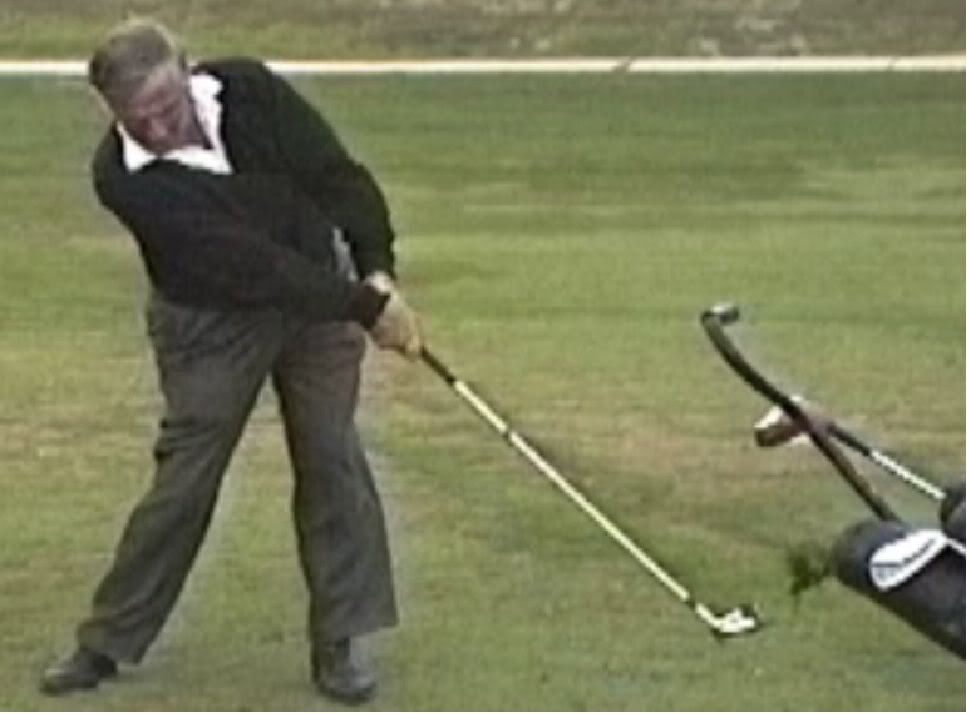
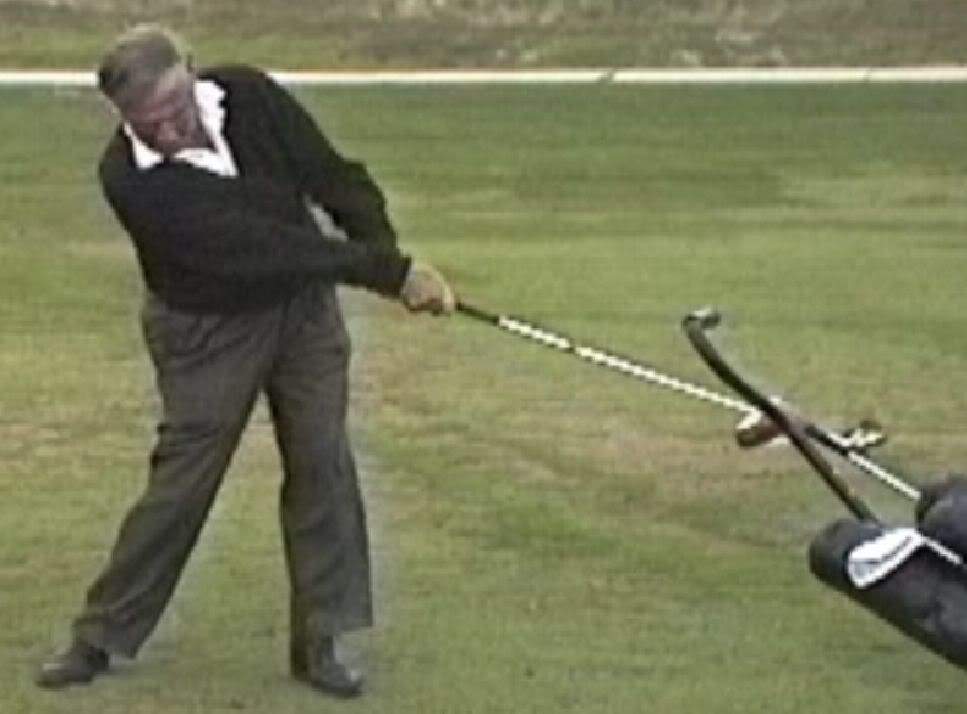
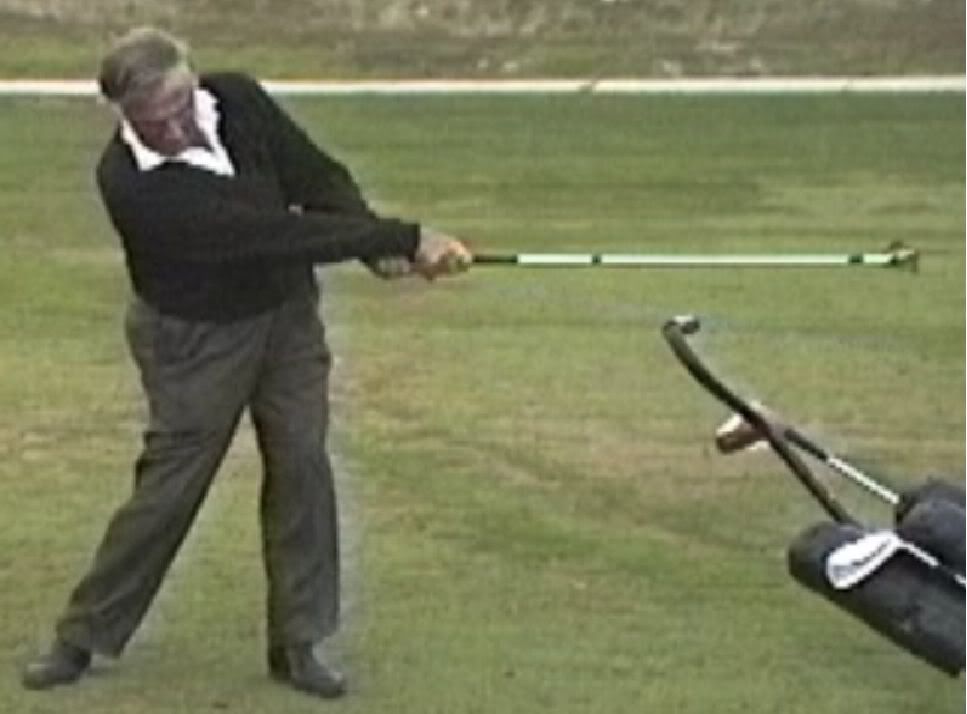
And now, 25 years and probably another 800,000 practice balls later, I think I know the difference between the two. I have described that difference clearly in countless posts -- including those most recent above -- and now have illustrated it in both still sequence and video.
The only difference between the Hinge Action and Finish Swivel you see in this video -- both, by the way, executed with a Strong Single Action Grip (Wristcock Only, no Wrist Bend) -- and the ones I photographed and sent to Homer Kelley in 1982 and later still those demonstrated in the first 'night-time' videos (late 2004) now on this site -- is the camera angle. And, at least according to my own understanding...
Unfortunately, it was not until I got on the phone with Homer Kelley in 1980 that I learned to differentiate Swivel Action (after the Follow-Through) from Hinge Action (during Impact).
I am interested on your opinions on the following perception:
Many amateurs have the idea that the trick is to swivel during impact. Impact becomes a blur of uncocking, rolling and swiveling.
In order to hit it further the selected option is to swivel more during impact. Since an over-swiveling during impact will effectively hood the face (de-loft and close) this may result in occasional longer shots (strong draws or pull-hooks). Even though the shots are likely to go all over the place it will become hard to convince the golfer that he should not (effectively) de-loft as much in order to hit it farther.
So how can it be that a (perceived) de-lofting will actually produce longer shots?
Tentative answer: Premature (over-)swiveling during impact will indirectly:
- Make the right shoulder rise
- Destroy the shoulder plane
- Cause round-housing
- Terminate the rotation and cause the hips to slide forward instead of rotating to face the target
- Unbending the right wrist
All-in-all: The faulty swivel action will distort the swing and eliminate many of the factors that enable the golfer to add more power to his swing.
At least in my case it did.
__________________
When James Durham recorded 94 at the Old Course at St Andrews in 1767, he set a course record that lasted 86 years. Golf: A curious sport whose object is to put a very small ball in a very small hole with implements ill desiged for the purpose - Sir Winston Churchill
Based on the video the uncocking, hinge and swivel must be precise. It becomes clear why the stationary head is necessary.
Sway slightly and the uncocking is to early or to far behind the ball.
I must not Know what I'm doing.... because if the clubface should look to the ground with the Correct Finish Swivel..then I really just don't know anything about TGM....So...I will continue my learning...Onward!!!
Last edited by annikan skywalker : 04-26-2006 at 04:48 PM.
/////////////////////////////////////////////////
Mr. 12 Piece... I suppose grip could be a factor here.
Not sure why Mr. Doyle wants the FACE pointing to the ground like this, but from talking with people that have been around him... this is what he wants.
I remember Mr. Yoda saying once in a situation similar to this... that just because the ball is gone does not mean that this(or similar) position is not important. I believe he said something about "a precision destination."
This is part of the "landing" of the golf stroke. You want a smooth landing. If the brain knows you are going to crash land, it will do something beforehand to prepare for that crash. Sooo... you better know how to "land." This idea came from Mr. Bleckley, who was/is associated with Mr. Kelnhofer G.S.E.D..
I would suspect to be geometrically correct the club should swivel back on plane after contact (thus no under or over swivel). Just as it swiveled on plane on the back swing.
I would suspect to be geometrically correct the club should swivel back on plane after contact (thus no under or over swivel). Just as it swiveled on plane on the back swing.
I agree; you should ideally be re-planing the clubshaft and clubface after impact so it mirrors the downstroke.
Mr. 12 Piece... I suppose grip could be a factor here.
Not sure why Mr. Doyle wants the FACE pointing to the ground like this, but from talking with people that have been around him... this is what he wants.
.....................................
First, whatever your views on the degree of swivel, there should be little argument for how important, and how lacking, rotation is for most players.
It is the single greatest bit of info I learned from reading Hogan's 5 Lessons.
Rotation point.
That said - I'm right there with Lynn - He learned the difference between hinge and swivel from Homer at 34. I learned it from Lynn a bit over a year ago at OCN (at about the same age).
The clearest way to 'feel' the difference is to get a true horizontal hinge action, which 'feels' very level. This combined with the straight line motion of the right arm (hitting or swinging, active or passive).
As for perverted or not, I would suggest the root issue is the clubface rotation around the sweet spot, not the hosel.
If #3 Accum is zero'd out, you wouldn't see this 'perversion' - but if you have a fair bit of #3, you will.
Grip type is certainly a factor as well.
__________________
"Support the On Plane Swinging Force in Balance"
"we have no friends, we have no enemies, we have only teachers"
Simplicity buffs, see 5-0, 1-L, 2-0 A and B 10-2-B, 4-D, 6B-1D, 6-B-3-0-1, 6-C-1, 6-E-2




 Linear Mode


