Hey man . . . could you give an explanation of your practice routine for each area of the game that you have outlined in the spreadsheet? Basically how you go about your business and how long it to for you to reduce your handicap from 7.8 to 2?
You rock dude!
Here is my explanation of my practice log. In this excel spread sheet I have 4 different pages. I have 2 days of a full practice session, and 2 days of a "half" practice session. Each day essentially has the same drills, I just alter the distances and my number of reps.
I must also note that I use an extensive amount of video to help with setup and analysis of my swing. I will very often have a camera setup with a laptop out on the range. I setup the laptop so that it is displaying the live video feed. I will then get into my setup position and then verify my setup by moving my eyes to the laptop to see how I look. This has helped my posture IMMENSELY!!!! I will also record several swings while on the range and then review them to see how it looks. Immediate video feedback is HUGE!!!
Putting 1) Touch drill to tees.
I pick one spot near the edge of the putting green. This is where I stroke each putt from. I then proceed to step off the distances that I am going to be hitting to that day and place a tee in the ground. I always walk off my putts on the course - so this is a very valuable drill for touch on medium to long putts for me. My distances that I am putting to are measured in steps and not in feet. I take "normal" steps here that are about 2.5 feet each.
I have 8 balls with me. I randomly hit putts to each tee. If my putt finishes within 2 feet of the tee, I mark an 'X' in the box. My goal is to have as many as possible finish in that 2 foot circle. After my first 8 putts (1 to each distance), I 'X' the putts that finished within 2 feet, collect the balls, and stroke my next 8 putts. I always vary distance and I never simply "go up or down the distance ladder". I do this 5 times on a full practice day (40 total putts).
2) Fine touch space drill
I place a tee in the ground at my starting point. I then place a tee in the ground 2 steps away and also another tee at 20 steps away (You need a bunch of balls for this drill). I start by hitting my first putt as close as possible to the tee that is 2 steps away. I then try and hit my next putt as close as possible to the first putt, but just past it. I keep doing this all the way out to 20 steps. My score is the number of balls that I can fit between 2 and 20 steps. If I can fit 25 balls in that space - my score is 25. There is a catch though!! If I am unable to hit a ball past the previous ball, I subtract 2 from my overall score for each time this happens.
3) Full Routine
I simply hit 10 putts from different distances utilizing my full pre-putt routine. I track the number of putts made and also the number of putts that finish within 2 feet of the hole. I mark an M for made and an X if I missed but it finished within 2 feet.
4) 10 ft putts on aimline with putter clip.
I built my own "aimline". I use wooden shishkabob skewers that you can buy at any grocery store. I attached thick string to the top of each shiskabob. I hit putts from 10 feet away on as level a spot as I can find. I also use putter clips from Dave Pelz to help me work on center face contact.
I hit 25 total putts and I track the number of putts that I made and also the number of putts that hit the prongs on the putter clips and veered violently offline.
5) Clock drill
I will find a gently sloping hill and place 12 balls around the hill. I will place 4 balls on a straight line at the 12 o'clock, 3 o'clock, 6 o'clock, and 9 o'clock position. These balls are on a straight line at 3 feet, 4 feet, 5 feets, and 6 feet away from the hole. Looks like this:
.
.
.
.
. . . . O . . . .
.
.
.
.
I will pick one of the lines, and hit all 4 balls from each. I place an x in the box for each putt that I make.
6) Sloping short putts
For this drill, I try and find a hole that has a lot of slope around it. Just like the above drill, I have 4 lines of 5 balls around the hole with one line being left-to-right putts, one line being right-to-left putts, one line being straight uphill, and the final line being straight downhill putts. The balls are placed 3, 5, 7, 9, and 11 FEET away from the hole.
I do one line at a time and record with an 'X' which putts I made.
7) 3 foot drill
I stroke 20 putts in a row from 3 feet and record how many I made.
Chipping
This is pretty easy. I have several pieces of black rubber that I cut out into 4 inch circles. I place the pieces of rubber at 5, 10, 15, 20, and 25 steps onto the green. I then go to a spot that is 2 steps off the green (2 steps from the fringe). I hit a chip to each distance, always varying my distance and never going "up the ladder". I record if the chip finished within 5 feet, and I also record what club I used. I always vary what clubs I am using to chip with. I believe this really helps to promote feel.
I do this drill from 2, 5, 10, and 15 steps off the green. I hit 4 balls to each distance. 20 chips per "station". 80 total chips.
Pitching
For this I walk off on the range distances of 30-70 yards at 10 yard intervals. I use small orange cones that you can buy at any sporting goods store. Your best bet is small soccer cones, they are about 5-6 inches wide and only a few inches high. They are small enough that I keep them right in the bag.
I then hit a shot to each distance and never going up the ladder. I will hit shots from 30yds, 60yds, 40yds, 70yds, and 50yds. I will repeat this pattern 10 times for 50 total swings. I record how many shots land within a 10 foot circle after each rep. I also record what club I used that day. I will vary from 60* wedge, 56* wedge, 52* wedge, PW and 9I.
Bunker play
Again using the orange cones, I set up cones at 5, 10, 15, 20, and 25 STEPS away from the edge of the bunker. I will hit 4 shots to each distance, recording how many land within 10 feet.
I then hit full swings from the bunker. I hit 12 total shots using 4 different clubs. I hit 3 balls with each club. I simply record whether or not I made good contact. You will be amazed how confident you will get on full swing bunker shots after you start working on them. I no longer fear a full swing bunker shot. I used to hit them fat all the time and would advance the ball half the distance I wanted to. Not anymore!
Full Swing
"Target box"
When I do this, I am hitting 5 balls each with alternating clubs. I will hit 4 or 5 balls in a row to a specific target using the same club and record if I hit with a reasonable distance of my target. When hitting 3 wooods in this drill, I always hit them off the turf.
"Alignment box"
I always have the video camera on for this. I use a PVC pipe T-square for alignment. I use the camera to check setup. I alternate clubs and hit 5 balls with each club. I will generally record and review 2 or 3 swings during this portion of my practice. I will hit 4 or 5 balls in a row to a specific target using the same club and record if I hit with a reasonable distance of my target. When hitting 3 woods in this drill I always tee them up.
"Wedge Work box"
I will hit 8 full shots with each of my wedges to specific targets. I vary targets with each shot. I will record if I hit within a reasonable distance of my intended target.
"Tee shot work"
I will hit 10 balls with my driver to an imaginary fairway and record how many finished in the fairway. I do this also with my 3 wood and my hybrid 3-iron and record number of fairways hit. (I only hit 5 balls with my 3 iron)
"Play front or back nine"
Using my full pre-shot routine, I will play my home course's front or back nine. I will hit my tee shot, guess where it ended up, and then hit approach shots. I will record how many "good shots" I hit.
The thing I find most frustrating about golf is everytime you think you have fixed something it rears its ugly head again.
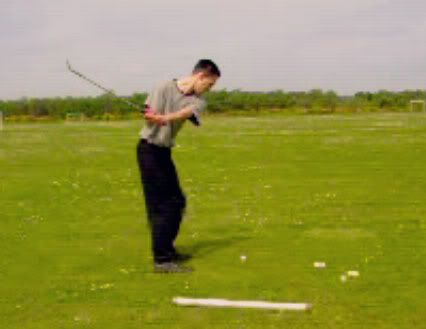
I mean look at this !
This is dreadful! I do get it back close to the turned shoulder plane on the downstroke but this is what ive been doing since a kid! - Last year I had thought it was gone forever.... Took a video yesterday for first time this year and guess whats back ! - it was a pretty nice shot though.... 5 yard draw...lol
I believe many/most people are not practicing well. They may think they are, but often are not very close to doing what they want to do. They may have the correct information, but they simply are not doing what they think they are doing.
Solution... they need to be monitored while they practice. If the student gets the correct information, then is monitored, at least some, during each and every practice session... he will improve, and probably improve drastically. He won't be able to practice wrong.
Many tour players do this. Nearly every time they practice, they have their teacher, or caddie, or someone they trust watching.
If you know you have good information, but are not improving... try to figure out a way to do what I'm suggesting. Eventually, after a sound technique is learned, the player can gradually be reduced off this, until he is monitored less frequently.
Monitoring myself on video nearly every time I go to the range has been a HUGE help for me.
Here is my explanation of my practice log. In this excel spread sheet I have 4 different pages. I have 2 days of a full practice session, and 2 days of a "half" practice session. Each day essentially has the same drills, I just alter the distances and my number of reps.
Stickner . . . In my opinion you have made an invaluable contribution to this forum and it should be commended. You should be proud to have the discipline it take to follow such an organized systematic approach to improvement. I think you have the template down but the question for most people would be do they have the self discipline to follow it?
Questions . . .
How many days a week did you/do you practice? How much time do you devote in a session? Do you go through the entire long-game, chipping, pitching, putting drills each practice session?
Here is my explanation of my practice log. In this excel spread sheet I have 4 different pages. I have 2 days of a full practice session, and 2 days of a "half" practice session. Each day essentially has the same drills, I just alter the distances and my number of reps.
I must also note that I use an extensive amount of video to help with setup and analysis of my swing. I will very often have a camera setup with a laptop out on the range. I setup the laptop so that it is displaying the live video feed. I will then get into my setup position and then verify my setup by moving my eyes to the laptop to see how I look. This has helped my posture IMMENSELY!!!! I will also record several swings while on the range and then review them to see how it looks. Immediate video feedback is HUGE!!!
Putting 1) Touch drill to tees.
I pick one spot near the edge of the putting green. This is where I stroke each putt from. I then proceed to step off the distances that I am going to be hitting to that day and place a tee in the ground. I always walk off my putts on the course - so this is a very valuable drill for touch on medium to long putts for me. My distances that I am putting to are measured in steps and not in feet. I take "normal" steps here that are about 2.5 feet each.
I have 8 balls with me. I randomly hit putts to each tee. If my putt finishes within 2 feet of the tee, I mark an 'X' in the box. My goal is to have as many as possible finish in that 2 foot circle. After my first 8 putts (1 to each distance), I 'X' the putts that finished within 2 feet, collect the balls, and stroke my next 8 putts. I always vary distance and I never simply "go up or down the distance ladder". I do this 5 times on a full practice day (40 total putts).
2) Fine touch space drill
I place a tee in the ground at my starting point. I then place a tee in the ground 2 steps away and also another tee at 20 steps away (You need a bunch of balls for this drill). I start by hitting my first putt as close as possible to the tee that is 2 steps away. I then try and hit my next putt as close as possible to the first putt, but just past it. I keep doing this all the way out to 20 steps. My score is the number of balls that I can fit between 2 and 20 steps. If I can fit 25 balls in that space - my score is 25. There is a catch though!! If I am unable to hit a ball past the previous ball, I subtract 2 from my overall score for each time this happens.
3) Full Routine
I simply hit 10 putts from different distances utilizing my full pre-putt routine. I track the number of putts made and also the number of putts that finish within 2 feet of the hole. I mark an M for made and an X if I missed but it finished within 2 feet.
4) 10 ft putts on aimline with putter clip.
I built my own "aimline". I use wooden shishkabob skewers that you can buy at any grocery store. I attached thick string to the top of each shiskabob. I hit putts from 10 feet away on as level a spot as I can find. I also use putter clips from Dave Pelz to help me work on center face contact.
I hit 25 total putts and I track the number of putts that I made and also the number of putts that hit the prongs on the putter clips and veered violently offline.
5) Clock drill
I will find a gently sloping hill and place 12 balls around the hill. I will place 4 balls on a straight line at the 12 o'clock, 3 o'clock, 6 o'clock, and 9 o'clock position. These balls are on a straight line at 3 feet, 4 feet, 5 feets, and 6 feet away from the hole. Looks like this:
.
.
.
.
. . . . O . . . .
.
.
.
.
I will pick one of the lines, and hit all 4 balls from each. I place an x in the box for each putt that I make.
6) Sloping short putts
For this drill, I try and find a hole that has a lot of slope around it. Just like the above drill, I have 4 lines of 5 balls around the hole with one line being left-to-right putts, one line being right-to-left putts, one line being straight uphill, and the final line being straight downhill putts. The balls are placed 3, 5, 7, 9, and 11 FEET away from the hole.
I do one line at a time and record with an 'X' which putts I made.
7) 3 foot drill
I stroke 20 putts in a row from 3 feet and record how many I made.
Chipping
This is pretty easy. I have several pieces of black rubber that I cut out into 4 inch circles. I place the pieces of rubber at 5, 10, 15, 20, and 25 steps onto the green. I then go to a spot that is 2 steps off the green (2 steps from the fringe). I hit a chip to each distance, always varying my distance and never going "up the ladder". I record if the chip finished within 5 feet, and I also record what club I used. I always vary what clubs I am using to chip with. I believe this really helps to promote feel.
I do this drill from 2, 5, 10, and 15 steps off the green. I hit 4 balls to each distance. 20 chips per "station". 80 total chips.
Pitching
For this I walk off on the range distances of 30-70 yards at 10 yard intervals. I use small orange cones that you can buy at any sporting goods store. Your best bet is small soccer cones, they are about 5-6 inches wide and only a few inches high. They are small enough that I keep them right in the bag.
I then hit a shot to each distance and never going up the ladder. I will hit shots from 30yds, 60yds, 40yds, 70yds, and 50yds. I will repeat this pattern 10 times for 50 total swings. I record how many shots land within a 10 foot circle after each rep. I also record what club I used that day. I will vary from 60* wedge, 56* wedge, 52* wedge, PW and 9I.
Bunker play
Again using the orange cones, I set up cones at 5, 10, 15, 20, and 25 STEPS away from the edge of the bunker. I will hit 4 shots to each distance, recording how many land within 10 feet.
I then hit full swings from the bunker. I hit 12 total shots using 4 different clubs. I hit 3 balls with each club. I simply record whether or not I made good contact. You will be amazed how confident you will get on full swing bunker shots after you start working on them. I no longer fear a full swing bunker shot. I used to hit them fat all the time and would advance the ball half the distance I wanted to. Not anymore!
Full Swing
"Target box"
When I do this, I am hitting 5 balls each with alternating clubs. I will hit 4 or 5 balls in a row to a specific target using the same club and record if I hit with a reasonable distance of my target. When hitting 3 wooods in this drill, I always hit them off the turf.
"Alignment box"
I always have the video camera on for this. I use a PVC pipe T-square for alignment. I use the camera to check setup. I alternate clubs and hit 5 balls with each club. I will generally record and review 2 or 3 swings during this portion of my practice. I will hit 4 or 5 balls in a row to a specific target using the same club and record if I hit with a reasonable distance of my target. When hitting 3 woods in this drill I always tee them up.
"Wedge Work box"
I will hit 8 full shots with each of my wedges to specific targets. I vary targets with each shot. I will record if I hit within a reasonable distance of my intended target.
"Tee shot work"
I will hit 10 balls with my driver to an imaginary fairway and record how many finished in the fairway. I do this also with my 3 wood and my hybrid 3-iron and record number of fairways hit. (I only hit 5 balls with my 3 iron)
"Play front or back nine"
Using my full pre-shot routine, I will play my home course's front or back nine. I will hit my tee shot, guess where it ended up, and then hit approach shots. I will record how many "good shots" I hit.
This sounds like great "playing" but is it "practice"? It sounds like a fantastic way to check if your "practice" is working
This sounds like great "playing" but is it "practice"? It sounds like a fantastic way to check if your "practice" is working
Show me a golfer that has too many swing thoughts, and I'll show you a golfer that simply can't hold up under pressure. The guy that learns to get the ball in the hole is the guy that wins.
Show me a golfer that has too many swing thoughts, and I'll show you a golfer that simply can't hold up under pressure. The guy that learns to get the ball in the hole is the guy that wins.
And you have given us the organized template to follow in how to do just that . . . GET THE DAMN BALL IN THE HOLE!
At the end of the day you have to write down a number . . .




 It sounds like a fantastic way to check if your "practice" is working


 Linear Mode


