....nothing to do with moving passive central body mass closer to the left leg...
Jeff.
In relation to the link you refer?
__________________
If you cannot take the shoulder down the clubshaft plane, you must take along some other path and add compensations - now, instead of one motion to remember, you wind up with at least two!
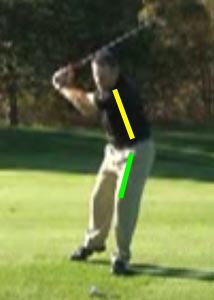
This is his alignment when he starts the downswing. His spine and upper torso are angled to the right (yellow line) while his thighs (green line) are angled to the left. That is the critical body alignment that allows for an effective downswing pivot action. How does he start the downswing? Not by a lower body movement (shift-rotation of the hips). He states that he simply lets the momentum of the club produce the downswing. Now whether he pulls the club down with his hands, or whether he starts the downswing with a right shoulder throw action, the end-result on his lower body can be clearly seen in the video. His left knee moves left-laterally and the left thigh rotates counterclockwise (while he puts increasing weight on the left foot) => that causes the pelvis to rotate to the left/backwards. That lower body move is exactly what Hogan does in his downswing (except that Hogan initiates the downswing with a lower body movement).
How does Shawn Clement get into the proper alignment position to start his downswing. A key element is that he starts at address with rightwards spinal tilt. Then he pulls the right hip back during the backswing and that causes the pelvis to shift left-laterally while the head (and therefore upper spine) is kept stationary. In particular, as a result of the pelvic shift movement left-laterally, the lumbar spine moves left-laterally while he keeps his head and upper spine stationary. That produces the rightwards-tilted spine, rightwards tilted torso and stable head position (yellow line). I think that this skeletal alignment is the critical part of the equation. The fact that his central mass around his navel moves leftwards in the backswing (as a result of the left-lateral pelvic movement) is incidental. In other words, I agree with VJ's belief that the key element in Hogan's backswing is the angling of the right thigh to the left, which pushes the pelvis left-laterally during the backswing, so that Hogan has the reverse-K look exemplified by Shawn Clement in that photographic image. However, any weight shift is incidental - as Shawn Clement stated in his one-leg swing video. He makes no attempt to shift weight. He merely adopts the "correct" body alignments necessary to execute a fluid downswing over a braced lead leg.
He has 2 feet touching the ground (i would like to see him hit it "a tad further" truly on one leg ).
He has a weight shift (within the contact surface (heel and sole) area of the left foot and probably onto the right toe...despite what he says)
He , very importantly, has a pre-turned right hip... he would not hit a good shot if that right toe were touching the ground parallel to target line.
He avoids round-housing by placing the right foot behind him. Hogan achieved the same by moving his hips towards target before he pulled the right elbow down...avoiding collision.
Easier to collide right elbow and right hip if you try and slide and pull down at the same time...maybe...
This is his alignment when he starts the downswing. His spine and upper torso are angled to the right (yellow line) while his thighs (green line) are angled to the left. That is the critical body alignment that allows for an effective downswing pivot action. How does he start the downswing? Not by a lower body movement (shift-rotation of the hips). He states that he simply lets the momentum of the club produce the downswing. Now whether he pulls the club down with his hands, or whether he starts the downswing with a right shoulder throw action, the end-result on his lower body can be clearly seen in the video. His left knee moves left-laterally and the left thigh rotates counterclockwise (while he puts increasing weight on the left foot) => that causes the pelvis to rotate to the left/backwards. That lower body move is exactly what Hogan does in his downswing (except that Hogan initiates the downswing with a lower body movement).
How does Shawn Clement get into the proper alignment position to start his downswing. A key element is that he starts at address with rightwards spinal tilt. Then he pulls the right hip back during the backswing and that causes the pelvis to shift left-laterally while the head (and therefore upper spine) is kept stationary. In particular, as a result of the pelvic shift movement left-laterally, the lumbar spine moves left-laterally while he keeps his head and upper spine stationary. That produces the rightwards-tilted spine, rightwards tilted torso and stable head position (yellow line). I think that this skeletal alignment is the critical part of the equation. The fact that his central mass around his navel moves leftwards in the backswing (as a result of the left-lateral pelvic movement) is incidental. In other words, I agree with VJ's belief that the key element in Hogan's backswing is the angling of the right thigh to the left, which pushes the pelvis left-laterally during the backswing, so that Hogan has the reverse-K look exemplified by Shawn Clement in that photographic image. However, any weight shift is incidental - as Shawn Clement stated in his one-leg swing video. He makes no attempt to shift weight. He merely adopts the "correct" body alignments necessary to execute a fluid downswing over a braced lead leg.
Jeff.
Jeff . . . you make some good points man. In addition to your pelvis spine deal . . . the geometry makes sense. Pivot lag built in . . . axis tilt and left shoulder and low point location work.
This dude has a nice video about his interpretation of Hogan's transition as well. Worth taking a look at.
That's a terrific demonstration of Hogan's late backswing left-lateral hip shift movement. It gives one the impression that the greatest advantage of the "move" is that it starts to replant weight onto the left foot and thereby brace the left leg, so that it can support the downswing pivot thrust action that is going to happen a fraction-of-a-second later when the downswing starts in earnest. I think that Hogans' "timing" and fluidity of movement is his greatest swing characteristic.
Regarding Shawn Clement.
He must transfer weight to the right foot at the start of the backswing if he is moving his arms across his body to the right. However, any weight shift is incidental and not a deliberate action. His general intention is to have a centralised swing that is rotary in nature. That's how I think of Hogan's swing - it's a right-centralised rotary swing with no deliberate intent to shift weight in a lateral direction. A key element in a rightwards-centralised swing is that there is rightwards spinal/torso tilt during the downswing, and one couldn't swing effectively with leftwards spinal tilt or with a head/spine axis that shifts left-laterally during the downswing. I like Shawn Clement's concept about bracing the left side with a rightwards spinal tilt. Here is link to another Shawn Clement video lesson that emphasises this point of bracing the left side via the biomechanical technique of rightwards spinal tilt.
Note that when he "braces his tilt" he juts his left pelvis in a left-lateral direction. Hogan did that same maneuver, but he did it in the his late downswing when he shifts his pelvis left-laterally.
In his one-leg swing video, Shawn Clement stresses the importance of having the right toe flared outwards so that the right hip can turn easily backwards during the backstroke. That allows the arms to move inside along an inside track, and get "deep" without any need for any deliberate independent arm-movements (independent of the overall directional movement of the shoulder sockets).
I personally think that, as a side-issue, that his lack of coiling (due to a free right hip clearing action in the backswing) demonstrates that coiling the upper body against the resistance of a limited lower body turn is not a necessary/obligatory requirement for very effective swing power.
This has developed into an excellent thread...thanks Jeff, KOC & Bulldog for the great material you have created and presented in this thread. The work is first class.
That's a terrific demonstration of Hogan's late backswing left-lateral hip shift movement. It gives one the impression that the greatest advantage of the "move" is that it starts to replant weight onto the left foot and thereby brace the left leg, so that it can support the downswing pivot thrust action that is going to happen a fraction-of-a-second later when the downswing starts in earnest. I think that Hogans' "timing" and fluidity of movement is his greatest swing characteristic.
Regarding Shawn Clement.
He must transfer weight to the right foot at the start of the backswing if he is moving his arms across his body to the right. However, any weight shift is incidental and not a deliberate action. His general intention is to have a centralised swing that is rotary in nature. That's how I think of Hogan's swing - it's a right-centralised rotary swing with no deliberate intent to shift weight in a lateral direction. A key element in a rightwards-centralised swing is that there is rightwards spinal/torso tilt during the downswing, and one couldn't swing effectively with leftwards spinal tilt or with a head/spine axis that shifts left-laterally during the downswing. I like Shawn Clement's concept about bracing the left side with a rightwards spinal tilt. Here is link to another Shawn Clement video lesson that emphasises this point of bracing the left side via the biomechanical technique of rightwards spinal tilt.
Note that when he "braces his tilt" he juts his left pelvis in a left-lateral direction. Hogan did that same maneuver, but he did it in the his late downswing when he shifts his pelvis left-laterally.
In his one-leg swing video, Shawn Clement stresses the importance of having the right toe flared outwards so that the right hip can turn easily backwards during the backstroke. That allows the arms to move inside along an inside track, and get "deep" without any need for any deliberate independent arm-movements (independent of the overall directional movement of the shoulder sockets).
I personally think that, as a side-issue, that his lack of coiling (due to a free right hip clearing action in the backswing) demonstrates that coiling the upper body against the resistance of a limited lower body turn is not a necessary/obligatory requirement for very effective swing power.
Jeff.
Jeff . . . nice post. I think that Clemments has some very nice pieces. Axis tilt is certainly something that you want in the swing. But the question is where when and how much? I think his recommendation of axis tilt in the set up works for HIS pattern. Since he swing his arms high on both sides he needs tilt early to keep them from flying over the plane. He gets this by a. cheating it in the set and b. by adding more tilt in the backstroke and c. more by more hip slide in his transition. Works well with high hands but maybe not if the hands are lower and deeper.
That being said . . . I think he NAILED the Hogan move. Very nice. And anybody that talks about staying tilted with a centered head can be on the A-Team . . . period. He also has some nice videos on his site relating golf to other dynamic motions . . . at times I feel like he may try to sell me some weight loss products or some home cleaning supplies . . .but his information is well thought out.
Although I like Shawn Clement's video lessons, he speaks in simplistic terms and uses vague terminology (eg. gravity, momentum) to describe forces powering the golf swing. He would be able to offer much better advice if he studied and understood TGM.
Jeff, it is not my theory that when the hips are turned back to
the left, that this tightens the muscles of the hips and the
shoulders. This was Hogan's theory. I posted what he said.
I do agree with his findings.
I watched the video from Shawn Clements. I certainly agree
with his braced tilt. His one leg drill was very good. Note that
his center of mass was over the pivot axis before starting down.
I do not agree with his video on the free fall of the arms. It
appears that he is using a shift with turn as he dropps the arms.
He says that he "pushes" through the ball. I think as a swinger
that he should be pulling the arms through the ball.
Hogan states, on pg 93, of the five lessons, that the arms
are carried down by the movement of the hips. V.J. pieced
together a particular swing in which Hogan rotated his hips
100 degrees in 0.18/Sec. V.J. went on to say that, "It is
evident that this type of speed is correlated to having the
the center of mass over an axis of rotation. Sure I believe
in axis tilt. Note from Shawn's picture that his left shoulder
appears to be even with the ball even with the axis tilt. This
is a conerstone of V.J.s findings. If you try to use a shift with
turn, as in the arms drop video, I do not think that you can
make the moves that V.J. describes. I also agree with Yodas
premis that you set the accumulators with the hip movement
and whirl the gyroscope.
Your work on the subject is very good. I certainly appreciate
your time and effort. After watching the video, I can see
where you are coming from.


 ).
).


 Linear Mode


