I understand your idea of the COG of the clubhead and I have no problem understanding the lathe example. I also can understand Toolish's comment about how the hosel twists around the COG of the clubhead when one twirls the vertical club. I don't disagree with all these points. I can even agree that PP#3 traces the SPL through the sweetspot when the clubhead in the immediate vicinity of ball impact (when the clubhead has rotated so that there is a small, but significant, difference between the sweetspot plane and the clubshaft plane).
What I cannot understand is what relevance these "facts" really have with respect to the golf swing. I never sense the hosel rotating around the sweetspot-PP#3 axis in a golf swing. I can only sense the clubface closing and opening, and it "feels" like the clubface is rotating around the clubshaft axis. It is my present belief that the reason why I harbor this "belief" is that I presently believe that natural human biomechanical actions dictate opening of the clubface opening in the backswing and clubface closing in the downswing/followthrough, and that these actions have no necessary causal connection with the idea of there being a axis between the sweetspot and PP#3. However, I am open to new insights.
I can understand why human beings open the clubface in the backswing, because the left wrist has to remain flat and the left arm has to rotate clockwise in the backswing to get the left hand to the usual end-backswing position. However, I do not know whether the Robot-Fit type machine also rotates the clubface that much in the backswing, and if it does, how it gets the clubface to rotate back to square by impact if the wrist joint simply consists of two enmeshing gears that operate passively in response to centrifugal release forces.
I think the sample of a center shafted club would be great tool for analysis, especially in such a discussion.
So, if we swing such a club without changing anything else, would it mean that we would hit the ball dead center of the face = where the shaft is attached behind...or...would we toe the ball each time ?
I'm not suggesting anything is constant in a real golfer... but yes.. the gears make the rate proportional to the arm rotation angular velocity and.. its not my theory gone bad .... its yours Yodasluke.
TGM:
10-22-A FULL SWEEP This pattern starts the Loading Action at the beginning of the Backstroke and smoothly and evenly accelerates the Club ahead of the Hands so as to arrive in position at the intended Assembly Point.
10-24-A FULL SWEEP RELEASE This procedure Triggers the Release at the Start Down by either the Hand Throw or Right Arm Throw (10-20) Non-Automatic Trigger Types. All the employed Accumulators slowly and evenly straighten and the Clubhead slowly and evenly accelerates through Impact per 2-N. See 6-C-2-B.
6-N-0 RELEASE TYPES There are two Release Types – the Automatic and the Non-Automatic – which are paired with a Release Point per 10-24.
The two Types differ in that:
1. The Automatic is triggered mechanically (10-20) – the Non-Automatic is a deliberate muscular manipulation
2. The Automatic drives the Hands at the Aiming Point (6-E-2) – the Non-Automatic drives the Hands to their Impact location (visual reference point) (3-F-5).
3. There may be a “Starting to Hit” in the Non-Automatic but not with the Automatic.
These are discussed in greater detail in Chapter 10-24.
The earlier in the Downstroke the Release occurs, the larger, longer and slower the Release Arc will be for both Clubhead and Hands. Other things being equal, this will require higher Hand Speed to produce yardages equivalent to that of the short quick arc of Maximum Delay. This involves Angular Speed which is measured by the number of degrees of an Arc through which the motion moves per second. From Release to Impact is just so many degrees of travel – at the Left Shoulder and/or at the Left Wrist. Doubling the travel time (for instance) halves the travel rate. Also see 2-P and 7-23.
(7th edition) 6-N-O, paragraph 3 - add "The smaller the Release Arc (Endless Belt Pulley - constant Hand Speed) the faster the Right Elbow must straighten and the faster there will be "Extension" (Lever Assemblies 2-P) and "Overtaking" (6-F #3 Accumulator) until the Right Arm becomes straight. All without affecting The Travel Rate of the Endless Belt."
Since the human has a limit to horse power, Maximum Delay equates to greater distances. The robot can use a Full Sweep Release, because the Hand Speed is almost unlimited. The presumption that I've made is that the robot would be made to use the same gears in the Backstroke and Loading as it would in Delivery and Release. Mechanically, it would be the simple way to design the gears.
Originally Posted by no_mind_golfer
As I was thinking about issue this I asked myself: why would they would they design clubface rotation into the swing machine since it complicates the machine (one more DOF to contend with). I made a call and the answer was because that was the way Byron Nelson (the model) did it and also because they found they needed gearing there to help manage the deceleration. (It took Battelle 3 years to develop the iron byron and initially they were breaking a lot of shafts). Then I asked myself why does iron Byron Nelson and everyone else fan the face open on the backswing? The answer to that is... TRY IT. You can't not.
In your last sentence, if you're attempting to state that you cannot keep from opening the face, you haven't seen many bad golfers.
Originally Posted by no_mind_golfer
As far as leaving the face open at impact goes (delay in closing?) bottom-line is golfer's left hand is not getting back where it was at takeaway.
Bottom-line is: Delaying the Release Point doesn't mean the Clubface remains open at Impact.
Originally Posted by no_mind_golfer
Many golfers look a lot different at impact than they do at setup... hands may be way forward... shoulders too open or too closed etc. They can compensate for different impact positions by intentionally (closing usually) the club face at set up. (You would be amazed at how "toe-in" my dad sets up with his driver but it works for him... he's ALWAY down the middle) That way when they get back to impact the face is aligned where they need it to be.
TGM:
3-F-7-A STEERING is the Number One malfunction – The Bent Left Wrist and Clubhead Throwaway. Any or all of the following faults during Impact may need to be adjusted out – holding:
1. the Clubface square to the Target Line
2. the Clubhead on Target Line
3. the Clubhead on a level or upward path
A very successful anti-steering therapy is an exaggerated “inside-out” Cut Shot per 10-5-E. Study 2-J-3, 2-N and 12-3-39. You always Swing along the Plane Line but not always along the Flight Line. So learn to dismiss the Flight Line. Depend on Clubface alignment for direction control (2-J). In fact, learn to execute all Plane Line Variations (10-5) to remove all uncertainty from your Computer (14-0).
I'm sure your father using the toe-in alignment is a good compensation for Steering. One might be able to close the Clubface at Address and employ Steering to "ALWAYS" hit it down the middle. And, I'm sure you'll tell me that distance is not a problem for him.
Originally Posted by no_mind_golfer
Get the back of your left hand back to facing the target at impact (like it was at se-up) and your club face will be fine......
2-J-1 IMPACT ALIGNMENTS The geometry of all alignments stems from the Impact geometry requirements. So, the first step in preparation for a Golf Shot is the establishment of the Impact Conditions. See 7-8. The Clubface must be exactly square to the Target Line (10-5) only at the Point of Separation. So the Clubface alignment at Impact Fix must fit the selected Hinge Action (7-10, 10-10). For Horizontal Hinging, it is Slightly “Open” at Impact Fix to allow for “Closing” during Impact. The longer the shot, the more “Open.” Angle Hinging gives the Clubface a Slice producing uncentered motion so while the Clubface does “Close” during Impact, Clubface alignment is slightly “Open” for short shots but for longer shots it must be set up more and more “Closed.” The alignment for Vertical Hinging and Cut Shots are the same at Impact Fix as it is intended to be at Separation because these are “No Roll” procedures. Alternative alignment procedures are presented in 7-10. The Machine (1-L) is positioned and adjusted to the Stroke – not vice versa (8-0). Remember – the Impact Point must become “On Line” at Separation.
The Grip and Clubface Alignment are chosen at Impact Fix. I'm not sure where your "set-up" is located. If you're using an Adjusted Address, the Left Wrist and Clubface are not in their Impact Alignments.
I have been thinking about this statement-: "There can be a rotational center that runs through the COG, and this is what we're seeking. We're looking on the Z axis, as a center of rotation could be found on other axes. The Clubshaft cannot be a center of rotation, since there is nothing on the underside of the hosel to counterbalance the Clubhead."
You seem to be implying that golfer needs to find the center of rotation of the club's COG. However, I increasingly believe that such a situation would only be necessary if the golf swing mimicked the action of a grandfather clock - where there is a single fixed fulcrum point and where the pendumum swings in a vertical arc under the fulcrum point. However, a human golfer swings a golf club i) along an inclined plane and ii) he significantly opens the clubface in the backswing and closes it in the downswing and iii) there is no "fixed" single fulcrum point. It is the way the human body is constructed that allows a golfer to square the clubface without having to worry about a golf club having a "theoretical" axis of rotation going through the sweetspot.
I am not a good golfer but on a "good" day I can hit my five-iron about 165 yards towards a distant target and all my shots will land within 10 yards radius of the target. I regard that as being reasonably accurate. How do I achieve that level of accuracy considering that I never think of any axis of rotation going from the sweetspot-to-PP#3? I simply know that if I keep my clubshaft on-plane throughout the backswing and downswing, that I will create a rounded clubhead arc that is symmetrical to the ball-target line. I know that if my clubshaft is parallel to the ball-target line at the third parallel position, then I am on-plane.Then I only need to ensure that my left hand swivels passively into impact so that the back of the left hand faces the target at the time of ball-clubface separation. If I achieve those goals, the ball goes straight towards my target and the ball is constantly struck within 1/2" of the sweetspot. I never have to mentally think of an imaginary axis between PP#3 and the sweetspot. How would that help me?
I think the sample of a center shafted club would be great tool for analysis, especially in such a discussion.
So, if we swing such a club without changing anything else, would it mean that we would hit the ball dead center of the face = where the shaft is attached behind...or...would we toe the ball each time ?
NMGolfer remarks have a lot of sense, IMO.
Cheers
Nice idea. Id think that assuming we are swinging the sweet spot, we would hit the sweet spot. Homer Kelley in his tape with Tom Tomessello (on the Peter Croker site) said something to the effect that "if you are not swinging the sweet spot, you're swinging the shaft and if you are doing that, your in trouble". Im thinking shank.
He also spoke of old long nosed clubs and how they promoted CF closing the face. This makes sense to me. Take a center shafted putter and compare it to a heel shafted putter. Even at these low speeds you can feel the heel shafted putter "gateing". Crenshaw's old 8802 putter for example, you have to time its closing but it is sweet and packs a little extra punch too I think.
What I cannot understand is what relevance these "facts" really have with respect to the golf swing. I never sense the hosel rotating around the sweetspot-PP#3 axis in a golf swing. I can only sense the clubface closing and opening, and it "feels" like the clubface is rotating around the clubshaft axis.
Any reasonable person could "feel" the same thing. But, reality is a different thing. They are very close in feel. But, the Clubshaft is not the center of rotation. The reality is that the hosel (extension of the Clubshaft) is not always tracing the Delivery Line.
Let's examine each example:
1. The Clubshaft traces the Delivery Line and the Clubshaft is the center of rotation.
This results in aiming the hosel at the ball, with obvious consequences. In this example, the hosel would remain on the Delivery Line before, during, and after Impact. The Sweet Spot would rotate around and outside the ball and the hosel would hit the ball.
2. The Clubshaft traces a parallel line that's inside the Delivery Line and the Clubshaft is the center of rotation.
In this example you'd have to be a proponent of tracing a line that doesn't extend through the ball. The Sweet Spot would have to rotate out and around the hosel. I'm seeing a windshield wiper type of effect, just like in the previous example. The force vectors are terribly scattered.
3. The center of rotation that extends through the COG traces the Delivery line.
Here, the Sweet Spot is being Delivered to the ball. This is the obvious choice for solid contact. The hosel approaches the ball on the same Plane with the Sweet Spot, but it rotates away from the ball (counter-clockwise) as the center of rotation moves down the Delivery Line.
Do something for me, and I'll promise that it will help you to see the options. You need to see the center of rotation. Take short iron and tape a piece of string to the Sweet Spot and to the #3 Pressure Point. This is your new 'shaft'. Trace the Delivery Line with every option that I listed, above. Then, let me know what you find.
Originally Posted by Jeff
It is my present belief that the reason why I harbor this "belief" is that I presently believe that natural human biomechanical actions dictate opening of the clubface opening in the backswing and clubface closing in the downswing/followthrough, and that these actions have no necessary causal connection with the idea of there being a axis between the sweetspot and PP#3. However, I am open to new insights.
I'm not opposed to this idea of this utopia. But, if it was so 'natural', I wouldn't see the walking disasters that hit balls at my public range. They're doing what seems 'natural' to them.
I am not a good golfer but on a "good" day I can hit my five-iron about 165 yards towards a distant target and all my shots will land within 10 yards radius of the target.
I have no greater professional goal than to help people to a level in golf that they could not achieve on their own. That would include changing the first part of your sentence. I want you to be a great golfer. And, I'm sure my desire for you is no greater than your own.
But, 165 yards is between an 8 iron and 7 iron for me. My 5 iron goes 200 yards. Understand that I'm not trying to get into a pi$ contest with anyone. I'm just making a point about distance. Shorter hitters can hit the ball straighter at times. But, short and straight doesn't get it done from 7,200 yards.
We have three pieces to this puzzle:
Clubhead - Pressure
Clubface - Directional control
Clubshaft - Geometry/Plane
Because the distance seems short, direction is good, and you're telling me the Plane is good, I would be looking at the power leakage. In doing so, you'll find inter-relationships in the puzzle. Finding the causes and effects begin the peeling of the onion.
Any level of success is not necessarily directly correlated to form and function. You could be the most talented athlete that ever walked the planet. If you are, those are less than stellar numbers. If you have trouble dressing yourself, those are magnificent numbers. What's important is getting 100% of what you bring to the table.
Nice idea. Id think that assuming we are swinging the sweet spot, we would hit the sweet spot. Homer Kelley in his tape with Tom Tomessello (on the Peter Croker site) said something to the effect that "if you are not swinging the sweet spot, you're swinging the shaft and if you are doing that, your in trouble". Im thinking shank.
He also spoke of old long nosed clubs and how they promoted CF closing the face. This makes sense to me. Take a center shafted putter and compare it to a heel shafted putter. Even at these low speeds you can feel the heel shafted putter "gateing". Crenshaw's old 8802 putter for example, you have to time its closing but it is sweet and packs a little extra punch too I think.
OB
I tend to agree. However, a small but important implication is that in case of a center-shafted club the shaft plane = the sweetspot plane.
Therefore, we can go further and create a variable weighted toe/heel of such a club and see if e.g. with a heavy toe/light heel center shafted club (imitating the proportions of a standard club to a degree) the shaft plane still equals the sweetspot plane.
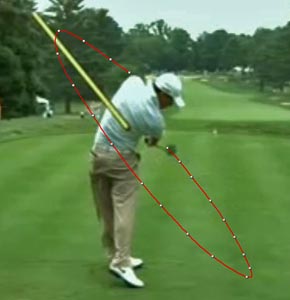
I always attempt to mimick his swing pattern - by attempting to be on the same inclined plane in the backswing and downswing (while slowly and progressively shifting planes between the elbow plane and turned shoulder plane in the backswing and vica versa in the downswing), and to always be on-plane even during the followthrough and early finish. I try to always get my clubshaft to be parallel to the ball-target line at the third and fourth parallels.
This is the clubhead path that I try to emulate.
When starting the backswing, I trace the SPL during the takeaway - and that means that the PP#3-sweetspot axis line points at the ball-target line. After the first parallel, it is the butt end of the club that points at the ball-target line and not any "hypothetical" axis of sweetspot rotation. For me, the most critical part of the swing in terms of being on-plane is between the first parallel and the third parallel. If I can keep on-plane during that time period and get to the third parallel perfectly on-plane, then I know that my clubshaft will be perfectly on-plane during the downswing time period between the third parallel and impact. In other words, I am mainly focused on ensuring that my clubshaft is on-plane when the club is above waist level, and during that time it is the butt end of the club, and therefore clubshaft, that points at the baseline of the inclined plane. In other words, all your theorising about options 1,2, and 3 have no relevance with respect to my above-waist biomechanical movements that are required to keep the clubshaft -on-plane.
I have tied a string between the sweetspot and PP#3 and it is no value, because the only time that I actually see the string is during the takeaway, at which time I can easily stay on-plane. The string has no value for the critical biomechanical movements that occur above waist level- in both the backswing and downswing. Seeing the string blur between the third parallel and impact has no potential value because if I am not on-plane during that time period, then it is far too late to alter events.
In fact, I have now trained my hands (specifically PP#3) to move correctly by "feeling" it trace the SPL and I never even think of the clubshaft and/or the sweetspot. My only awareness of the clubshaft is after I have completed the shot - when I replay the shot in my mind. I can then usually recall where the clubshaft was situated at the third and fourth parallel, and I know retrospectively that if the clubshaft wasn't parallel to the ball-target line at those two time points, then I obviously didn't succeed in my goal of being on-plane throughout the entire swing.
Jeff.
p.s. I am not a good golfer by Ben Hogan's standards, but I am a great golfer by my standards. I never dreamt that I would ever regularly break 80 (from the senior tees) considering my degree of physical inflexibility and lack of golf athleticism. I never play 7,200 yards courses because I am not a masochist. I only play 6,000-6,500 yards courses by always playing from the senior tees. My driving distance is 220-240 yards.




 Linear Mode


