Ill take Grip Rotation for extra yards please Alex. Draw shot tendency yes as the ball POSITIONING moves back along the Arc of Approach but mitigated by the more upright Plane Angle ... More down , less out associated with shorter sticks, eh.
How bout you personally Yoda.
" Grip or Plane Rotation?" Asked Ed McMahon to the great Carsini.
I just go back and forth between aiming point and driving my hands to impact fix hand position with each club to feel the aim point for each club. It may not be the most exact method at first, but you get to feel the proper aim point eventually.
I just go back and forth between aiming point and driving my hands to impact fix hand position with each club to feel the aim point for each club. It may not be the most exact method at first, but you get to feel the proper aim point eventually.
My quiet hands and wedges are zipping down-plane so fast from TSP that I am afraid to mess with various Aiming Points. I am just enjoying the wallop so much and the feeling of the ball go squish!!
ICT
__________________
HP, grant me the serenity to accept what I cannot change, the courage to change what I can, and the wisdom to know the difference. Progress and not perfection is the goal every day!
My quiet hands and wedges are zipping down-plane so fast from TSP that I am afraid to mess with various Aiming Points. I am just enjoying the wallop so much and the feeling of the ball go squish!!
ICT
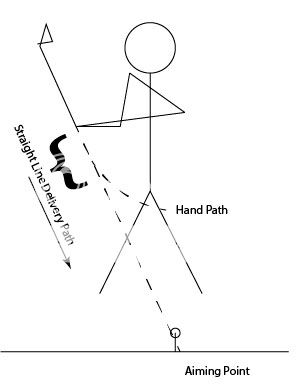
I had you adjust your stance width which adjusts your right shoulder location at impact to the right forearm angle of approach. You test this with a Waggle at Impact Fix, and you're doing well with this procedure. So, your Aiming Point is always going to be "the Ball" as illustrated below. I think that this is the best all-around way to go.
If you have a "Straight line Delivery Path" (second phase of the downstroke acceleration sequence) then you have an Aiming Point (not every has one). If you extend the line to the ground, it should point somewhere along the Plane Line. Drag the #3 PP down the Straight Line Path to the Aiming Point.
Throw-out begins at the end of the straight line where the pulley begins (dashed line).
There is another way....Not, in my opinion the best way (one of Homers ways). But, you can keep your stance width the same and adjust your Aiming Point. Then, the aiming point controls the release point. So, for a Driver the Aiming Point will be aft of the ball and a Wedge might have an Aiming Point forward of the ball. But this doesn't work if you keep changing your stance width.
And, very important, the #3 Accumulator angle in your Left hand can change to fine tune the process.
Here's a little something for you . Bucket sent me this book , I miss that guy where the heck is he high diddly hiding? Wish he'd come back .
IMO, Homer didnt invent the Aiming Point. Just like he didnt invent Hinge Action etc etc. But he decoded it quite nicely ..........then he wrote the most confusing book ever written on golf . Well unless Daryl or I decide to write one that is. Or maybe we collaborate? peanut butter ? And chocolate? That'll never taste good.
Re aiming point . Think about the longer levers and how they take longer to switch ends. Get an old 2 iron and try to hit it. You need to sweep it off the turf in common speak . Random Sweep Release isnt called "sweep' for nothing . The longer clubs need to be released earlier to get to there Fix position by impact. Just like old Abe says on page 67. The Aiming Point PROCEDURE can be employed to effect this . Or the aiming point procedure can be employed to delay release . Homer believed that it was the best way to learn Snap release .
IMO as an aside and I know how averse you are to digression so I appologize in advance.... people get too enamoured with Snap Release . Or super Snap . You got Full Sweep at one end , Snap at the other and everthing in between (Random Sweep). They are all useful . The Release Point is a Mechanical Adjustment . The longer levers demand an earlier release. It can all be done by feel of course too. Thats how most folks do it. Even those with no perception of what we call the
Here's a little something for you . Bucket sent me this book , I miss that guy where the heck is he high diddly hiding? Wish he'd come back .
IMO, Homer didnt invent the Aiming Point. Just like he didnt invent Hinge Action etc etc. But he decoded it quite nicely ..........then he wrote the most confusing book ever written on golf . Well unless Daryl or I decide to write one that is. Or maybe we collaborate? peanut butter ? And chocolate? That'll never taste good.
Re aiming point . Think about the longer levers and how they take longer to switch ends. Get an old 2 iron and try to hit it. You need to sweep it off the turf in common speak . Random Sweep Release isnt called "sweep' for nothing . The longer clubs need to be released earlier to get to there Fix position by impact. Just like old Abe says on page 67. The Aiming Point PROCEDURE can be employed to effect this . Or the aiming point procedure can be employed to delay release . Homer believed that it was the best way to learn Snap release .
IMO as an aside and I know how averse you are to digression so I appologize in advance.... people get too enamoured with Snap Release . Or super Snap . You got Full Sweep at one end , Snap at the other and everthing in between (Random Sweep). They are all useful . The Release Point is a Mechanical Adjustment . The longer levers demand an earlier release. It can all be done by feel of course too. Thats how most folks do it. Even those with no perception of what we call the
I am drawing Daryl's stick figure and running out to an indoor driving range to further field test release points and stance widths!
Rock on with your bad selves!
ICT
__________________
HP, grant me the serenity to accept what I cannot change, the courage to change what I can, and the wisdom to know the difference. Progress and not perfection is the goal every day!
Radically different alignments -- Hitters versus Swingers.
Absent demonstration, almost impossible to describe in words.
Even then, only for the few.
Sorry, O.B., can't go there.
Hah .
Isnt it really Hitters , manipulated Hands Swingers (making for almost everybody) versus True Swingers?
And BTW , shouldnt we annotate 6-H-O F accordingly? "Associate the following with True Swinging". Given "Plane Line Rotation".
K how bout this one then Yoda? If you positioned the ball back of Straight Away Position and didnt Rotate the Grip (face towards the target line or start line) but instead rotated the plane line to point the face at your start line .... Im thinking you'd hit a straight shot yes assuming you've aligned for zero divergence between face and clubhead path. But didnt you just effectively add loft to the club face?
Do you swing to the "right" with the driver and to the "left" with everything else? Must the Plane Line rotate "Closed" with the driver (and its lauded "Upstroke") and "Open" with everything else (and their "Downstroke").
Maybe I haven't looked a lot but its easy to find Irons off the rack without added "Hookface" but I haven't seen a Driver without added "Hookface". I have a Nike Driver with at least 5 degrees added. Pings are just as bad but I have an OLD Titleist pretty close to zero.
Radically different alignments -- Hitters versus Swingers.
Absent demonstration, almost impossible to describe in words.
Even then, only for the few.
Sorry, O.B., can't go there.
When I was practicing on the radar-based driving range, it took me about 10 swings to remember the bucket and Extensor action. Before doing that my ball speed according to the machine was about 82 mph on my driver (I think it is off two clubs since it had me hitting my 6 iron 140 yards which is what I hit my 8 iron on a 50 degree day). With full Extensor action and quiet hands and aiming at the inside quadrant of the ball loading the # 3 PP and flipping the hip I got up two 86 mph on the machine with about a 210 yard carry and roll.
Smashing through the ball felt great! Pretty straight ball with narrow stance and TSP Horizontal Hinge.
For yucks, I played St.Andrew's and had one birdie on my way two an 85 managing to avoid all sand traps except one. Lots of really stupid putts into a screen. Weird. It was an easy 85 and yes I did put the simulator on calm and sunny, may Jack Morris forgive me!
Putting on the greens at St. Andrew's for real was easier than the computer, real rap, no fraudin', done it twice!' Computer rough/heather is easier though, a lot easier, LOL!
ICT
__________________
HP, grant me the serenity to accept what I cannot change, the courage to change what I can, and the wisdom to know the difference. Progress and not perfection is the goal every day!
Last edited by innercityteacher : 12-12-2012 at 12:03 AM.
I had you adjust your stance width which adjusts your right shoulder location at impact to the right forearm angle of approach. You test this with a Waggle at Impact Fix, and you're doing well with this procedure. So, your Aiming Point is always going to be "the Ball" as illustrated below. I think that this is the best all-around way to go.
If you have a "Straight line Delivery Path" (second phase of the downstroke acceleration sequence) then you have an Aiming Point (not every has one). If you extend the line to the ground, it should point somewhere along the Plane Line. Drag the #3 PP down the Straight Line Path to the Aiming Point.
Throw-out begins at the end of the straight line where the pulley begins (dashed line).
There is another way....Not, in my opinion the best way (one of Homers ways). But, you can keep your stance width the same and adjust your Aiming Point. Then, the aiming point controls the release point. So, for a Driver the Aiming Point will be aft of the ball and a Wedge might have an Aiming Point forward of the ball. But this doesn't work if you keep changing your stance width.
And, very important, the #3 Accumulator angle in your Left hand can change to fine tune the process.
Thanks Daryl! I will ruminate on the meaning of the drawing and OB's comments too! I swing faster with the feeling of my hands back letting the hip do the work!
__________________
HP, grant me the serenity to accept what I cannot change, the courage to change what I can, and the wisdom to know the difference. Progress and not perfection is the goal every day!


 Or maybe we collaborate? peanut butter ? And chocolate? That'll never taste good.


 Linear Mode


