I am now thinking the two are the same and the note applies to Waggle and not Forward Press.
From 3-F-5 THE ADDRESS ROUTINE, the “Start Down” Waggle involves checking for “Clearing the Right Hip ( 2-N-0, 10-14).”
Further, from 2-N-0, “Proper Clubhead control is dependent on coordinating the Downstroke Hip Turn with the selected Right Elbow Position, Motion and Path to avoid collisions….”. and from 10-14-A, B, “use the….Turning/Sliding Hip to carry the Right Elbow around into Release position…”
Also, FWIW, the 7th Edition index contains Clear the Right Hip and Right Hip Clearing with the same seven references, plus Clear Right Hip with two references not included for the other subjects. The 6th Edition index does not contain these subjects
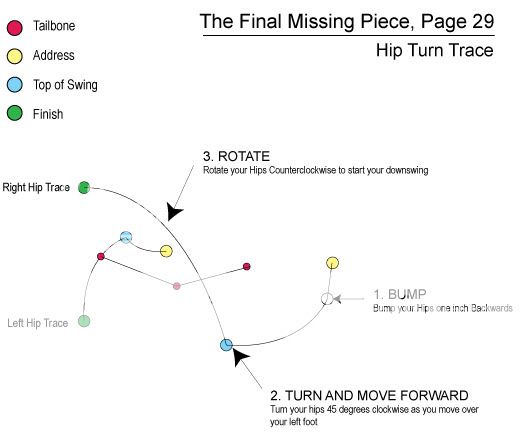
Daryl~Does your graphic of the hip movement agree with VJ Trolio's Final Missing Piece or what is your assessment of the difference? Thanks.
My Hip Turn accommodates my swing strategy which includes a Stationary Head, strong Weight Shift and keeping the Spine angle from Address to Top of Swing while allowing a very strong sense of staying "On the Ball" and keeping the Hips well inside my Stance throughout the Swing. My Hip Action is on the very strong side of Action. "The Final Missing Piece" Hip Action is a little on the weak side and basically carries the Shoulders and Power Package around to Impact.
I try to keep Zone 1 as simple as possible.
1. PURPOSE
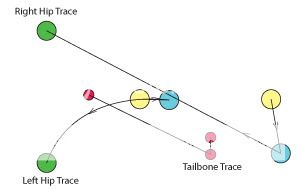
My Hip Turn Trace promotes a straight Line Delivery Path. This is my Hip Trace. This is the Path of the Hips for almost every Pivot Stroke.
"The Final Missing Piece" Left Hip moves in front of its Address Posture and promotes a Circle Path Delivery Path.
2. Comparison
Very Different
My Hip Turn leaves the Right Leg Forward Lean at Address undisturbed until the Downstroke by only moving the Right Hip behind about 3 inches while the Left Hip move laterally only to the Right.
Weight Shift Top Of Swing: My Trace places 90% of the Weight on the Right Foot at the Top of the Swing. VJ's puts 75% of the Weight on the Left Foot at the Top of the Swing.
I almost sit back on my Right Hip Socket at the Top. With "The Final Missing Piece", one sits back on the Left Hip at the Top of the Swing.
My Hips Turn to the Plane Line but are not physically Turned. My Hip Turn is simply the Product of Knee Bend and weight shift with no rotational effort, while "The Final Missing Piece" Hip Turn is a purposeful rotation of the Hips.
My Hip Turn accommodates my swing strategy which includes a Stationary Head, strong Weight Shift and keeping the Spine angle from Address to Top of Swing while allowing a very strong sense of staying "On the Ball" and keeping the Hips well inside my Stance throughout the Swing. My Hip Action is on the very strong side of Action. "The Final Missing Piece" Hip Action is a little on the weak side and basically carries the Shoulders and Power Package around to Impact.
I try to keep Zone 1 as simple as possible.
1. PURPOSE
My Hip Turn Trace promotes a straight Line Delivery Path. This is my Hip Trace. This is the Path of the Hips for almost every Pivot Stroke.
"The Final Missing Piece" Left Hip moves in front of its Address Posture and promotes a Circle Path Delivery Path.
2. Comparison
Very Different
My Hip Turn leaves the Right Leg Forward Lean at Address undisturbed until the Downstroke by only moving the Right Hip behind about 3 inches while the Left Hip move laterally only to the Right.
Weight Shift Top Of Swing: My Trace places 90% of the Weight on the Right Foot at the Top of the Swing. VJ's puts 75% of the Weight on the Left Foot at the Top of the Swing.
I almost sit back on my Right Hip Socket at the Top. With "The Final Missing Piece", one sits back on the Left Hip at the Top of the Swing.
My Hips Turn to the Plane Line but are not physically Turned. My Hip Turn is simply the Product of Knee Bend and weight shift with no rotational effort, while "The Final Missing Piece" Hip Turn is a purposeful rotation of the Hips.
Hip Trace of "The Final Missing Piece" is below.
Hogan Grid:
My Hip Trace
Interesting that, in both tracings, the left hip moves very little relative to the right hip. Don't know if there's anything significant there, but it's something I've never considered.
Do you have an assessment relative to ease of clearing the right hip?
VJ mentioned that Hogan's right hip moves parallel to the target line as it positions left and also differentiated between the Hogan and Snead spine angle at the top/end.
Do you have an assessment relative to ease of clearing the right hip?
Clearing the Right Hip is a Zone 1 issue. The Right Elbow doesn't interfere with the Right Hip, the Right Hip interferes with the Right Elbow.
Train Zone 1.
Lastly, if you stand fully upright and turn your hips, you legs twist to allow the motion. But when you bend at the waist or Hips then the knees bend and straighten to allow the Hips to Rotate in their sockets.
There are a lot of ways to swing a club but Zone 1 should accommodate. Secondary Axis Tilt is tricky because it often throws the entire machine off Plane with very little chance of recovering. This sometimes radical (2 or 3 degrees) inside-out swing needs a strong compensation otherwise the Club Shaft (and Club Head) rise above the Plane starting at Impact.
Now that is a great question Doc. If its cleared already why or how does one clear it again?
My personal interpretation, with a little help from my friends, is that the first "clear" is a turn of the right hip, the second "clear" is a Slide of the previously turned Right Hip which Tilts the Axis of the Shoulders , gets the weight left and "clears" a path for a Straight Line Delivery Path of the Hands.
So in terms of the right hip its: "turn, slide" and then swing all with a centered Head. Slide with a Delayed Turn of the Hips. Mr Hogan's pattern is a fine example of this procedure. There was a cleared Right Hip in both directions, no "Roundhousing", NO!
OK when I was walking around St Andrews with Lynn I asked him about this one. We were watching Dustin Johnson hit a "quail high" knock down on 11, as I recall. Anyways........his response was something to the effect that.....
"The right hip must turn inside the right shoulder". He mentioned an instructor from yesteryear that discussed this in detail. Sorry cant remember the name.
The Hip Slide as the second "clear" of the right hip in 12-3, as I proposed above, while being a very useful thing, is not employed for non weight shift strokes where Roundhousing is just as destructive and so the answer to the question lies elsewhere.
Here's JB Holmes from a birds eye view. See how his right hip is inside the line of his right shoulder giving his right elbow a clear path to its Impact position with no need to re route , roundhouse.




 Linear Mode


