This is interesting. It's something I'm working on but it's only in the incubation stage. I've plotted 10 COG Orbits from a 48 degree wedge to a 12 degree Driver. I've plotted the Orbits full scale from above, behind, from the front and each from 90 degrees to the Plane. When I overlapped each orbit I noticed that the Orbits cross each other about 5-6" aft and forward of Low Point.
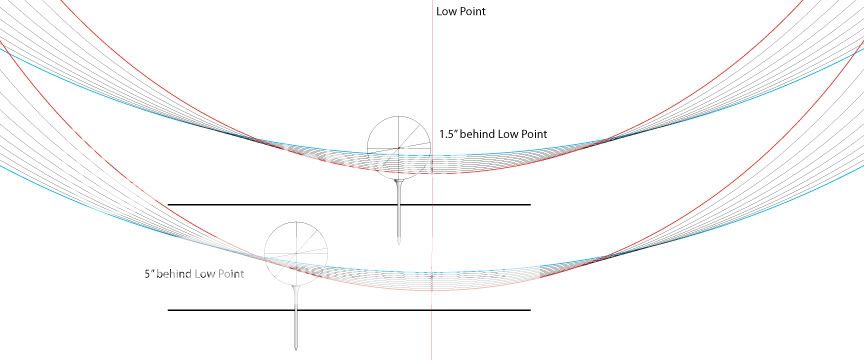
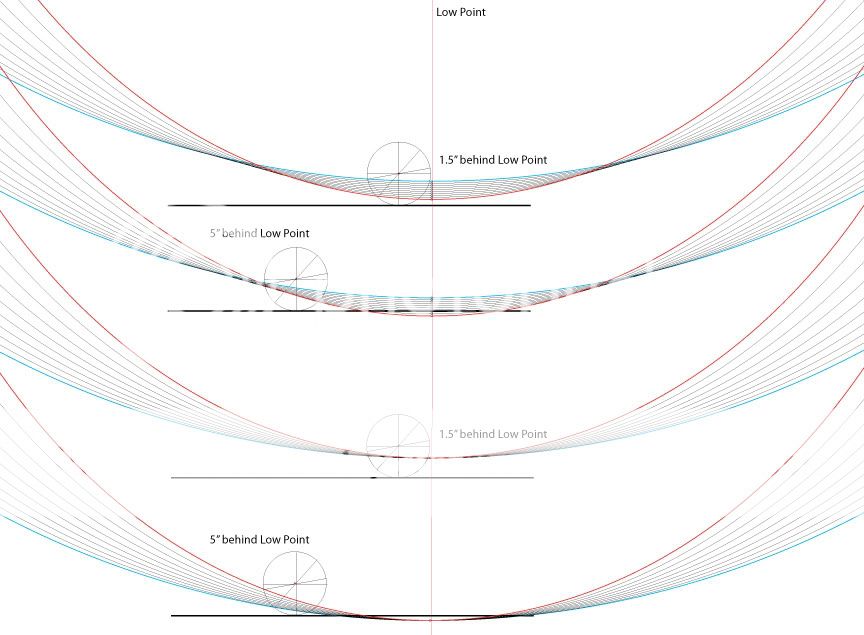
The Red Orbit is the Wedge and the Blue Orbit is the Driver.
The Top set of Orbits depict the ball positioned slightly behind Low-Point and the Bottom set of Orbits depict the ball positioned about 5" aft of Low Point.
The Top Drawing shows that a Driver with 12 degrees of Loft will contact the Ball slightly below the equator and the Wedge with 48 degrees of Loft will contact the ball much farther down. Each club between progressively varies in length and loft. This is how I've always imagined impact contact points to be.
The Bottom drawing is startling because it seems to show that regardless of loft or Club length, the contact point is close to the same for every club.
I've accounted for Angle of Attack, Release Point, Loft and Club Length in the drawings.
What to do now?
The next step for me, is to video 10 swings with each club, average them, and plot the averaged orbits. But, that's going to take a lot of work.
So, before going further with the project, I was wondering if I've overlooked something which would invalidate my orbit plotting. If I have, then it's better to chalk it up as another bungled wild goose chase than to spend a month plotting actual orbits.
So, I'm asking for opinions. There must be something wrong with my plotting. ???
1. why different address elevations?
2. why constant radius?
3. Why do we sacrifice approx 10% of the radius by limiting #2 accumulator to level at impact?
As you suggest, there must be something wrong with the plots. Especially the one on the bottom.
I think a good start would be to spread the contact points at impact the same way as the top drawing. You can do that by moving the arches of the shorter clubs straight down. Then you will get similar impact points but deeper divots for the shorter sticks. Right now the divots seem to be the same for all sticks.
Then - if you want to draw this for a good golfer, you can tilt the swing planes progressively so that you get a reasonably shallow divot for all sticks.
Then we can perhaps start think of the implications of the two lever system and the three different hinges...
This could develop into something very interesting.
This is interesting. It's something I'm working on but it's only in the incubation stage. I've plotted 10 COG Orbits from a 48 degree wedge to a 12 degree Driver. I've plotted the Orbits full scale from above, behind, from the front and each from 90 degrees to the Plane. When I overlapped each orbit I noticed that the Orbits cross each other about 5-6" aft and forward of Low Point.
The Red Orbit is the Wedge and the Blue Orbit is the Driver.
The Top set of Orbits depict the ball positioned slightly behind Low-Point and the Bottom set of Orbits depict the ball positioned about 5" aft of Low Point.
The Top Drawing shows that a Driver with 12 degrees of Loft will contact the Ball slightly below the equator and the Wedge with 48 degrees of Loft will contact the ball much farther down. Each club between progressively varies in length and loft. This is how I've always imagined impact contact points to be.
The Bottom drawing is startling because it seems to show that regardless of loft or Club length, the contact point is close to the same for every club.
I've accounted for Angle of Attack, Release Point, Loft and Club Length in the drawings.
What to do now?
The next step for me, is to video 10 swings with each club, average them, and plot the averaged orbits. But, that's going to take a lot of work.
So, before going further with the project, I was wondering if I've overlooked something which would invalidate my orbit plotting. If I have, then it's better to chalk it up as another bungled wild goose chase than to spend a month plotting actual orbits.
So, I'm asking for opinions. There must be something wrong with my plotting. ???
Has anyone seen this before?
Hinge?
Subtracting the downward clubhead vector where appropriate?
[quote=BerntR;79835]Right now the divots seem to be the same for all sticks.QUOTE]
Bernt,
I thought that - for a moment - however keep in mind he's tracking the sweetspot - not the bottom of the club. So the divots will still vary with the club being used.
__________________
Life Goal- Developing a new theory of movement based on Brain Science
Interests - Dabbling with insanity
Hobbies- Creating Quality
I realise he's tracking the sweet spot. But there's a discrepancy between the sweet spot lines and the contact point with the ball on the bottom drawing. At least for the most angled clubs.
How high on the ball impact happens is a direct function of effective loft at impact. If the drawing was correct, a driver and a 64 degree wedge would have almost the same launch angle with ball back in the stance.
I adjusted the COG Orbits to Intersect at Low Point in the Lower 2 Illustrations and depict one Ball Location behind Low Point and the other about 5 inches behind Low Point.
This doesn't make any sense because with each club in the bag, the COG of the Clubhead is progressively higher or lower. So, Soling the Club at Address and taking out the slack in the machine will give you the precise COG Orbit for each Club. So Playing the Ball 1.5 inches behind Low Point in the top Drawing seems to agree with golf club design and Geometry of the circle.
The Bottom 2 illustrations require the Player to raise or Lower each Club at Impact Fix and Address to different heights above the ground to align each clubs center of gravity to one another. This also provides a startling revelation. When the Ball is located 5 inches behind Low Point and resiting on-the-ground, then the clubhead will always strike the ground before the ball is struck. This can be augmented with Shaft Lean however, as the shafts lean progressively forward, the Impact Contact Points once again become the same. Hmm?
The Drawings also illustrate that when the Ball is located 5 inches behind Low Point, the Clubhead will practically scoop a divot deep enough to sod your lawn. That can't be right.
Also, and very important to current TGM bashing discussions is the issue of clubface closing. I've contended that it's not the purpose of Hinging to close the clubface, but that Hinging only determines to which associated plane the clubface closes in relation to... Locating the Ball 1.5 inches behind low Point however will show that the Clubface needs approximately 1/10 of a degree of closing to sustain the Line of Compression. Hmm? Certainly that's less than the Normal to Path Closing ratio.
The Physics, Geometry, Golf Club Design and Homer Kelley are beginning to converge for me. It's becoming increasing clear that the purpose of inclining the Striker is for Trajectory by controlling the Rebound Force, the Purpose of Locating the COG of the Clubhead is in order to make the inclined striker contact the ball at progressively lower points on the ball to cause progressively higher rates of spin and the purpose of locating the ball 1.5 inches behind low point for every shot is to allow all of this to occur. The Geometry of the Circle and Hinge Action only needs a 1/10th degree of closing to make the ball respond to an angular force as it would to a linear force.
There's not much science here. This is pretty simple stuff. The Complexity doesn't rest with understanding the simple Science.
This is going to be a fun project. But, I'm going to wait and listen to comments and I will continue to doubt myself.
I realise he's tracking the sweet spot. But there's a discrepancy between the sweet spot lines and the contact point with the ball on the bottom drawing. At least for the most angled clubs.
How high on the ball impact happens is a direct function of effective loft at impact. If the drawing was correct, a driver and a 64 degree wedge would have almost the same launch angle with ball back in the stance.
This is something I need to study. Thankyou for the insight.
My instincts say that the Angle of Attack is much different between the Driver and 64 degree wedge. And, more importantly, the downward degree of the Line of Compression is determined by that, which determines rebound direction and rebound force. So, although the contact points are the same, the trajectory is much different. As far as spin is concerned, although the "Ball, rolling up the face of the inclined striker doesn't account for all of the spin production" it may account for a fair amount of it when the ball is located that far back in your stance.
In the two bottom drawings you're prescribing same sweet spot height with driver and wedge. That would actually mean much deeper divots with the driver, sine the sweetspot is higher on the face.
I would like to see a third set of drawings where the lines have basically the same order & spacing through impactas in the first, topmost drawing with impact 1.5" before the ball. That would locate the sand wedge sweet spot impact lower at the ball than the driver impact, and much much much lower than the driver sweet spot at low point.
One interesting thing about ball back is that if you sole the club , the ball contact will be above the sweet spot because of shaft lean. That would translate into a "flyer" gear effect that has the ball shoot up in the air with less back spin, especially if the club has short hosel and weak shaft. With my good ol' Tommy Armor 845s irons I never could hit the ball consistently low. If I hit hard down on the ball it popped high up in the air. Now I'm beginning to understand why.
Daryl,
At least in the first post - the scale isn't right. Meaning this - when I printed it and measured how far back 5 inches from low point was - it was an inch. Then on the same print out I measured the ball which was 1/2 inch in diameter - that would make the ball have a 2.5 inch diameter. If the ball in your drawing was porportionally drawn - then it would change some of your conclusions.
Assuming everything was 1/5 scale - then when I extended your circle out - to a half circle and measured the diameter - it was around 7 inches - times 5 would be a swing diameter for the wedge at 35 inches - which I would assume (I don't know) would be a smaller impact radius than an actual wedge shot (of course, that would depend on how much snap release the player was using.
Just some quick thoughts - could be wrong.
__________________
Life Goal- Developing a new theory of movement based on Brain Science
Interests - Dabbling with insanity
Hobbies- Creating Quality






 Linear Mode


