A big thank you is in order to everyone who took the time to view my swing videos and reply to this thread. I wasn't expecting this magnitude of assistance but I really do appreciate it. I have a lot of information to digest, so I'll post back shortly with some further questions (and possibly photos/videos if it stops raining here).
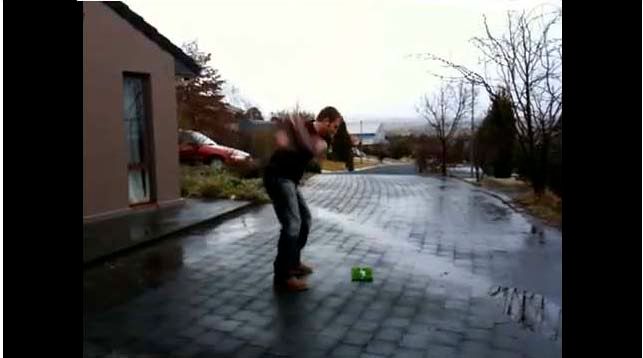
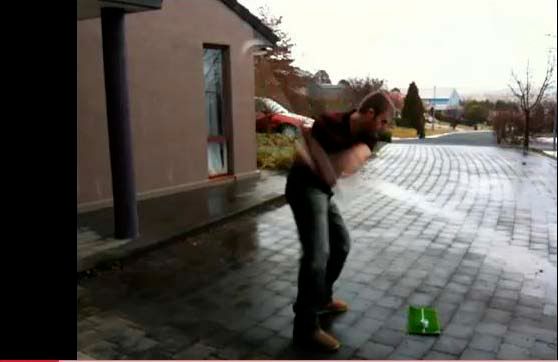
It has been a miserable day (weather wise) here today. It is cold and has been raining heavily as well. Unfortunately, this means I was unable to practice on the range/course. However, the rain did ease slightly so I decided to record some swing videos whilst hitting "birdie balls". The only changes I have made (so far) are on the backswing with increased hip turn and flatter hand path. Am I on the right track?
It has been a miserable day (weather wise) here today. It is cold and has been raining heavily as well. Unfortunately, this means I was unable to practice on the range/course. However, the rain did ease slightly so I decided to record some swing videos whilst hitting "birdie balls". The only changes I have made (so far) are on the backswing with increased hip turn and flatter hand path. Am I on the right track?
Before:
After:
dude!!!! AWESOME WORK!!!
Have a look at the before and after videos and compare where your left arm is when parallel to the ground . . . AWESOME WORK. Impressive man!!! You got some talent. I really really like it.
Next step . . . . get you a mic stand or something that will allow you to make swings with something sticking on your head. Get your head to stop chasing and coming up so fast.
This is IMPRESSIVE!!!! You are a talented dude . . . now keep your head centered . . . don't let it come up and chase the ball. NICE man!!! See you Later "over the top" . . . which you really weren't in the first place . . . you just gave yourself more space to make your move and not get your hands out over the plane. SWEET!
BEFORE . . . . .
The only changes I have made (so far) are on the backswing with increased hip turn and flatter hand path. Am I on the right track?
It looks like you also added a bit of Hip Slide with a Delayed Turn as well. Nice. Thats an amazing change in a short period of time, you are very athletic.
If you feel like your swing is getting too long with that added Right Hip Turn for some shots, you can employ 10-15-B Delayed Hip Action. Where the Hips turn a predetermined amount only and then semi lock. This will stop the Shoulders turning at a preselected place , tighten the left side tension and set the stage perfectly for the Hips to initiate the Downstroke Shoulder Acceleration. (Which is the main purpose of the Startdown Waggle drill). Something you do quite naturally but the Slide is going to ramp it up a bit as it takes out the slack in your left side.
Like everything in TGM these are not " moves" or "positions" but Alignments. You dont just turn your right hip any old amount , you turn it just enough so it can achieve its primary purpose (allowing the right elbow to pass on the backswing without sending it to the outside , "roundhousing". And no more than is necessary to allow you to turn your shoulders the desired amount based on your own personal flexibility. Too much is just as bad as too little. Most guys these days tend towards the latter and freeze the Right Hip and the pivot in Startup in an effort to set up immediate tension for power reasons but see their right elbow avoid a collision with the "Stuck" Right Hip by "roundhousing" the elbow and Hands to the outside of the Inclined Plane.
This ground- up "pulling" in Transition is Swinging, Drag Loading per 10-19-C, if you have the book. If you dont , please get it. It'll save you a lot of grief trying to research these terms.
Unfortunately it isn't in the book. Although one can concoct almost any swing procedural combination, the book doesn't specifically address swinging on the elbow plane with its usual and necessary compensations.
The book addresses in great detail, the TSP with an On-Plane delivery of the #3 Pressure Point, Flat Left Wrist, Straight Base Line of the Inclined Plane and Stationary Head; in other words, quite foreign to Elbow Plane Swingers.
It's too bad because the Elbow Plane is a very difficult swing to master and takes an enormous amount of time and effort to become truly proficient. The Standard Patterns in the Yellow book are easier to master and will give almost any golfer a lifetime of pleasure on the golf course.
Unfortunately it isn't in the book. Although one can concoct almost any swing procedural combination, the book doesn't specifically address swinging on the elbow plane with its usual and necessary compensations.
The book addresses in great detail, the TSP with an On-Plane delivery of the #3 Pressure Point, Flat Left Wrist, Straight Base Line of the Inclined Plane and Stationary Head; in other words, quite foreign to Elbow Plane Swingers.
It's too bad because the Elbow Plane is a very difficult swing to master and takes an enormous amount of time and effort to become truly proficient. The Standard Patterns in the Yellow book are easier to master and will give almost any golfer a lifetime of pleasure on the golf course.
Interesting . . . . took this cat an enormous amount of time to change his pictures . . . 24 hours or so? Eternity . . . .
Did somebody slip some clorox in your crackpipe again?


 Now, BC will be an elbow plane swinger for life.




 Linear Mode


