A Swivel tilts the Clubface. For a Swinger, the COG of the Club should be aligned with the Clubshaft during the Downswing so that the #3 PP is directing the Cog of the Clubhead and during Release, the Shaft will Rotate properly around the Sweetspot and not the Clubhead rotating around the Shaft (have you ever shanked a ball?). So, the Clubface is aligned to the Swingplane. Meaning, that the leading edge of the Clubhead is parallel to the Swingplane during the Downstroke. But for Impact, the Clubface needs to be Vertical. So, you'll Swivel from an On Plane Clubface to a Vertical Clubface for Impact.
Do you know how to Swivel during the Backstroke and Swivel the Clubface Vertical for Impact?
Turning and Rolling is the Clubface opening and Closing. Can you hold the Clubshaft in your Right Hand only and make the Clubface close as it approaches Impact without Swiveling (or Hooding) the Clubface. Can you make a very slow motion with only your right hand holding the club so that you can visually "See" watch the clubface close only? Can you do it without tilting the face neither up or down?
They are separate Motions. But Both can be completely automatic as a result of Alignments. Simple if you know the Alignments. Would you like to know what those Alignments are and how to get them?
Thx for feeding me information. It didn't say pling after one reading - but I'll try again (and again).
"Do you know how to Swivel during the Backstroke and Swivel the Clubface Vertical for Impact?" I guess not.
"Would you like to know what those Alignments are and how to get them?" Yes.
Anyway I will copy this and one day (soon I hope) it will come in handy when I suddenly get it (if that day comes..). For the time being I can relate to shanking. That's one of my specialities.
The master move the 25th component in TGM. It ties everything together in a very neat and foolproof way so that you don't have to think about all the nitty gritty details. But Homer left it out of the book because he was planning to file a patent. That's why we're all still searching for the holy grail. All except Yoda. But Yoda is bound by an NDA that he had to sign before Homer could share his big secret.
Seriously; I think the master move is to put your mind in your hands and have your main focus on what you're trying to do with the club, the ball and the hands at a very high level. Your ball striking intentions should adjust the components and bring the puzzle together through mental background processes. When golf is simple you can just take aim and fire at as many cylinders as you want to. And the components will deliver according to the plan.
This requires components that are well learned and organised to comply with what your hands need to do. Unfortunately, this organisation tends to drift constantly.
The golfing machinery doesn't have the mechanical and structural rigidity that other machines do. It is basically in the process of falling apart all the time. Preventive maintenance and good monitoring skills is required to keep the machine functioning well enough to det the job done. The minute you start believing that you've "got it" and shut down your monitors, that's when you're heading for problems. Feeling what's going on in the stroke is incredible important. Monitoring skills.
When you put your mind on one single component (like the shoulder turn or foot action or whatever) there is a tendency that all the other components disappear from the radar. And before you know it you've completely lost sight of your ball striking and have no idea where the ball is going to go.
And I guess, also a stable mindset is part of the receipt for success. But that's a part I know very little about, really. Cause my mindset tends to be drifting all the time. If I play well I get more ambitious and creative for each shot. If I struggle I am just too keen on fixing whatever problem there may be even though I am able to keep the ball in play.
We all want to play excellent golf, and how well we play makes a big difference to how we think and feel out on the course. The irony of it is that we would probably play better with a quiet mind that just repeated the same thinking over and over and were unaffected by the quality of ball striking and the score.
The master move the 25th component in TGM. It ties everything together in a very neat and foolproof way so that you don't have to think about all the nitty gritty details. But Homer left it out of the book because he was planning to file a patent. That's why we're all still searching for the holy grail. All except Yoda. But Yoda is bound by an NDA that he had to sign before Homer could share his big secret.
Seriously; I think the master move is to put your mind in your hands and have your main focus on what you're trying to do with the club, the ball and the hands at a very high level. Your ball striking intentions should adjust the components and bring the puzzle together through mental background processes. When golf is simple you can just take aim and fire at as many cylinders as you want to. And the components will deliver according to the plan.
This requires components that are well learned and organised to comply with what your hands need to do. Unfortunately, this organisation tends to drift constantly.
The golfing machinery doesn't have the mechanical and structural rigidity that other machines do. It is basically in the process of falling apart all the time. Preventive maintenance and good monitoring skills is required to keep the machine functioning well enough to det the job done. The minute you start believing that you've "got it" and shut down your monitors, that's when you're heading for problems. Feeling what's going on in the stroke is incredible important. Monitoring skills.
When you put your mind on one single component (like the shoulder turn or foot action or whatever) there is a tendency that all the other components disappear from the radar. And before you know it you've completely lost sight of your ball striking and have no idea where the ball is going to go.
And I guess, also a stable mindset is part of the receipt for success. But that's a part I know very little about, really. Cause my mindset tends to be drifting all the time. If I play well I get more ambitious and creative for each shot. If I struggle I am just too keen on fixing whatever problem there may be even though I am able to keep the ball in play.
We all want to play excellent golf, and how well we play makes a big difference to how we think and feel out on the course. The irony of it is that we would probably play better with a quiet mind that just repeated the same thinking over and over and were unaffected by the quality of ball striking and the score.
This was a lot different than I had expected, but not less interesting. I had no idea that this could be so complex. But it's probably right (as usual). The mechanics are something to learn - and "forget" in a sence - because it should be translated into feel. But at one stage or another it's probably ok to focus on a master move if this piece of mechanics is especially important in one's swing. And that can vary from player to player, I guess..?
There is aiming and there is aiming, no? Has he taking the game to a higher level than hands controlled pivot perhaps?
Playing with "ball flight controlled hands and pivot"?
Look at the target. Plan the stroke. Visualise the ball flight. and hands and pivot are set to go. He is scary precise with his approaches when he's hot.
Fred Couples was quoted recently as saying, "Lots of times I don't even aim".
One of my students of many years, Jim Renner now a new member of the PGA Tour, came to me this spring to work on his pre-shot routine or we have come to know as Preliminary Address (8-1). When he asked me what I do, I explained to him about Alignment and how I always used the same ideas used by Jack Nicklaus. He looked at me puzzled as if he never heard of such a thing. When I pressed him on how he aligns himself to the target he said, “I just look out there and hit it". This immediately brought Fred couple to mind. "Why didn't we ever go over this before," he asked. To which I replied, "We never had to."
"Would you like to know what those Alignments are and how to get them?" Yes.
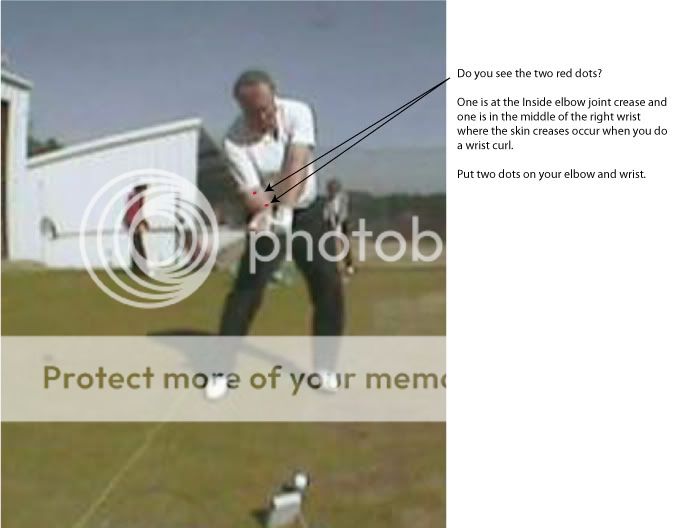
Get into his positions. The Clubshaft is close to parallel to the Plane Line. Are your Dots facing up toward the sky? They should.
Perform the Following with a Bent and Level Right Wrist.
Swivel
1. Stay in that position and take your Left hand off the Club.
2. Do some right arm dumbell curls. Up and down. repeat. Notice that the Clubface becomes aligned to the Plane when you bend your elbow up from this position.
3. Notice that the Clubface Swivels to the Plane when you bend your elbow and swivels back to vertical when you unbend your right elbow.
Swiveling is almost completely automatic with full swings. Unbend your right elbow until your right arm is straight and you'll see a complete pre-impact swivel to vertical.
Next: Horizontal Hinge - Simple.
1. Assume the positions of the Golfer above.
2. Do you see where the clubface is pointing? Yes. It's facing away from you and across the target line.
3. Take your left hand off of the club. Keep your right elbow bent.
4. move your right arm wedge (as a single unit) to your Left until the Clubface is facing your target by rotating your right forearm. It's ok to pivot a little. Your right forearm is now on the angle of approach, but not actually because it's still bent.
5. Are the two dots facing up? They should. Did you notice how easily the clubface closed? Yes. Was that difficult to do? no.
6. Assume the positions of the Golfer above.
7. Do you see where the clubface is pointing? Yes. It's facing away from you and across the target line.
8. Take your left hand off of the club
9. Unbend your right elbow until your arm is almost straight.
10. The dots are still facing up
11. move your right arm wedge (as a single unit) to your Left until the Clubface is facing your target. It's ok to pivot a little.
12. Are the two dots facing up? They should. Did you notice how easily the clubface closed? Yes. Was that difficult to do? no. Now, your right forearm is on the angle of approach that HK talks about. This is just like your right forearm wedge at Impact Fix.
13. Assume the positions of the Golfer above.
14. Do you see where the clubface is pointing? Yes. It's facing away from you and across the target line.
15. leave your left hand on the club.
16. Unbend your right elbow until your arm is almost straight.
17. The dots are still facing up
18. move your right arm wedge (as a single unit) to your Left until the Clubface is facing your target. It's ok to pivot a little.
12. Are the two dots facing up? They should. Did you notice how easily the clubface closed? Yes. Was that difficult to do? no.
13. Do you notice how your left wrist rolled and the back of the left wrist is facing the target. Yes.
14. Did you twist your right wrist? no
15. are the dots still facing up? yes.
16. Here is what you did. You Uncocked, Swiveled and Rolled On-Plane.
Now, make those motions with your right elbow moving as it would while doing normal golf swings.
Go hit some pitch shots. No More Shanks. Are the Dots facing up at Impact? Yes.
(For Hitters, the Dots are Facing the Target). If a Swingers wrist dot is facing the target, then he's mixing hitting and swinging.


 Cause my mindset tends to be drifting all the time. If I play well I get more ambitious and creative for each shot. If I struggle I am just too keen on fixing whatever problem there may be even though I am able to keep the ball in play.




 Linear Mode


