Is it possible that you should define the "end-backswing" as when his hands change direction, and not the club? Because his hands have started moving back down in frame 3.
...let me define what represents my definition of the end-backswing - it is the time-point when the clubshaft starts to move in the opposite direction....
Jeff.
Jeff,
Thanks for the work, that is really nice and i am reading 8-6 now...might be we have different idea of the term "end of the backswing"
__________________
If you cannot take the shoulder down the clubshaft plane, you must take along some other path and add compensations - now, instead of one motion to remember, you wind up with at least two!
I think that the clubhead should start to change directions almost at the same time as the hands change directions. However, I could easily concede that in Hogan's situation, there may be slight delay between Hogan's hand movement and clubhead movement, because Hogan had ultra-flexible wrists and there may be a momentary delay before the clubhead changes directions.
KOC
There is no "gold standard" definition of the end-backswing, and I prefer to use the golf research laboratory definition. Even Phil Cheetham at the TPI now uses this same definition - when the clubhead changes direction. He previously defined the end-backswing position when the lower body changed directions and started to move forwards.
Pg 93, Hogan said Initiating the downswing with the hips is of
such critical importance that many top-run golfers, sensing
that their timing will be better accomodated, start to turn
their hips to the left a fraction of a second before the club
reaches the top of the backswing. There's nothing wrong with
this.
Pg 74, When the hips are turned back to the left, this
tightens the muscles between the hips and the shoulders just
a notch more-something like the way a fellow gives each lug
that little extra tightening twist when he's changing a tire.
Maximum tension in the muscles betwee the hips and the
shoulders produces maximum speed.
Jeff, I love your pictures. Thanks for putting them up.
If you get a chance, look a frame No. 3 on page 41 of
the Final Missing Piece. It shows that Hogan had moved
the center of Mass to the left leg before starting down.
Jeff, I think that Leadbetter said it best. "I believe that Hogan's
lateral hip slide is a major cause of his high finish. Let me explain
why. The slide toward the target position his hips well foward.
As his hips began to rotate open from this forward position,
Hogan raised his body and stood up on the shot after impact."
I think that the key here is that Hogan was able to pivot with
the Center of Mass way to the left near or over his left leg.
Another point, V.J. noted that the head drops almost two inches
at the top of the swing. This is caused by the shift left
before the downswing. V.J. presents via of an engineering study
what and where the Center of Mass/Center of Gravity is.
Keep up the great work/postings/pictures. I sure enjoy them.
Regardless any definition you want, the most important move i learnt from VJ work...it is a gif file, refresh the page to see the "MOVE".
__________________
If you cannot take the shoulder down the clubshaft plane, you must take along some other path and add compensations - now, instead of one motion to remember, you wind up with at least two!
You seem to define the center of mass as the area around the navel. In that sense, Hogan did move his center of mass slightly leftwards in the final stage of the backswing (as seen in image 3 on page 41). However, that doesn't mean that 70% of Hogan's total body mass was on the left foot at the end-backswing position. The center of mass can be slightly leftwards of the stance center, but the proportion of total body mass favoring the right side versus left side has to also factor in the weight of the upper torso, two arms and head.
You also wrote-: "When the hips are turned back to the left, this tightens the muscles between the hips and the shoulders just a notch more-something like the way a fellow gives each lug that little extra tightening twist when he's changing a tire. Maximum tension in the muscles betwee the hips and the shoulders produces maximum speed."
I personally believe that your theory that increasing the stretch of the torso muscles - by moving the pelvis before the upper body (what Jim McLean calls the dynamic X-factor) - produces maximimum swing power is a theory without adequate scientific evidentiary support.
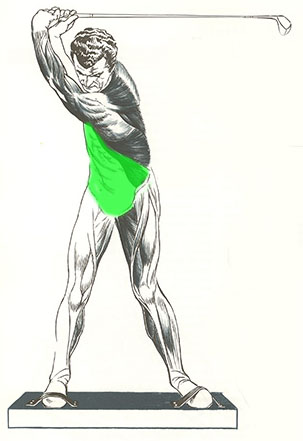
I wrote a review paper on Jim McLean's X-factor, and I used this photo to make a point.
The torso muscles stretched when the pelvis moves before the upper torso is shown in green. Those muscles are essentially the abdominal oblique muscles on the right-lateral side of the mid-torso. I personally don't believe that stretching those few (limited) muscles plays a large role in generating pivot power in the downswing. However, I do think that kinetic sequencing is important and I do that think that one should start the downswing with a hip shift-rotation movement before rotating the shoulders - but I think that the primary reason relates to the concept of i) taking up spinal slack, and ii) getting a balanced sequential torso rotation (like a figure skater spinning on the ice - the spin has to start from the bottom-up). I personally think that the stretch factor concept (stretching eccentrically loaded torso muscles muscles by a small amount) plays a minor role in maximising swing power.
You wrote-: "Jeff, I think that Leadbetter said it best. "I believe that Hogan's lateral hip slide is a major cause of his high finish. Let me explain why. The slide toward the target position his hips well foward. As his hips began to rotate open from this forward position, Hogan raised his body and stood up on the shot after impact."
I disagree with Leadbetter's assertion that it was solely the lateral pelvic slide that is responsible for Hogan's excellent high finish. I think that Hogan's excellent high finish was simply due to the i) overalll efficiency of his downswing pivot action + ii) his superbly executed continued-torso rotation post-impact. His downswing pivot action was so efficient that he fully released his power accumulators to a straight right/left arm post-impact situation. However, he not only released his power accumulators perfectly, he also continued to turn his torso superbly during the followthrough and finish phases of the swing, and that directed his straight arms in an upwards and leftwards direction to a high finish.
You also wrote-: "I think that the key here is that Hogan was able to pivot with the Center of Mass way to the left near or over his left leg."
I personally don't think that having the center of mass (body mass near the center of the torso) slightly leftwards increases the efficacy of the downswing pivot action. The human body is not like a spinning cylinder, which spins faster when the center of mass is near the central axis of rotation. Hogan had a superb downswing pivot action for many reasons, and one of the main reasons relates to his body alignment at the start of the downswing.
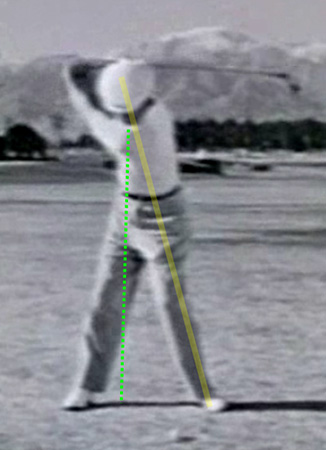
Hogan had a typical reverse K look at the at the start of the downswing. I personally believe that when the upper torso is angled to the right (causing the head to be slightly right-of-center) while the lower torso is angled to the left (thereby creating the reverse-K appearance) that the human body is optimally positioned to perform an efficient downswing pivot action. The yellow line represents the skeletal structural alignment between the head and left foot (spine, pelvis, left thigh, left tibia) that can be braced when the downswing is initiated by a pelvic shift-rotational movement. I personally believe that Hogan's super-efficient lower body movement during the early/mid downswing required this skeletal structural alignment (spine and upper torso angled slightly to the right) to allow it to occur with maximum efficiency. In other words, I place major emphasis on body alignments (especially supporting skeletal structural alignments) that allow for optimum biomechanical movements and I place minor emphasis on central body weight distribution (especially passive weight [organ weight and mesenteric fatty tissue weight] distributed in the mid-body).
I agree with you that Hogan's transition pelvic move is important, but I think that the value of the "transition move" relates to the creation of the optimal skeletal structural alignments necessary for an optimum downswing pivot action (see post reply to dkerby above) and that it has has nothing to do with moving passive central body mass closer to the left leg. When Hogan shifted his pelvis left-laterally in the late backswing, he optimised his reverse-K alignment before starting his downswing pivot action in earnest.
To reinforce my argument that body alignment places a major role in swing power, look at this swing video of Shawn Clement swinging off one-leg.
He can hit the ball as far, if not slightly further, off one-leg than two legs. Why? Note that he has no body coiling in his one leg swing, and therefore zero X-factor, and the absence of any coiling of his upper body against the resistance of his lower body doesn't affect his swing power. I think that a key element in his one-leg swing's swing power is the method that he adopts to position his spine with rightwards spinal tilt at address. That maneuver creates the braced reverse-K structural alignment necessary for his "efficient" downswing pivot action over one-leg.
Jeff.
Last edited by Jeff : 05-30-2008 at 01:58 PM.
Reason: Add additional material


 Stay away from my house! My kids! Especially my dog!


 Linear Mode


