So -many planes:
Get them all "guessed" at FIX and they all change at impact.
Here is a big one.
COG pull causes toe down at speed.
The shaft is now bent in an arc.
the grip now points, not at the hossel, not at the cog but, because it is a tangent to the arc of the bent shaft caused at toe down, out beyond the toe of the clubhead. But how much? What is the correction? how is it added? Tell me what becomes the feel at pp #3?
Not an Easy Riddle.
Hint- I have posted the solution as I see it some time ago.
In the book Homer assumes the shaft or more correctly the LCOG (from #3pp to Sweetpot) to travel the inclined plane for plane compliance. But in the audio tapes he discusses a procedure where the Clubhead only travels the Inclined Plane. This latter procedure allows the Clubhead to travel up the Turned Shoulder Plane immediately in Startup . Making for a Clubhead only Inclined Plane of motion with no shift necessary and leaving the Hands beneath the Inclined Plane in Startup. (Not my cup of tea BTW and not what Lynn teaches his students). He also stated that the clubhead only plane of motion was a necessity for complying with the true Angle of Approach Procedure. "Its a clubhead only plane of motion" said Homer. "A Vertical Plane " , "well almost vertical".
But ...... this is probably of little use to anyone except those trying to fully understand the GEOMETRY of the true Angle of Approach PROCEDURE. So far historically , there are probably only a handful of people in that group. Maybe less. Maybe only one, Homer himself. Ted Fort has used the "true" Angle of Approach Procedure in professional tournament play.
To illustrate the ideas behind the swing plane, I tried once to explain the Angle of Approach procedure in a general golf forum. To say the least I had very little success !
In the book Homer assumes the shaft or more correctly the LCOG (from #3pp to Sweetpot) to travel the inclined plane for plane compliance. But in the audio tapes he discusses a procedure where the Clubhead only travels the Inclined Plane. This latter procedure allows the Clubhead to travel up the Turned Shoulder Plane immediately in Startup . Making for a Clubhead only Inclined Plane of motion with no shift necessary and leaving the Hands beneath the Inclined Plane in Startup. (Not my cup of tea BTW and not what Lynn teaches his students). He also stated that the clubhead only plane of motion was a necessity for complying with the true Angle of Approach Procedure. "Its a clubhead only plane of motion" said Homer. "A Vertical Plane " , "well almost vertical".
But ...... this is probably of little use to anyone except those trying to fully understand the GEOMETRY of the true Angle of Approach PROCEDURE. So far historically , there are probably only a handful of people in that group. Maybe less. Maybe only one, Homer himself. Ted Fort has used the "true" Angle of Approach Procedure in professional tournament play.
BTW it could be argued that everything has an "angle of approach" ... the Right Forearm, the right hip, the right knee , the left testaclese assuming you have one ... Lets not confuse the true Delivery Line of the ClubHEAD Angle of Approach Procedure with any other components "angle of approach", Right Forearm or or or .....Molson Muscle (beer belly).
Short version , if you''re swinging and using a lot of turning and letting things free wheel , unmanipulated so to speak, you are probably planing the LCOG , Sweetspot Plane and thats what we should assume when discussing this the most common of golf procedures. With a Right Forearm angle of approach in mind or a left side Primary Lever Flail action or whatever.
We can restrict the scope to the Impact Interval because Ball response depends on that.
The Lie Angle of the Club affects direction. If the Hands are too low, then the ball goes Left, if too high then the ball goes right. It's named "Swing Plane" because we will Swing the Club along this Plane.
So the Swing Plane is built-in to the club, and it's normally somewhere between the Shoulder and Elbow planes. Our job begins by aligning the ball, low point and the target to this plane. Low point and target are already reconciled. Just get the ball right.
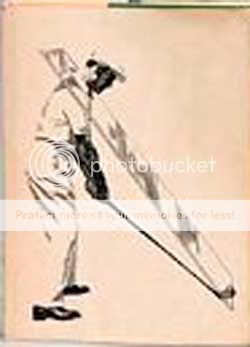
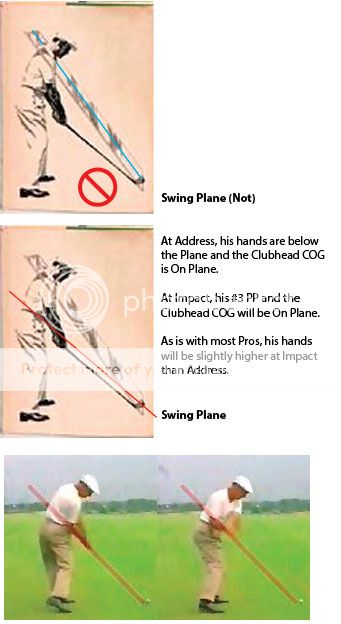
Ben Hogan, in his book "Five Lessons" made an obvious mistake and he himself contradicted this illustration in numerous interviews and demonstrations.
We can restrict the scope to the Impact Interval because Ball response depends on that.
The Lie Angle of the Club affects direction. If the Hands are too low, then the ball goes Left, if too high then the ball goes right. It's named "Swing Plane" because we will Swing the Club along this Plane.
So the Swing Plane is built-in to the club, and it's normally somewhere between the Shoulder and Elbow planes. Our job begins by aligning the ball, low point and the target to this plane. Low point and target are already reconciled. Just get the ball right.
Ben Hogan, in his book "Five Lessons" made an obvious mistake and he himself contradicted this illustration in numerous interviews and demonstrations.
Isn't that pix Hogan at address? what was Hogans mistake?
HB
Isn't that pix Hogan at address? what was Hogans mistake?
HB
One point to make is that there are 3 Planes. Left Arm Wedge, Right Forearm Flying Wedge and Swing Plane. Although its possible to align the Flying Wedges at 90 degrees and thus have the Club on both of these Planes simultaneously, the Left Arm Wedge Plane is Opening and Closing (Turning and Rolling) and cannot directly move the Club along the Swing Plane. It can do so under the guidance of the Right Forearm Flying Wedge.
I've been talking about hand paths in the context of the Turned Shoulder Plane because it's the most common, but let's look at the Turning SP - the version with vertical moving arms. Homer says the hands trace a line on the ground INSIDE the base line, so in this case, the hand path NEVER lies in the Swing Plane, unlike the Turned SP in which the hands trace the baseline from the Top.
Hogan's plane - the pane of glass was just an upper bound under which the club head must remain. In the second pic, you have correctly traced the elbow swing plane in red. But in the last two photos, you have traced the shaft, not the Sweetspot Plane which goes through the ball, and under which the hands lie, and this happens even though he has very high hands through impact. Also, that's not impact in the left photo - his hands move dramatically left at and after impact. There are many rotary swingers who's left wrists are not quite uncocked to the level position and so their hands are much more under the elbow swing plane than Hogan's.
Last edited by MizunoJoe : 12-09-2012 at 11:38 AM.
One point to make is that there are 3 Planes. Left Arm Wedge, Right Forearm Flying Wedge and Swing Plane. Although its possible to align the Flying Wedges at 90 degrees and thus have the Club on both of these Planes simultaneously, the Left Arm Wedge Plane is Opening and Closing (Turning and Rolling) and cannot directly move the Club along the Swing Plane. It can do so under the guidance of the Right Forearm Flying Wedge.
So, in the context of this post, post #1 of this thread is not practical?
Hogan just said DON'T GO ABOVE the glass plane and the DOWN SWING plane is relocated BECAUSE OF AXIS TILT.
Hogan did not talk about COG plane or "sweet spot" plane. Likely because he was smart enough to know it was not useful to the golf swing beyond an accademic curiosity.
Hogan's plane - the pane of glass was just an upper bound under which the club head must remain. In the second pic, you have correctly traced the elbow swing plane in red. But in the last two photos, you have traced the shaft, not the Sweetspot Plane which goes through the ball, and under which the hands lie, and this happens even though he has very high hands through impact. Also, that's not impact in the left photo - his hands move dramatically left at and after impact. There are many rotary swingers who's left wrists are not quite uncocked to the level position and so their hands are much more under the elbow swing plane than Hogan's.
I didn't trace those lines but put perfection aside for a moment and think of the intent. These illustrations were done by others and it was a simple search and find, copy and paste.
I've made BOLD in the quote below, an important point. Also, it may have been widely used in his day but its no longer widely used. There are two versions and as Homer said, its difficult to assign a reference point while using these procedure.
The Club will return appropriately to within a few degrees of the Clubs Lie Angle and as long as this is compensated, it will work.
Quote:
10-6-D TURNING SHOULDER Locating this Plane Angle reference point geometrically is very involved but seems readily defined from a “mechanical” description. Which is this; the Arms are simply raised and lowered vertically and the Wrists are Cocked and Uncocked with Left Wrist vertical to the ground at all times in a true Single Wrist Action – no Turn or Roll (10-18-C). All this, while the Pivot is imparting the On-Plane motion to the Hands and Arms in both directions. It brings the Hands directly to a Squared Shoulder Plane location. Its Off Plane (Vertical) Loading motion tends to Feel like Clubhead Throwaway but it is the Vertical Left Wrist application of the Golfer’s Flail as shown in Sketch 2-K#5, which insures a positive Downward motion for an effective Three Dimensional Impact.
So, in the context of this post, post #1 of this thread is not practical?
Hogan just said DON'T GO ABOVE the glass plane and the DOWN SWING plane is relocated BECAUSE OF AXIS TILT.
Hogan did not talk about COG plane or "sweet spot" plane. Likely because he was smart enough to know it was not useful to the golf swing beyond an accademic curiosity.
HB
Originally Posted by brownman
I may have mentioned before,but I mainly practice in and around 40 yrds,and every now and then hit long shots.So in saying this,it goes without saying that I hit every shot imaginable around greens,so ,in order not to get too bogged down and lose interest,A couple of weeks ago I began chipping using left and then the right ,it all hit home when I began getting into "plane of motion" in the book,it is a real fun time ,you really learn about alighnments of both arms and most of all...CONCENTRATION...no doubt a lot here have tried....love to hear your findings and results L+R handed
Brownman concludes that the Shaft can be controlled by the Left arm Wedge or the Right Forearm Flying Wedge with maybe equal results. And more important is that his Wedges are probably aligned at 90 degrees which makes it easier to switch his concentration from left to right and have good results while aligning the wedge to the swing plane.




 Linear Mode


