No doubt you see what I'm talking about. There has been little lower body rotation, i.e., your hips have simply slid left with no turn.
Do you know why it's a problem?
I don't Yoda ...I know how it developed though over the course of time, and its the probably the reason I hit it low with a lot of hooks (moving the circle back). I would imagine without the turn it promotes the stalling of the hands and the flipping of the club.
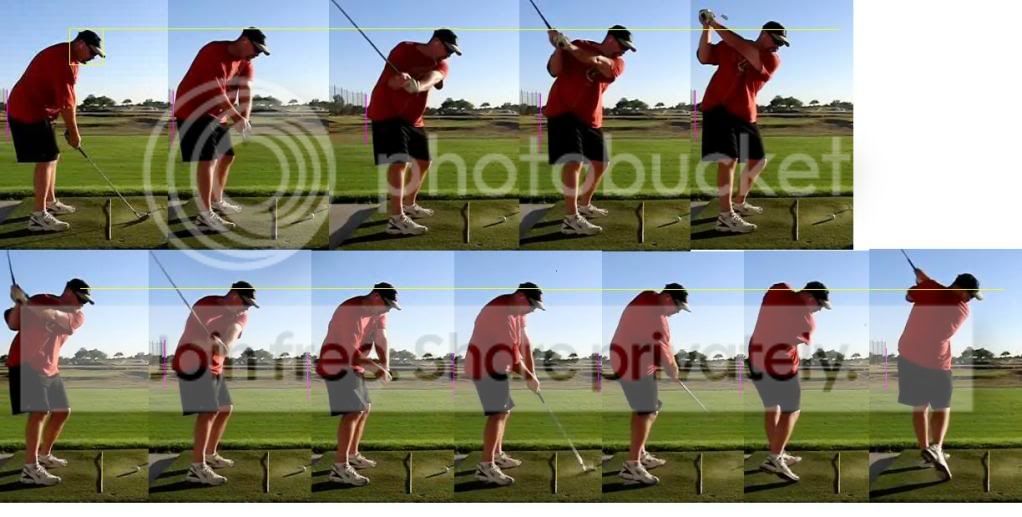
swing sequence with some reference lines showing some major pivot issues to my novice eyes....that being said this is actually improvement form when I started here.
swing sequence with some reference lines showing some major pivot issues to my novice eyes....that being said this is actually improvement form when I started here.
Lots of good stuff, gmb. You are so close.
Where do you live? I will be in many parts of the country next year during PGA TOUR events. Maybe we can connect.
I'll put up a schedule soon. At least a quasi-schedule!
Do you agree that your Downstroke sliding -- with noturn until post-Impact -- could be a problem?
I agree it is a problem, I don't even see a turn until very late, almost a fake turn to the finish. It appears like 7-14 is non existent in my swing.
I found this in 7-16 that may be useful for the issue
Quote:
The proper amount of Knee Bend is determined at Impact Fix (7-8 ) by the distance the Hips must move to allow the Right Forearm to point at the selected Plane Line per 2-J-3 and 7-3. The amount of Bend will also determine the amount of Backstroke Turn and Down-stroke Slide The amount of Bend will also determine the amount of Backstroke Turn and Down-stroke Slide. The less Bend, the more the Pivot and Hip Slide will be restricted in both directions and the more upright the Plane tends to be.
If the straightened Knee is allowed to lock “beyond center” the subsequent unlocking is disruptive.
The rotated Knee should not sag into an extreme position. That weakens the strong in-line structure of the normal knee and ankle alignment.
When the Address or Fix Knee Bend of either Knee is maintained throughout the Stroke, it feels and acts like the Body has a solid anchor to the ground and therefore so designated. The “Anchor” designation still allows the Knees to rotate through the Sit-Down Position as the Strokes lengthen. So, seldom does Impact occur during the true Sit-Down Position.
If you accept advice from a 6 hcp, here's my 5 cents:
Maybe you need to practice your footwork. It is your feet that drive the hips. Right hip forward and out - left hip forward and away from the target line.
My guess is that you don't use your left thigh to push the left hip away from the target line. This move is very golf-specific. It is a bit like pushing your left foot forward. But since the foot is grounded your hip will move backwards instad. This is an important part of getting the hip to where you want it to be through impact. Back and up to support a good turn through the ball and save your back as well.
You can practice it with a club across your neck, holding on each side. Try to get a big and stable shoulder turn. Rotate your upper body with the feet.
The hip move is a combination of forward move and rotation, and to a certain extent the left and right hip joints move independant. As soon as you've incubated the left hip back move you should be able to drive and turn your hip to where you want it throught impact - at least without a ball.
I agree it is a problem, I don't even see a turn until very late, almost a fake turn to the finish. It appears like 7-14 is non existent in my swing.
I found this in 7-16 that may be useful for the issue
The true Homer Kelley Hip "slide" is very misunderstood. A major part of the problem is of his own doing: In the 6th edition, he changed the definition of Slide Hip Turn from 'Slide with no appreciable Turn' to 'Slide with delayed Turn'. Unfortunately, he did not change the illustrating photos 10-14-B #1 and #2 (hence, their obvious "no Turn" on either the Backstroke or Downstroke). He also failed to change the Shift/Turn constraints under Component #14 in the Chapter 11 summary.
Then, some 25 years later, we get the post-humously published 7th edition. Not only did it fail to correct these oversights, it also listed the Slide Hip Turn as the selected Variation of Component #14 in both Basic Stroke Patterns (12-1-0 and 12-2-0). So now, we have a new generation of TGMers who must come to grips with the radical 'Slide' photos being 'what the TGM stroke looks like'. Not to mention that the Slide Hip Turn (or even the Standard and Delayed Hip Turns) is incompatible with the also new Rotated Shoulder Turn Variation as Component #13. Which, itself, is incompatible with both the Standard Pivot (listed Component #12) and the Line Delivery Path (listed Component #23).
So, where were we now? Ah, yes:
Given the current state of published affairs, what is the correct interpretation of the Downstroke Slide Hip Turn?
Leaving your Right Hip in its Backstroke Turn, just get your weight back to your left side, then . . .
The true Homer Kelley Hip "slide" is very misunderstood. A major part of the problem is of his own doing: In the 6th edition, he changed the definition of Slide Hip Turn from 'Slide with no appreciable Turn' to 'Slide with delayed Turn'. Unfortunately, he did not change the illustrating photos 10-14-B #1 and #2 (hence, their obvious "no Turn" on either the Backstroke or Downstroke). He also failed to change the Shift/Turn constraints under Component #14 in the Chapter 11 summary.
Then, some 25 years later, we get the post-humously published 7th edition. Not only did it fail to correct these oversights, it also listed the Slide Hip Turn as the selected Variation of Component #14 in both Basic Stroke Patterns (12-1-0 and 12-2-0). So now, we have a new generation of TGMers who must come to grips with the radical 'Slide' photos being 'what the TGM stroke looks like'. Not to mention that the Slide Hip Turn (or even the Standard and Delayed Hip Turns) is incompatible with the also new Rotated Shoulder Turn Variation as Component #13. Which, itself, is incompatible with both the Standard Pivot (listed Component #12) and the Line Delivery Path (listed Component #23).
So, where were we now? Ah, yes:
Given the current state of published affairs, what is the correct interpretation of the Downstroke Slide Hip Turn?
Leaving your Right Hip in its Backstroke Turn, just get your weight back to your left side, then . . .
Turn!
I'd like to nominate for inclusion in the LBG Hall of Fame in the " Yoda's all time best posts" category of which there are many.
I have filed it to my personal LBG file with exclamation marks.
Regards
Ob
PS Yoda , what notations would you recommend we make to our 6th or 7th editions in this regard?


 ...I know how it developed though over the course of time, and its the probably the reason I hit it low with a lot of hooks (moving the circle back). I would imagine without the turn it promotes the stalling of the hands and the flipping of the club.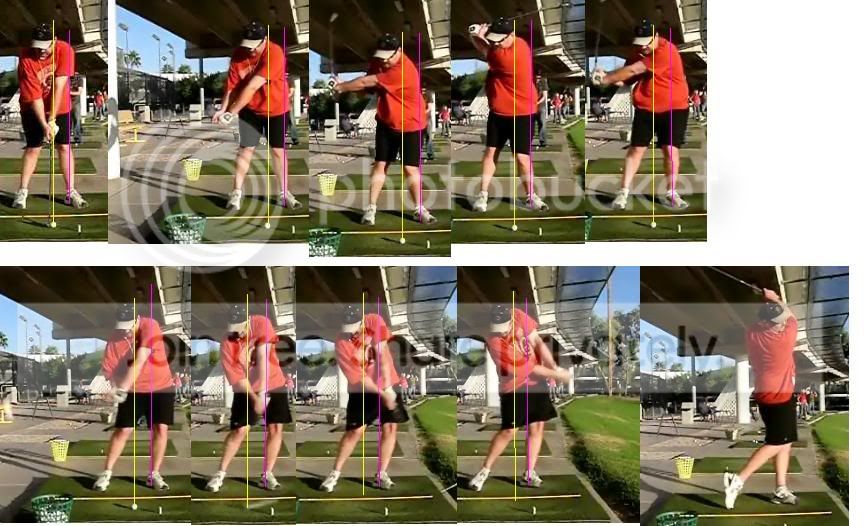


 Linear Mode


