Please post Pivot Drills that others may not be aware of. Upload pictures if possible.
The following are the McDonald Pivot Drills.
I recommend that "Exercise #2 and #4" be performed with the club behind the back and through the elbows. I don't recommend #10 and 11 because they promote a roundish Pivot. That may be ok for an Elbow Plane Swinger but not a TSP Swinger or Hitter.
Quote:
POWER PACKAGE TRANSPORT
7-12 PIVOT The Pivot is the utilization of multiple centers to produce a circular motion for generating Clubhead Force on an adjustable Plane. Plus the maintenance of balance throughout the weight shifts that accompany the turning and bending of the necessary for the two Line Delivery Paths. A Pivot is on superficially correct that fails to maintain alignments or allows the player to get “out of position”.
It is the massive vehicle which transports the Power Package Assembly to the launching pad and back-up support for the Hitters driving Right Arm (6-B-1). It is the massive rotor, supplying Angular Momentum for the Throw Out power transfer to the Swinger’s orbiting Left Arm (6-B-3).
It is the sequencing and spacing of Zone #1 Stroke Components. It consists of – as separate and distinct elements – the motions and actions of the Shoulders, Hips, Knees and Feet. The term Pivot is relative in that it can be classified as anything between Full motion and Zero motion and may include all, part or none of the possible Component Motions and actions. It defines their participation (6-M-1) including the requirements of Plane Angle and Stance Line Variations (10-12, 10-15-0). It is Zone #1, the first and foundational of the three Zones in Chapter 9. Study 2-0, 9-0 and items 1 and 2 under Sketch 1-L.
As Stroke Component, the term PIVOT refers only to the degree and direction of its own motion as the framework or pattern within which all the Pivot Components must be arranged and adjusted. The relative participation of the individual Pivot Components is always determined under their own Pattern references. ALL motion – Pivot and Power Package – moves parallel to the selected Delivery Line. That is, prior to the Downstroke Turn, a Slide parallel with either the Angle of Approach or the Plane line per 2-J-3.
Quote:
DUAL AGENT
7-13 SHOULDER TURN The Shoulder Turn Component is controlled by establishing the Planes on which the Right Shoulder can be rotated – which is in turn dictated by the Hip Turn Component. The Shoulder is the fastest and farthest moving component of the Pivot and actually transmits the Pivot motion to the Arms. Study 2-H. So, being part of the Power Package, its motion does not necessarily violate Zero Pivot requirement.
When the Shoulder moves on the same Downstroke Plane as the Hands it provides the greatest support and its best guidance to the Stroke.
However, it can also turn “Off Plane” and still impart rotation, and it can turn not at all and assign this function to the swinging Left Arm. But the Arms will always seek to move to – and on – the Plane of the Shoulder Turn, requiring compensation by Pressure Point #3 per 2-L#2 and 10-11-0-3. This, with inadequate Backstroke Shoulder Turn and/or inadequate Downstroke Shoulder Lag, will always produce an “Outside-In” Impact, with its stifling of the Clubhead orbit (4-D-0). Keep that Right Shoulder not only “back” but also “down” (On Plane), or you will “run out of Right Arm” before the Hands reach Impact Position – an automatic Throwaway (7-14, 8-6).
Incidentally, with Zero Accumulator #3 there is a theoretically a Left Shoulder Inclined Plane Angle. Therefore, being synonymous terms, it is far better to consider it as Zero Accumulator #3. See 6-B-3-B.
nice to get these together in a handy to print format - thanks D
__________________ The student senses his teacher’s steadfast belief and quiet resolve: “This is doable. It is doable by you. The pathway is there. All you need is determination and time.” And together, they make it happen.
Paul Bertholy and Bob MacDonald's Blast From the Past
Daryl,
Thanks for cleaning up and posting these Bob MacDonald images. I sincerely appreciate it!
Bambam, let's put these in a prominent place in our Gallery. Thanks!
P.S. Interested readers should know that, in the spring of 1982, Paul Bertholy, then 80-something years young and one of the most esteemed PGA of America teachers, gave me his personal copy of Bob MacDonald's 1927 book, Golf. At the conclusion of our two-day training session at his home at Foxfire in Pinehurst, NC, he motioned me out of the front room to a nearby closet. He opened the door, rambled around for a minute or so, and emerged with Bob's book, the same one he had referenced several times in our study. He then offered it up in both hands and said, "I want you to have this."
Thanks for cleaning up and posting these Bob MacDonald images. I sincerely appreciate it!
Bambam, let's put these in a prominent place in our Gallery. Thanks!
P.S. Interested readers should know that, in the spring of 1982, Paul Bertholy, then 80-something years young and one of the most esteemed PGA of America teachers, gave me his personal copy of Bob MacDonald's 1927 book, Golf. At the conclusion of our two-day training session at his home at Foxfire in Pinehurst, NC, he motioned me out of the front room to a nearby closet. He opened the door, rambled around for a minute or so, and emerged with Bob's book, the same one he had referenced several times in our study. He then offered it up in both hands and said, "I want you to have this."
Sorry . . . I just bought this one (my third!). Keep your searches working, and you'll soon find your own.
Lynnard . . . you still got your lead pipe? Mr. Bertholy was a TASKMASTER. I went to see him just before he died. I had just purchased the Machine . . . tried to read it . . . didn't get it . . . looked up golf skools on the intreenet and Mr. Bertholy's said he could make you swing like Hogan. So I decided I'd better go see him . . . pretty interesting stuff . . . and man his wife could make a good chicken salad samich. I remember him karate chopping wiffle balls to make them spin on a lunch table and popping you with pencils to illustrate #2 throw out snappy releaseeez.
I like exercises 10 and 11 personally. I see your objections, but think the exercises to be primarily body drills, Zone 1 and really more for the backswing than the downswing. The downswing for full shots normally having some Hip Slide , Axis Tilt as well as some lag to the Arms trailing the Body.
Per 7-12 the Pivot is a massive rotor that sets up the gyroscopic nature of the golf swing. In an actual golf swing, the Hands at about the position illustrated in exercise 11 appear to have Turned but they are still vertical to the Horizontal plane , the ground assuming, Horizontal Hinging. Most guys actually turn the forearms independently and often with a stalled Pivot, no clearing of the Right Hip and hence Mr Macdonalds drill number 10 and 11. The Forearms are Turned per say, but not independently! The Pivot can do much of it. Arm travel and forearm turn on the backswing are not as big as you would assume when isolated!
The first few inches of my swing feel exactly like exercise 10. Is this Pivot to Hands? Yes, briefly I guess, for me anyways. I feel like my turning right hip starts the club back on its journey. It goes really well with a Lagging Takeaway. As soon as I start to Right Forearm Pickup and Trace (1-L-6) the Hands are going Up as well as Back and In. And thereby on plane. Three dimensional Start Up. Lynn says the Hands can start Up right off the start though if you wish. You have to get into the Divergent Vectors of the Pivot and Arms to get this fully.
In short if you add a Right Forearm Pickup and 1-L-6 to Macdonald drill number 10 you've got Hands to Pivot and whatever plane angle you want. TSP or otherwise. Like you I prefer the TSP.
Doing just as illustrated in drills 10 and 11 would be Pivot to Hands and non planar for sure. But the body as rotor , Zone 1 is still critical to the golf swing. Hence the drill. Its a pure turn on an axis with no head Bob or Sway. Its sort of like how the 1-L machine without a second hinge pin would describe a cone shaped, non planar, Single Horizontal motion. Hence the second hinge pin, hence Dual Horizontal. The second Hinge Pin is not in the PIvot! The Pivot does not dictate the Plane Angle unless you are Pivot to Hands! Which would require a precise amount of waist bend to achieve a usable Plane Angle without a compensation of some sort.
I dunno. I've got a few videos of Lynn covering off these drills number 10 and 11 and a few other PIvot drills. Ill ask him if he would mind me putting them up on Youtube for all to see.
I like exercises 10 and 11 personally. I see your objections, but think the exercises to be primarily body drills, Zone 1 and really more for the backswing than the downswing. The downswing for full shots normally having some Hip Slide , Axis Tilt as well as some lag to the Arms trailing the Body.
Per 7-12 the Pivot is a massive rotor that sets up the gyroscopic nature of the golf swing. In an actual golf swing, the Hands at about the position illustrated in exercise 11 appear to have Turned but they are still vertical to the Horizontal plane , the ground assuming, Horizontal Hinging. Most guys actually turn the forearms independently and often with a stalled Pivot, no clearing of the Right Hip and hence Mr Macdonalds drill number 10 and 11. The Forearms are Turned per say, but not independently! The Pivot can do much of it. Arm travel and forearm turn on the backswing are not as big as you would assume when isolated!
The first few inches of my swing feel exactly like exercise 10. Is this Pivot to Hands? Yes, briefly I guess, for me anyways. I feel like my turning right hip starts the club back on its journey. It goes really well with a Lagging Takeaway. As soon as I start to Right Forearm Pickup and Trace (1-L-6) the Hands are going Up as well as Back and In. And thereby on plane. Three dimensional Start Up. Lynn says the Hands can start Up right off the start though if you wish. You have to get into the Divergent Vectors of the Pivot and Arms to get this fully.
In short if you add a Right Forearm Pickup and 1-L-6 to Macdonald drill number 10 you've got Hands to Pivot and whatever plane angle you want. TSP or otherwise. Like you I prefer the TSP.
Doing just as illustrated in drills 10 and 11 would be Pivot to Hands and non planar for sure. But the body as rotor , Zone 1 is still critical to the golf swing. Hence the drill. Its a pure turn on an axis with no head Bob or Sway. Its sort of like how the 1-L machine without a second hinge pin would describe a cone shaped, non planar, Single Horizontal motion. Hence the second hinge pin, hence Dual Horizontal. The second Hinge Pin is not in the PIvot! The Pivot does not dictate the Plane Angle unless you are Pivot to Hands! Which would require a precise amount of waist bend to achieve a usable Plane Angle without a compensation of some sort.
I dunno. I've got a few videos of Lynn covering off these drills number 10 and 11 and a few other PIvot drills. Ill ask him if he would mind me putting them up on Youtube for all to see.
Recently, I have been frustrated with my pivot sequence, just couldn't get it right. I read Watson's recent book, The Timeless Swing, and tried using his recommended drills for keeping the spine angle. It just was not working for me. I returned to the MacDonald drills, particularly numbers 10 and 11. They have been the key for me. Using those drills gives me a feel for what "turning in a barrel" is supposed to be. Combining the entire set of drills has worked wonders with my pivot sequence. My thought is that the entire set of drills is useful for ingraining the basic golf swing. Thanks again to Yoda for introducing them to me at least three years ago!
P.S. Interested readers should know that, in the spring of 1982, Paul Bertholy, then 80-something years young and one of the most esteemed PGA of America teachers, gave me his personal copy of Bob MacDonald's 1927 book, Golf. At the conclusion of our two-day training session at his home at Foxfire in Pinehurst, NC, he motioned me out of the front room to a nearby closet. He opened the door, rambled around for a minute or so, and emerged with Bob's book, the same one he had referenced several times in our study. He then offered it up in both hands and said, "I want you to have this."
I was grateful, but dumbfounded:
Why would he give away such a prized possession?
And why to me?
Only now am I starting to get the idea.
Lynn, sorry for the thread jack but this seems the right moment.........would you care to contrast Mr Bertholy's "Rod and Claw" with Homer's inert left arm and Extensor Action?
You, again, seem uniquely placed to give the ultimate description of both methodologies and so I must ask. Rod vs String so to speak. They both have merit to my mind.
Regards.
P.S. My apologies to Daryl for taking this great thread into Zone 2.
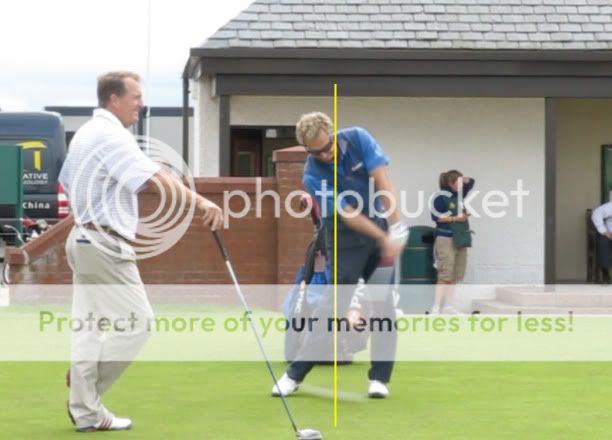
By moving the head off the ball during the Backstroke, it may remain there.
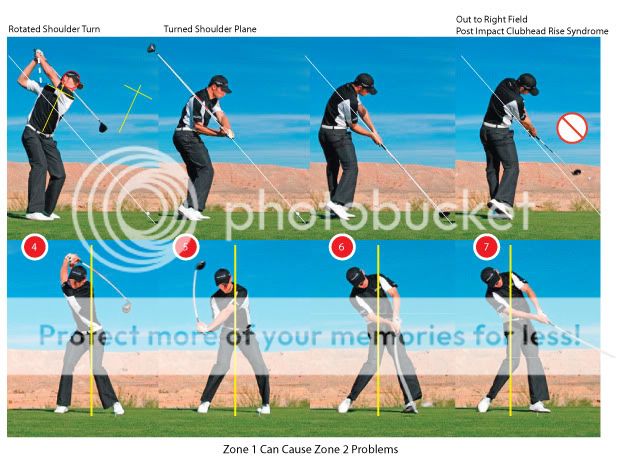
In the sequence below, #7, the Hips are out of alignment both Forward and front to back resulting in severe Axis Tilt and a Clubhead that rises above the Plane at Impact and Follow-through.
This Faulty Axis Tilt prevents his Left Hip from Turning as much as it needs. This Blocks his right hip from moving forward and forces it out toward the Plane Line too early. This prevents his right shoulder from continuing Down-Plane and Forward.
He may need to do this to get all of the distance he possibly can but imagine what it does to accuracy.
This Faulty Pivot really screws with Low Point, the Right Elbow, Impact Hand Location, Right Shoulder Location and Path, etc, etc.
Quote:
As I said, I was hitting the ball from my knees almost as far (and certainly as solidly) as I did while standing, and, in my prime, I consistently finished in the top 10 percent in driving distance while on tour. Don't forget, I was using a persimmon-headed, steel-shafted driver and a wound balata ball, let alone with no feet or legs!
The point here is, that, instead of driving my swing bottom forward and thus creating lag with my feet and legs, I relied on establishing a clear, forward-aiming point well out in front of my ball, and an aggressive forward shoulder and torso hip-turning motion to create the lag in my swing. Think of it this way: Because a club swung from the knees travels on a far more horizontal, or level-to-the-ground, arc than does one swung while standing up, the bottom, or low point, of such a swing also extends considerably more forward of the ball. Because this makes it easy to swing the club downward through and past the golf ball after impact, such a swing facilitates very solid contact as well. Certainly, it takes some time to get used to the initially awkward posture and geometry of hitting balls from the knees, but once done, you can really pound a golf ball that way.
Needless to say, the feet and legs add extra speed to the golf swing; but they become useless if they don't carry the hips and shoulders forward, to sustain the lag through the impact zone. I credit my efficient lag, created from the hips and shoulders, for driving the ball 250 yards, straight down the fairway. That means the feet and legs only had an additional 15 to 20 yards to give…….
The Impact Zone , Bobbie Clampett, Page 93
Bobby shows some of the same Pivot issues.
Having your head that far back keeps your shoulders that far back too. I bet his head doesn't move when he hits from his knees.
I noticed that on Bobby Clampett's actual drive his head swayed back even more. Not an unusual thing for a good player by any means but not necessary to my mind. I wondered if it was a compensation which moved his Left Shoulder back and gave him more time to Release. If thats what it is then you have to wonder if he could accomplish much the same thing without the Sway by just teeing the ball more forward in his stance. Dont get me wrong Id love to have Bobby's swing.
Those long drive guys have 4' long drivers or whatever and tend to Sway back too, I think to give them more time to Release their super long lever. You'll notice how Sadlowski's Sway increases during his Release, frames 5 to 6. There are ballistic, launch angle considerations too for sure, like he is creating an artificial up hill shot.
He's Canadian though and those guys are all kinda nutso, eh?
A Zone 1 compensation for a Snap Release related problem .......Bucket is going to be all over this one, I bet.
On the other hand, the head doesnt necessarily need to be positioned dead center between the feet does it? Isnt it dependent on the shot at hand? If you are in a fairway bunker or chipping or pitching or hitting out of the rough wouldnt you have your head more over your left side? Ive always noticed how Homer positioned his Head a little back of centre in this photo of him at Fix. From this position he wouldnt need to Sway back dynamically during the swing, its pre set, Fixed in a manner in accordance with the shot at hand.




 Hybrid Mode

